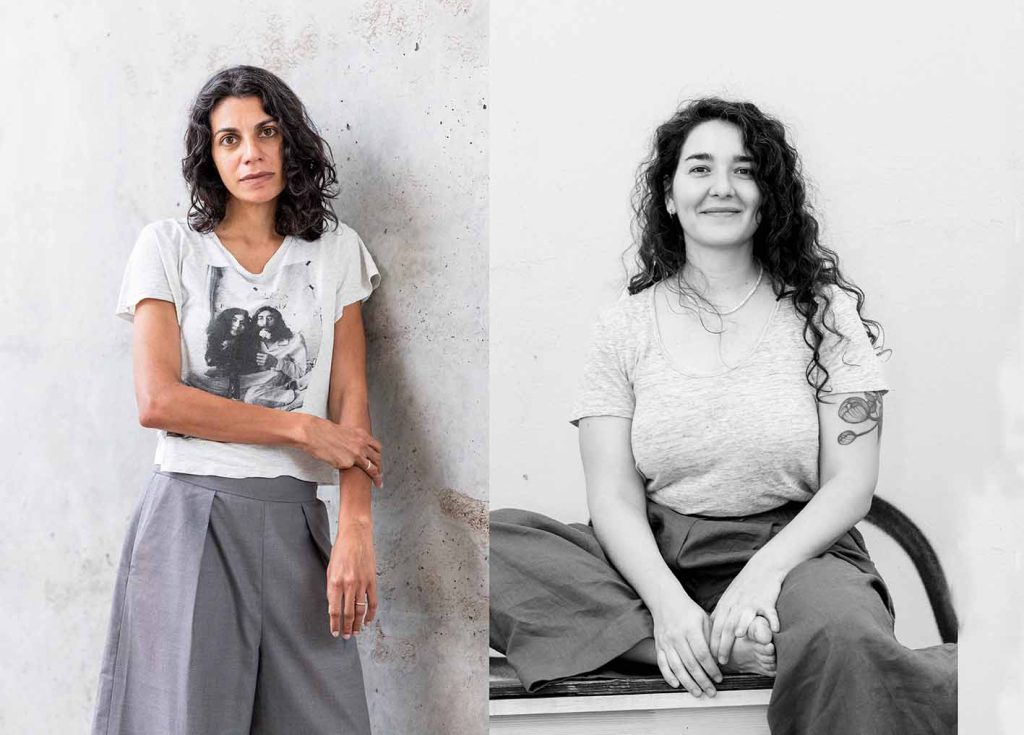
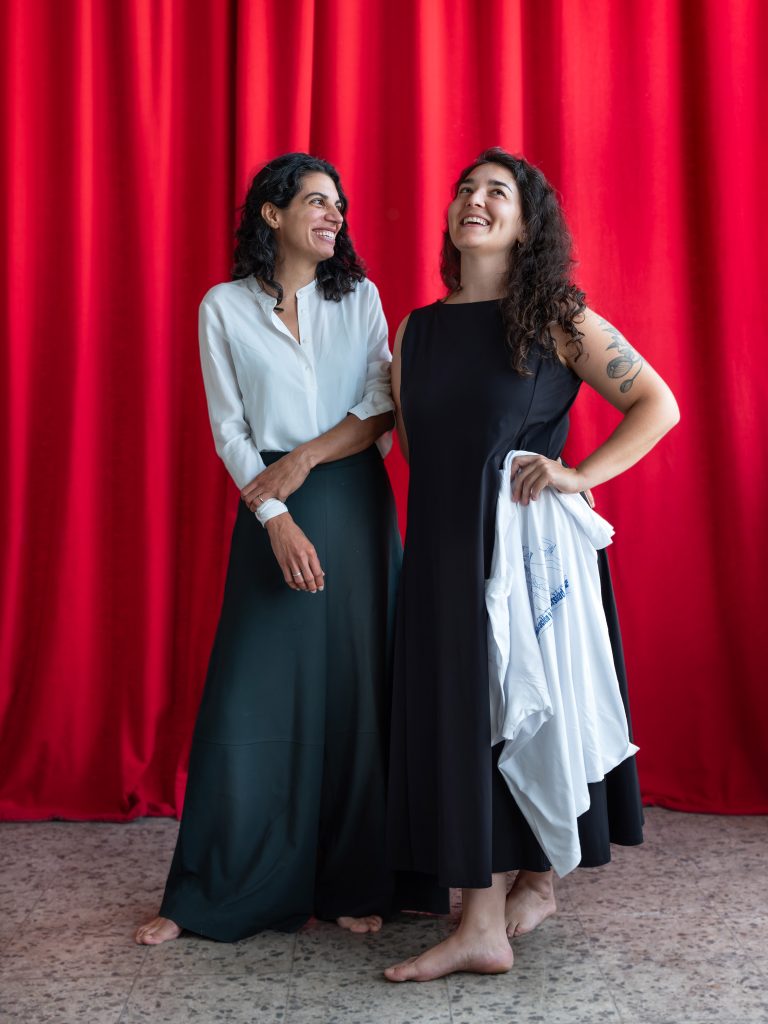
Zasha Colah and Valentina Viviani (curators, 13th Berlin Biennale), María Pichot, and Kekena Corvalán
We emphasize the significance of biennials professionally sustained by women who critically engage with issues shaping our artistic, curatorial, and political practices. With María Pichot, we shared experiences rooted in visual arts that are mobile, domestic, and vital. The Berlin Biennale’s evocative motto, “Passing the fugitive on,” resonated deeply. Zasha contributed a beautifully poetic curatorial text titled “From Boxing to Foxing,” which is available on Substack as part of the insights learned during the 13th Biennale.
Our conversation unfolded informally in the courtyard of the KW Institute for Contemporary Art in Berlin. We reflected on the experience of encountering living artworks that embody life’s transmission and a solidarity that transcends anthropocentrism and ethnocentrism because one does not need to be Indigenous to feel a sense of solidarity. We discussed cultural evidence that must be disseminated or preserved until the right moment arrives, about being “foxy” without being obvious.
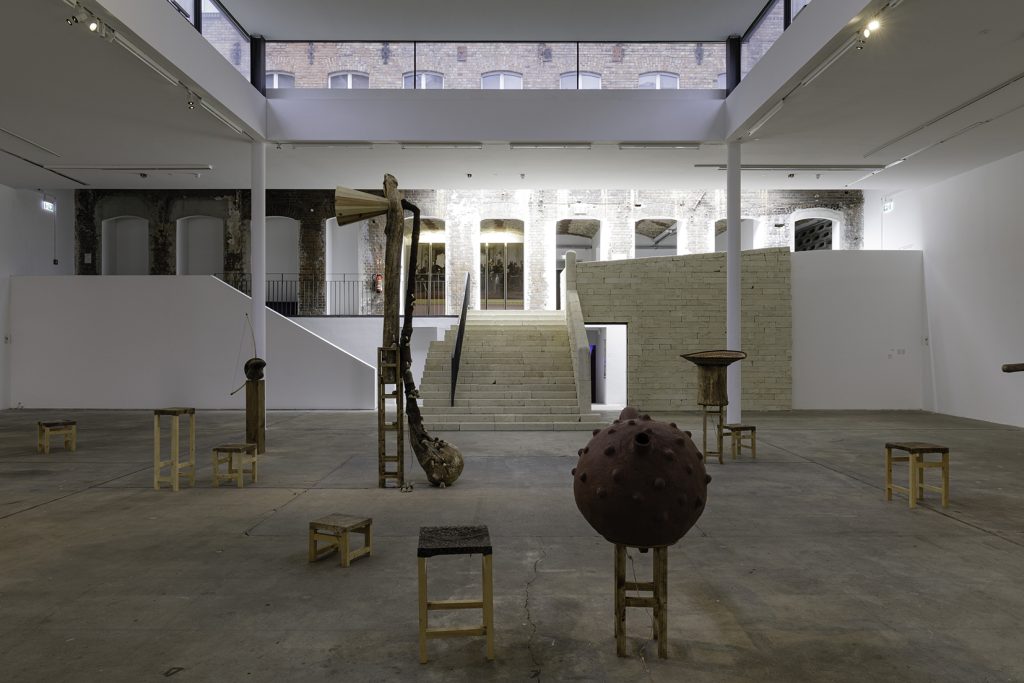
Installation view, 13th Berlin Biennale, KW Institute for Contemporary Art, 2025; image: Eberle & Eisfeld. From front to back: Anawana Haloba, Looking for Mukamusaba – An Experimental Opera, 2024/25. © Anawana Haloba; Sammlung Hartwig Art Foundation; Margherita Moscardini, The Stairway, 2025. © Margherita Moscardini; Gian Marco Casini, Livorno; Armin Linke, Negotiation Tables, 2025. © Armin Linke
We structured our dialogue around personal reflections and the Biennale in Berlin:
Our first question: Zasha, personally, how has the Biennale experience affected you, now that it is open?
ZC: I feel enthusiastic, enjoying the time with the artworks and the artists still here. When someone departs, we do not say “goodbye,” but “see you soon,” because many come from far away, and now we reconnect with them as we do with all of you. This is a meaningful moment to share quality time together, beyond the artist, connecting as human beings.
KC: And how do you feel now in your exchanges with attendees?
ZC: These past days have been dedicated to interaction with people. The art is on view, and we are getting to know one another, forming smaller groups. When students participate, we encourage connections—students learn about each other’s struggles, origin stories, and creative development, forming oral histories that some of us have been able to record. It is a surplus of meaning.
KC: After the Biennale concludes, what are your expectations for the post‑curatorial period?
VV: Now is the moment to relish the exhibition entering its life—people arrive, we meet them, we observe how the public engages with the works. We can sense the curatorial energy radiating through the show. From the outset, we entered this process without a clear understanding of the outcomes. Given the venues, artists, and expectations, we are satisfied. Observing audiences now, especially students, there is a strong interest and curiosity in what is on offer.
ZC: We remain active, working, and teaching younger generations. It is a process that unfolds over time: in the present, they discover issues and realize they can incorporate them into their teaching.
VV: For instance, our catalogue is conceived as a tool for classroom study. Each venue has not only themes but also narratives—texts with complexity that can be analyzed and learned from. There is much in this Biennale that deserves reconsideration. Some artworks, in particular, invite continued writing in the future. Making history through artistic practice challenges conventional modes of learning. This Biennale can provide abundant material for future work. We still do not know how much we will process.
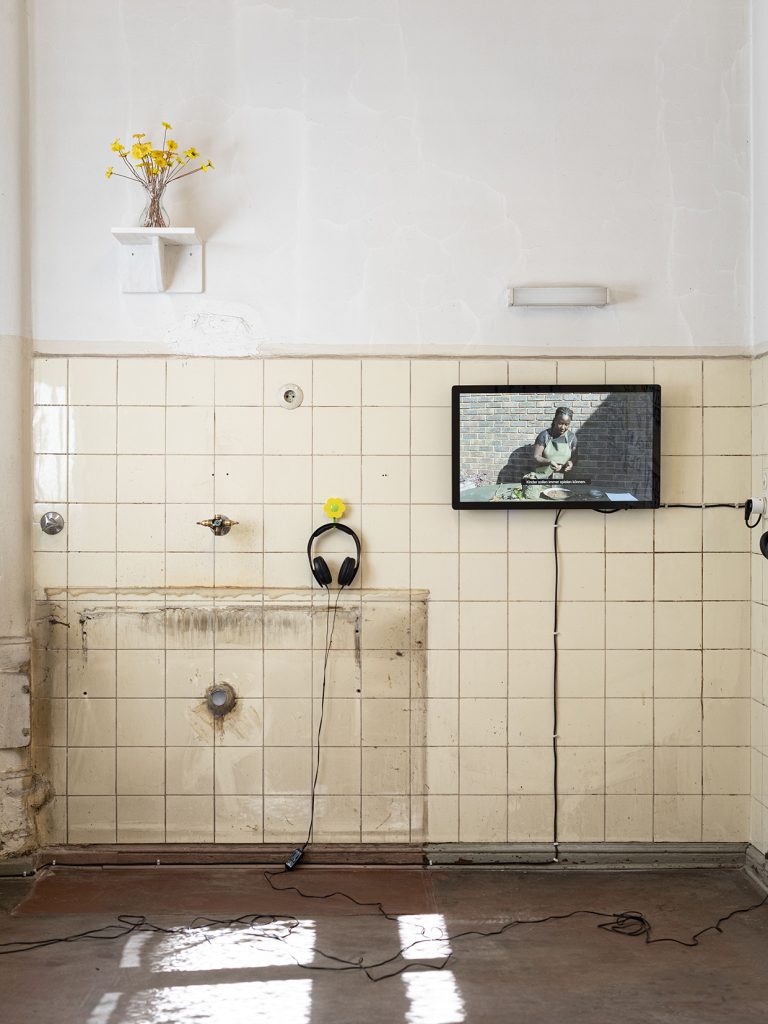
Helena Uambembe, How To Make a Mud Cake, 2021/2025, installation view, 13. Berlin Biennale, Former Courthouse, Lehrter Straße, 2025. © Helena Uambembe; image: Raisa Galofre
KC: Zasha, you are from India. How do you feel your nationality influences your curatorial work?
ZC: I am not a nationalist. I grew up in India, a country that has continually changed, and I feel it is more important than ever to express India’s voice. I do not think India belongs only to Indians, nor that it is merely an economic giant. A book titled “The Struggle for the Ideal of India” reflects what is happening now, with different groups holding varying ideas about what this geography means.
I come from Mumbai, a place of stark contrasts, where extreme poverty coexists alongside towering skyscrapers. However, I appreciate that poverty should not be isolated, but rather coexist within a broader reality. I want to contribute to the struggle for India’s ideal, and the Biennale reflects that.
KC: And how does that reality appear in your writing? Have you published books? Does writing serve curatorial practice?
ZC: Yes—but I am cautious that my writing does not sound archaic or solemn. I seek a fresh approach, one that avoids a political tone that depicts victims, instead portraying people with agency, who act, enjoy, and live. The tone matters.
Valentina adds that Zasha was her professor in Milan’s postgraduate program and her thesis advisor. Zasha recalls that Valentina was an outstanding student and later collaborated with her in Turin, teaching and working curatorially together. Their relationship felt natural. One could say India and Argentina share a certain diversity, social classes coexist, and political consciousness nurtures that feeling. Valentina’s education in Argentina’s high‑level public system resonates with Zasha’s experience in India. The ability to speak openly in class and later recognize that such freedom is rare is a process that mirrors how they teach horizontally, with full liberty.
KC: How did the idea of the fox, as theme or metaphor, emerge for the Biennale? Where does it come from, and what does it encompass? Who owns it?
ZC: In the city, you can encounter wildlife like a fox. They are elusive, playful, and evade humans. How can we understand “foxing”? As an attitude that avoids force through cunning, with a transversal logic just like certain artistic practices possess fox‑like qualities.
KC: Kekena, you said, “Foxing not boxing”—a reference to evasion rather than confrontation?
KC: (Kekena) Yes, steering clear of conflict with intelligence. Zasha resonated with that phrase and wrote it down to remember. “Foxing” includes strategic nonviolence. “Boxing” is the patriarchal notion of confrontation and war against the weak or dissenting. We related this to artworks by Courbet and Orlan, in which the idea of the “fox” is reclaimed as a symbol of sexually autonomous female identity, leading us to…
KC: How does this relate to feminism? Are you feminists?
ZC: If this project lives beyond personal identification, I hope that it receives appreciation in our practice.
VV: To me, it is a space defined by how we conceive the Biennale and relate to artists—what energies we bring, how we channel them, what stories we tell and how. Inevitably, feminist forms emerge in our doing.
ZC: We did not program it explicitly, but there are many women artists. We have discussed land as a condition not only for women to be feminists, but also for men to be feminists.
VV: We reclaimed the idea of women protesting ecological issues, deforestation, spiritual practices tied to the ecosystem, and how the forest sustains specific populations and beliefs. Women often understand this multidimensionally and are among the first to act.
ZC: Rooted spiritually in an integral way, these practices exist in our time, whether in India, the Amazon, or the Andes and they are contemporary. It is not idealizing nature in every form, but rather acknowledging its urgency and complexity, and recognizing when a space needs stillness or activation, as well as the responsibility and clarity needed to act effectively.
Zasha brought the concept of kindness, observed in the artists, especially when someone acknowledges anger. Always striving to transform it into kindness. Zasha admits that she has fought much in life against opposition, and she is interested in the transformation that entails. (Again: foxing, not boxing.) The curator and vice-curator affirm that they work amicably.
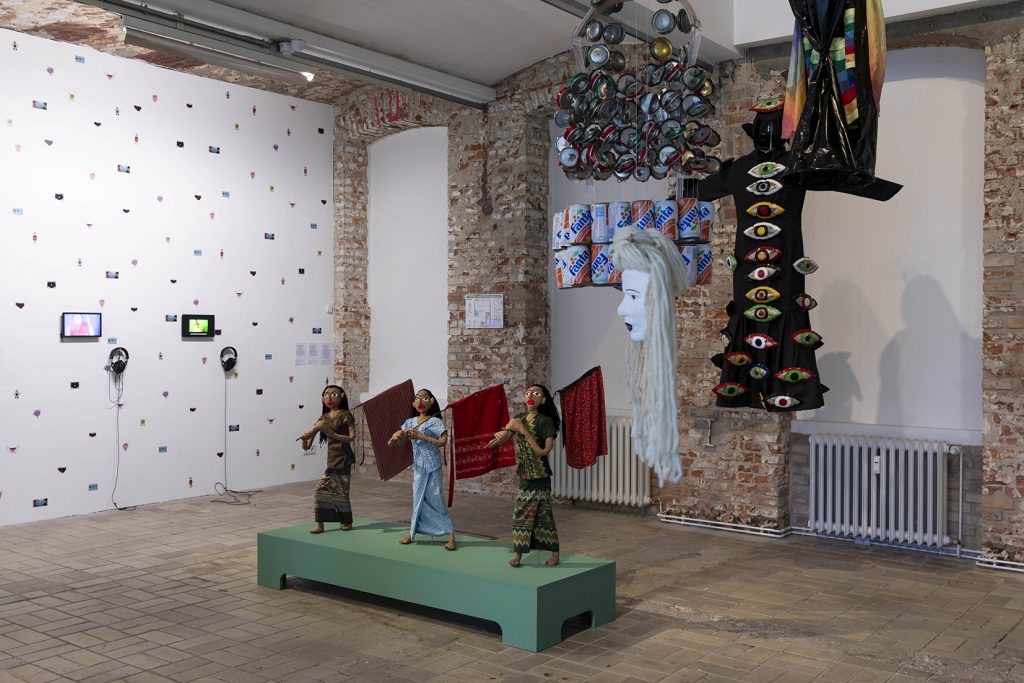
Installation view, 13th Berlin Biennale, KW Institute for Contemporary Art, 2025; image: Diana Pfammatter, Eike Walkenhorst. From left to right: Panties for Peace, Panties for Peace Emblems, 2010/25; Chaw Ei Thein, from the series Artists’ Street, 2025. © Chaw Ei Thein; Exterra XX – Künstlerinnengruppe Erfurt, Selection of performance objects, ca. 1988–1993. © Exterra XX – Künstlerinnengruppe Erfurt
KC: What is the politics of desire for each of you?
VV: Over these past two years, I have reclaimed desire more profoundly, in work, in personal life, but especially in encounters with others. Inspiration arises from sharing with artists, understanding where they come from, how their work takes form, and mutual understanding. There is much to do regarding women and art. Germany’s complex political position has prompted me to reassess my stance. My politics of desire is to live deeply.
ZC: My life is shaped by being a mother and daughter. My mother is ill; once she was a “Foxy” force, but now she is neither one nor the other. It is not easy to witness. My daughter is eight years old, gaining confidence, and relating well to others. She was timid. With Valentina, my daughter formed a bond and discovered meeting others. I regret not seeing my mother, who lives in Mumbai, more often, but I know she wants me to live fully, not remain confined at home. She would be upset if I stayed bedridden or stayed at her bedside permanently.
KC: What do you most enjoy about your professional practice? Would you recommend curating?
ZC: I do not advise my young daughter to pursue a career in curating. She seems drawn to plants and animals instead. However, I enjoy meeting artists, diversity, writing…
VV: What I enjoy most is working with artists the process, many conversations to access or understand the worlds they inhabit or propose. The exhibition’s foundations are empathy. My favorite moments are unexpected encounters, especially when someone from the Global South meets a poet from a faraway country. I feel the world reveals itself expansively. I value conversation greatly.
ZC: I had one major goal: to understand what is happening in Germany. I cared to respect and approach the culture thoughtfully.