By D. Dominick Lombardi
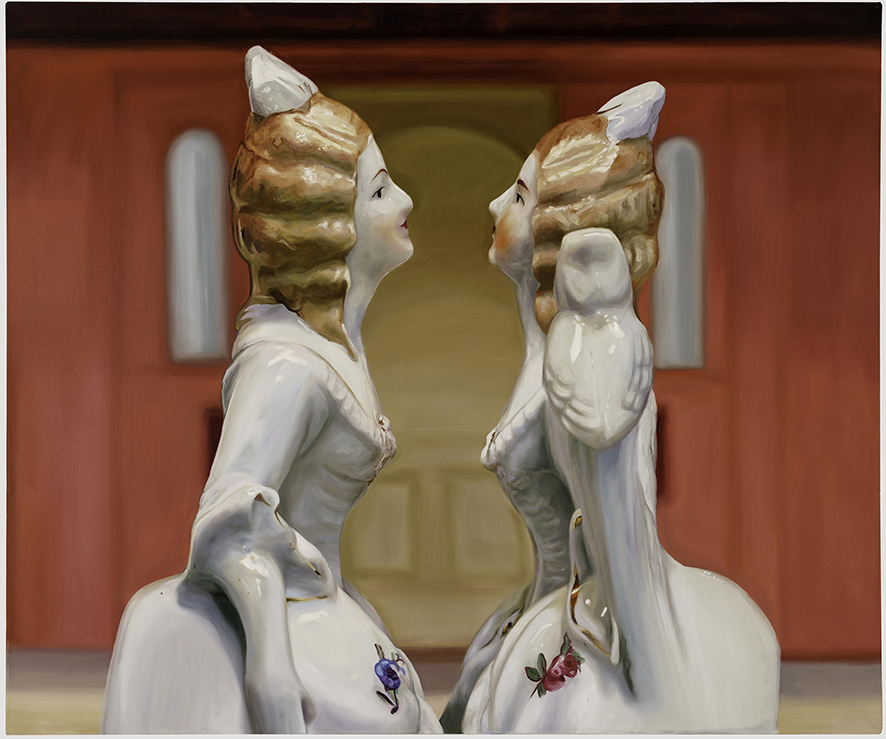
Emily Blair Quinn. Pecking Order, 2026. Oil on linen. 40 × 48 inches.
Vintage porcelain figurines can conjure up a variety of thoughts and references. I remember my aunt, who collected Hummels some sixty-plus years ago, displaying them primarily in a faux-antique glass case, or cutting them loose from the herd and strategically placing them on various end tables in her living room. Everyone knew that walking into her space, which was decorated with plastic-covered furniture (including the lampshades), you look but do not touch the cutesy little porcelain persons. The type of figurine that Emily Blair Quinn focuses on in creating her sculptures, paintings, and photographs are quite different. Hers are informed by the period around the Gilded Age, objects that present as super-white, so-called beautifications of cognitively stifled feminine figures, clearly objectified by their designers and makers.
At first glance, this type of statuary Quinn has repurposed may seem rather benign to most viewers. However, when Quinn starts transitioning them into the subjects for her art, the unidimensionality of the figures becomes clear, while the fact that this statuary was created as a positive commemorative of women of an era strains the senses. Quinn is also reminding us to think more deeply and openly that today’s standards still need a lot of work when it comes to gender norms.
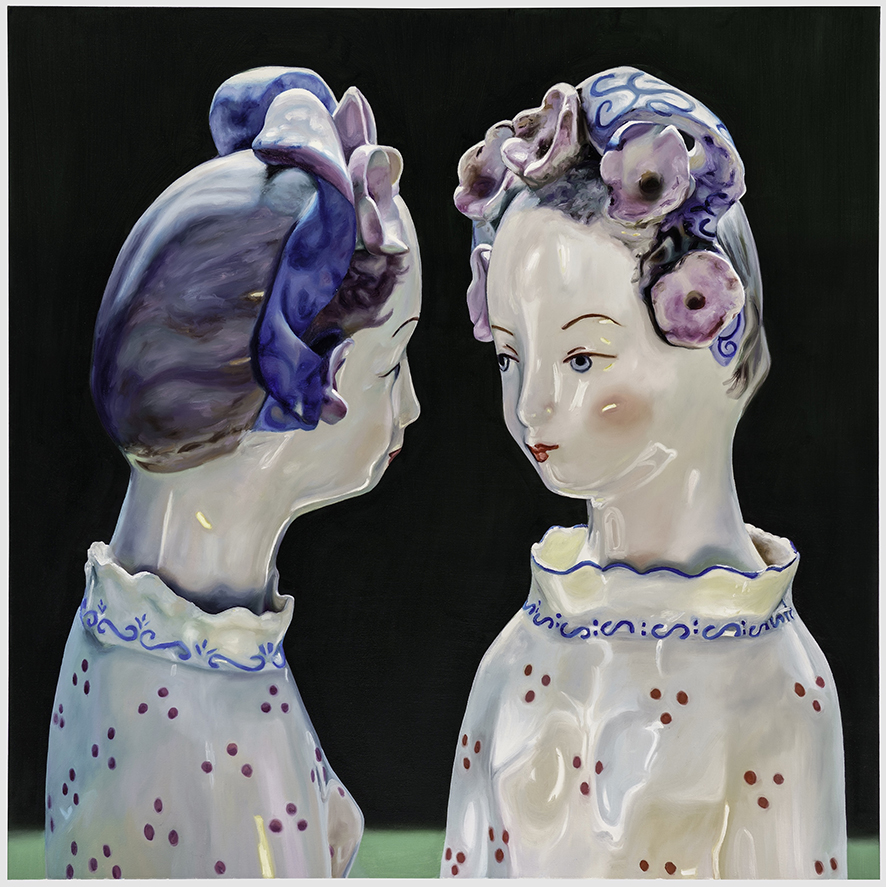
Emily Blair Quinn. Alter Ego, 2026. Oil on linen. 40 × 40 inches.
Take, for instance, the painting Pecking Order (2026), where two powdered wig-wearing women face off, sans the impropriety, placed in a far-off private room. Set as the artist often does in a dollhouse with precise theatrical lighting, Quinn brings these objects to life with a combination of precision and flair, painting the shining surfaces and colorful floral adornments that characterize her subjects. It is also clear that Quinn works from photographs, which stabilizes the exact position of highlights that would normally be a problem working from ‘life’. There is also a field of focus that is more profound in close-up photography, which makes this painting in particular more intimate.
In the narrative, Pecking Order suggests this face-to-face confrontation is built on the relative magnetism of one’s ‘beauty’ as it results in ‘attractiveness’. This is not only a stereotype, but a cruel game that continues today as many vulnerable young individuals face a false reality on social media that is fueled by a bevy of AI beauty apps run amok, causing much harm regarding self-image.
Alter Ego (2026) is similar to Pecking Order in the way the artist uses two subjects, while the title of this painting implies it is a double portrait as opposed to two individuals. Additionally, in Alter Ego, the artist employs a black background with a band of green at the bottom, making the subjects separate from the outside world, where inward thinking and subconscious thought take over. Using the same figurine and painting it from two different angles creates vastly different states of mind to the two opposing sides. On the left, the subject is weaker in mind and pouting, while on the right, there is more of a perceived level of confidence, strength, and superiority. Most importantly, the dichotomy in Alter Ego is different from Pecking Order as we can see the risk of damage it creates in the form of the possibility of self-loathing that can easily spiral out of control.
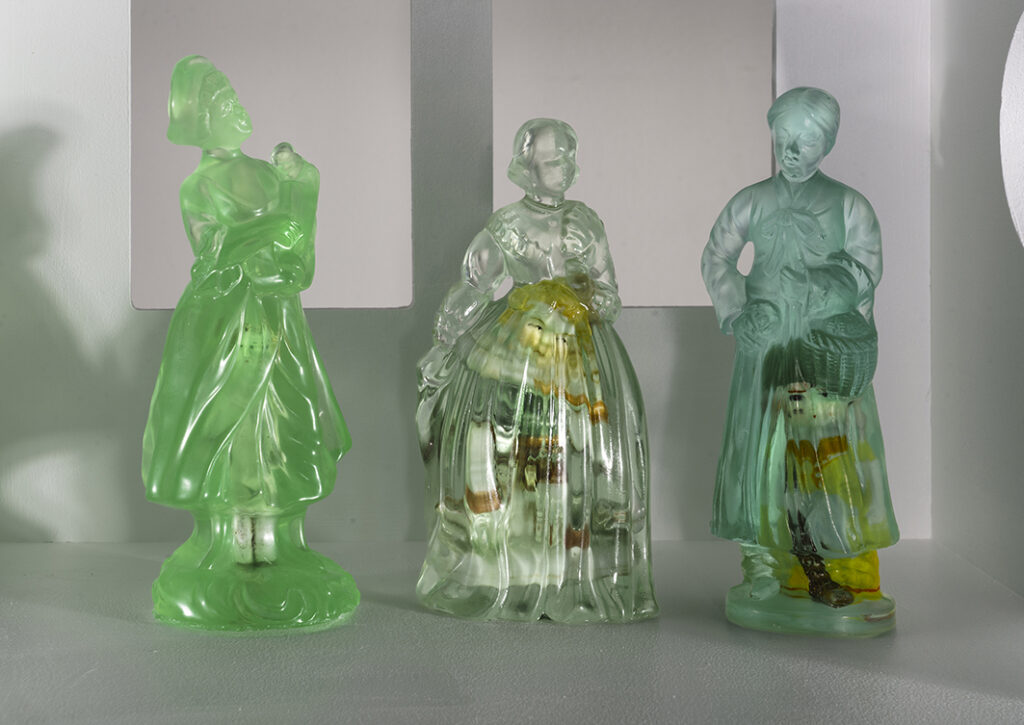
Emily Blair Quinn. Green Figurine 3, Green Figurine 4, and Green Figurine 5, 2025. Porcelain figurine in resin. Sizes variable.
Then there are Quinn’s translucent sculptures. These are tinted resin figures adorned in flowing garments with smaller figurines caught and cast inside. The objects within the main resin figures are of a greater variety than the painted subjects discussed earlier, ranging from the aforementioned Hummels to types such as a Dutch Milk Maiden and all the way to a tiny plastic dollhouse. The combination of the tinted resin with the smaller figurines embedded inside results in a dreamy, even surreal combination, making it harder to decipher by way of narrative. This leads one to think more in terms of time and memory as a form of multidimensional juxtaposition, while the color or tint of the resin makes them seem more innocent and cheery.
In addition to the sculptures and paintings, Quinn offers close-up photographs of the faces of the figures that are cast inside the resin sculptures. As portraits, they have an uncanny immediacy, distorted by refracted light that creates unnatural transitions. Pink Portrait 7 (2026) elicits confusion, a near psychedelic state, while a feeling of sadness overrides complacency in Pink Portrait 5 (2026). The photographs, in combination with the sculptures and the paintings, complete a well-thought-out body of work that very effectively drives Quinn’s point home: “a feminist aesthetic in which female subjectivity is neither passive nor fixed, but recursive, reflective, and self-determining.”
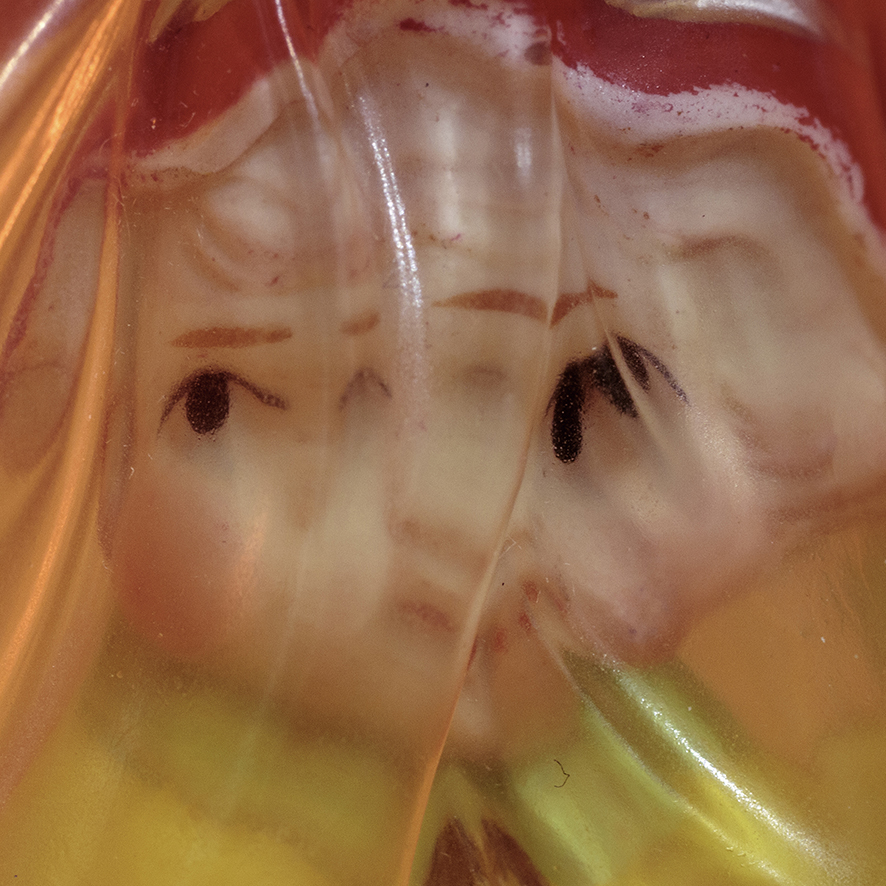
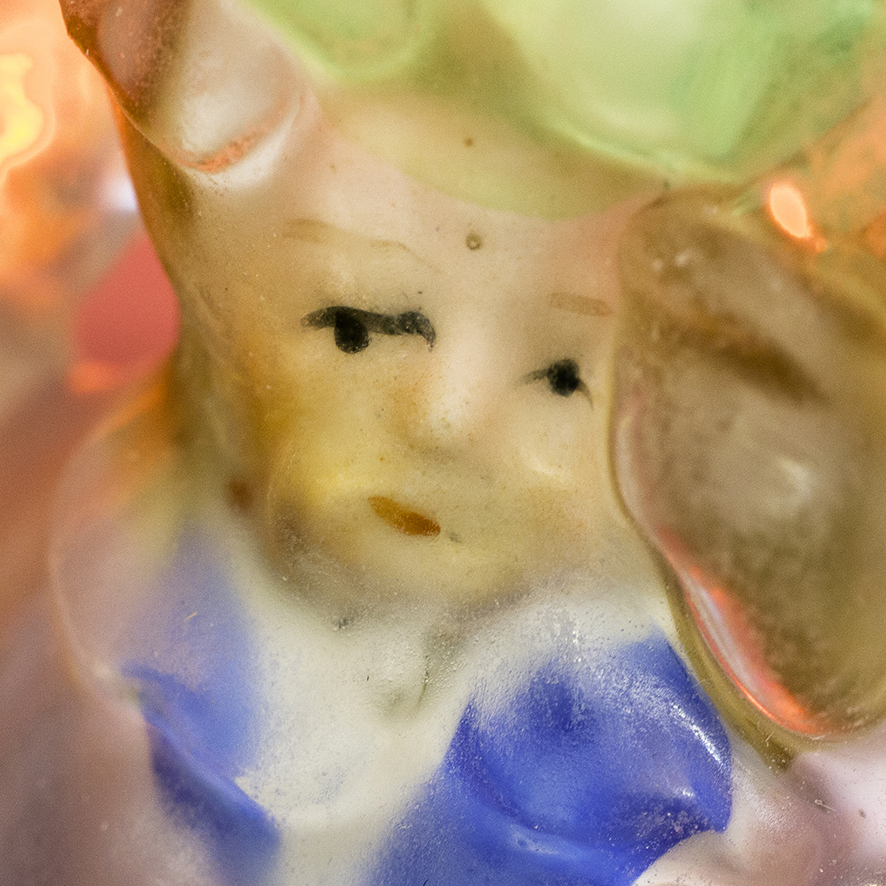
Emily Blair Quinn. Left: Pink Portrait 7, 2026. Framed digital inkjet print. 18 3/4 × 18 3/4 inches. Rith: Pink Portrait 3, 2026. Framed digital inkjet print. 18 3/4 × 18 3/4 inches.