By Yohanna Magdalene Roa
Caro Today: Endurance as Method
On the postcard book and the exhibition Caro es de Todos
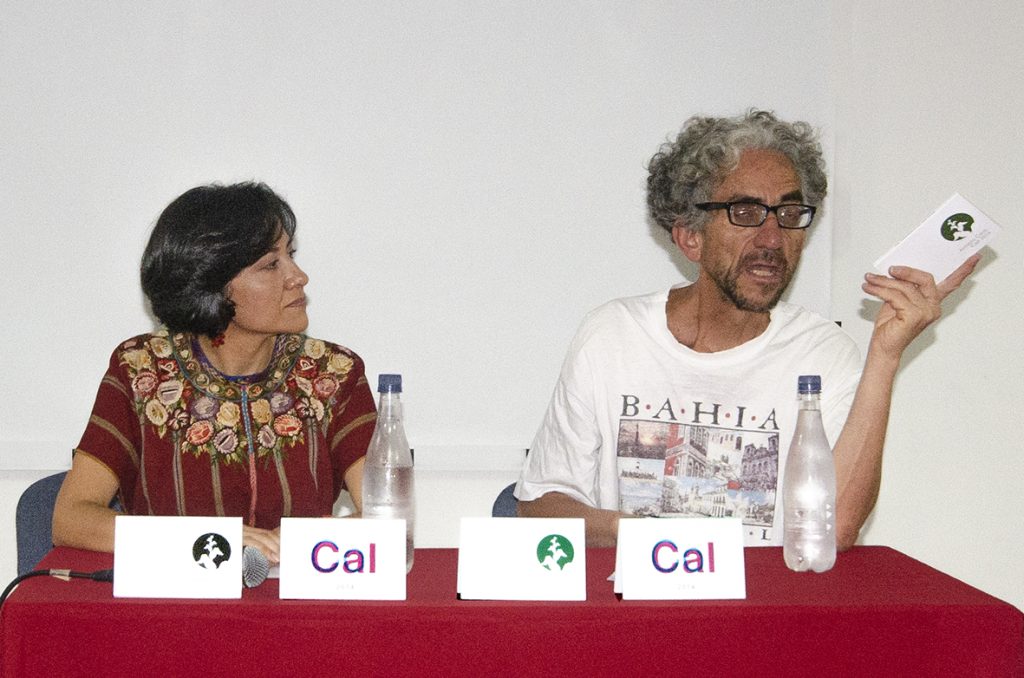
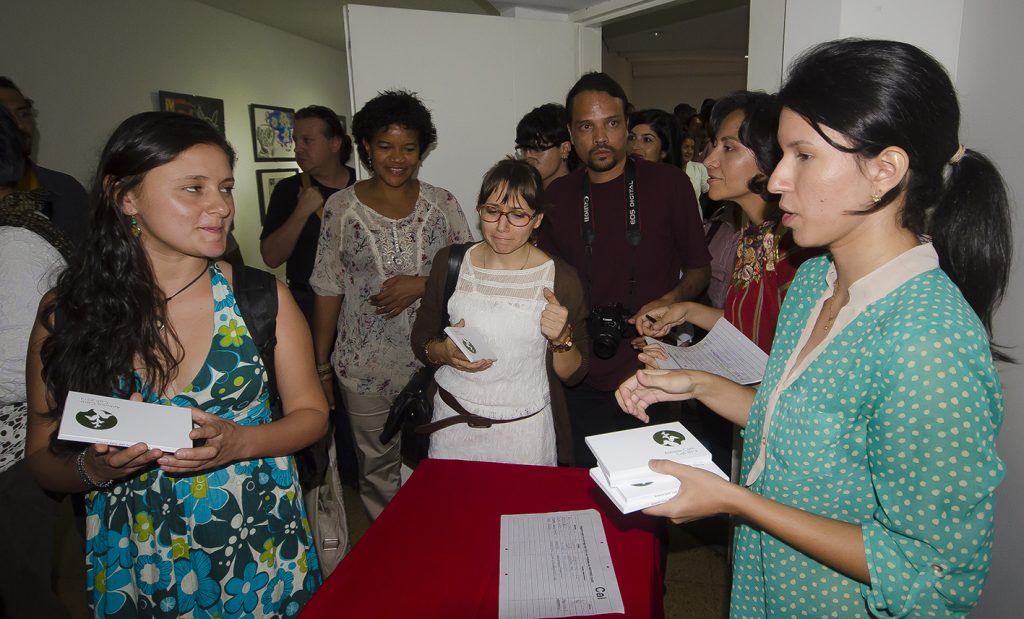
Yohanna M Roa and Antonio Caro. book launch at the Biblioteca Departamental de Cali, 2014. Courtesy of Fundación Humana Integral. Photo by Carlos Altamirano.
In 2014, while editing the book Postales de Antonio Caro and curating the exhibition Caro es de Todos, I came to understand something that runs through his entire practice: Antonio’s work does not obey linear time. His images slip out of chronology, inhabit their own temporal regime, and sustain a vitality that unravels any fixed historical reading.
Far from wearing down, they sharpen. Every new context rearticulates its critical power, allowing it to erupt again with surgical precision. This quality, extraordinarily rare in contemporary visual culture, explains why his work continues to operate today with the same disruptive force it carried at the moment of its debut.
At that time, Antonio was alive, lucid, incisive, always ready to stretch the limits of visual culture. No one imagined that, a decade later, this observation would become almost a rule governing his work’s behavior. Today, on December 10, his birthday, I return to the text I wrote in his presence in order to update it from another perspective: that of his unmistakable permanence.
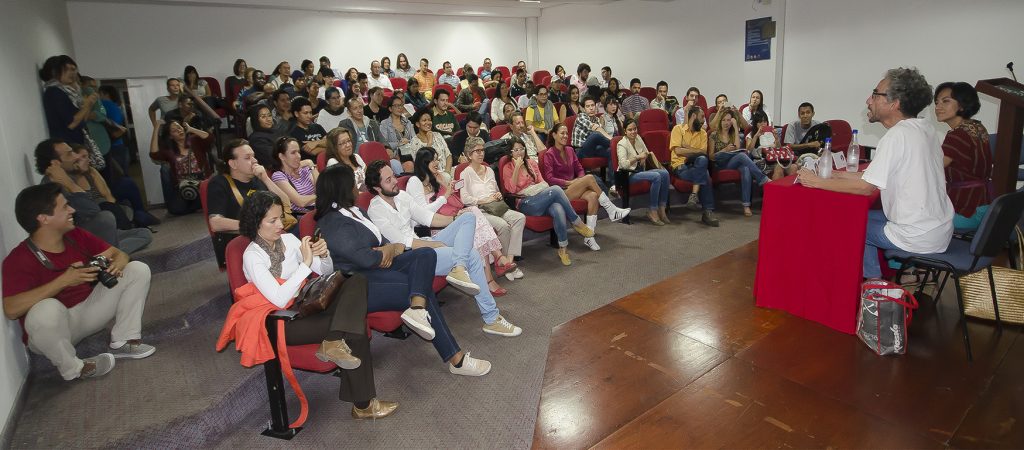
Images from the book launch at the Biblioteca Departamental de Cali, 2014. Courtesy of Fundación Humana Integral. Photo by Carlos Altamirano
Reflecting on the persistent youthfulness of his work leads me back to the story of the Argonauts’ ship. The vessel that set sail with Jason maintained its form throughout the journey, yet every breakdown required it to be rebuilt with materials from elsewhere. In the end, the ship was, simultaneously, the same and something else entirely.
This paradox accurately describes the operations of cultural superstructures: they shift rapidly, classify what no longer serves them, and discard what they consider obsolete. What remains is what manages to root itself, with structural force, in the intimate territory where culture and individual experience intersect.
Antonio Caro accomplished that difficult task: embedding his work into the deep cultural infrastructure, where images are not consumed but transformed. His conceptual gestures, radical in their formal simplicity and impeccable in their critical targeting, operate as fractures that ascend into the superstructure. His works function today as active signs, not relics. They do not age because Antonio never aimed for style; he aimed for the cultural nerve: language, branding, national emblems, advertising gestures, identity pigments, the semantic violence of power.
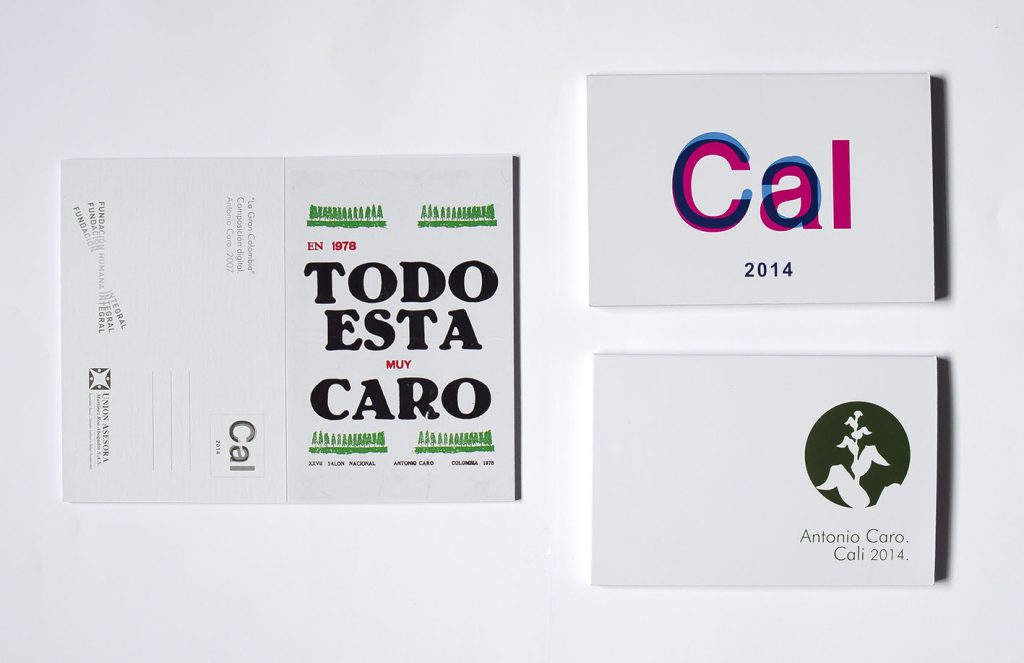
Antonio Caro. Homenaje a Manuel Quintín. Images from the postcard book, 2014. Fundación Humana Integral.
His work dismantles naturalized structures of the image of the nation, advertising rhetoric, structural racism, and the colonial frameworks that persist in daily life and returns them to the viewer as destabilizing questions. This is not art that describes reality; it alters it.
That is why his influence exceeds the field of art. Caro is one of the few Colombian artists whose iconography filtered effortlessly into popular culture: on urban buses, T-shirts, anonymous photocopies, improvised graffiti. He celebrated this circulation because he understood that it was there and not in the museum vitrine that his work reached its fullest critical potency.
This commemorative edition of Postales brings together sixteen essential works that map the rigor of his visual thinking: SAL (1971), Un tigre (1973), Defienda su talento (1974), Colombia (1975 and 1976), Bandera Colombia (1977), Todo está muy Caro (1978), Homenaje a Manuel Quintín Lame (1978), Proyecto 500 (1990), Estampilla (1993), Achiote (2001), Malparidos (2005), Dosis Personal (2006), Desgraciadas (2007), La Gran Colombia (2007), and Minería (2012). I remain deeply grateful for Antonio’s editorial gesture, because these postcards materialize his desire for a circulation that is free, democratic, and incisive.

Antonio Caro. Minería (Mining). Version for the postcard book, 2014. Fundación Humana Integral.
On a personal note, this book takes me back to the beginning of my relationship with his work: I was thirteen or fourteen on a bus in Bogotá when a sticker reading “Colombia” in the Coca-Cola typeface struck me with unexpected clarity. Years later, I learned that it had been created by an artist, Antonio, who would become a collaborator, an interlocutor, and a friend from my teenage years onward.
Many projects remained unfinished after his passing, but the mark he left on Colombian art, on those who worked alongside him, and on me is indelible.
Today, as I rewrite and update this text to commemorate his birthday, I reaffirm what his work makes unmistakably clear: He does not belong to a style. Caro belongs to the living conversation of culture.
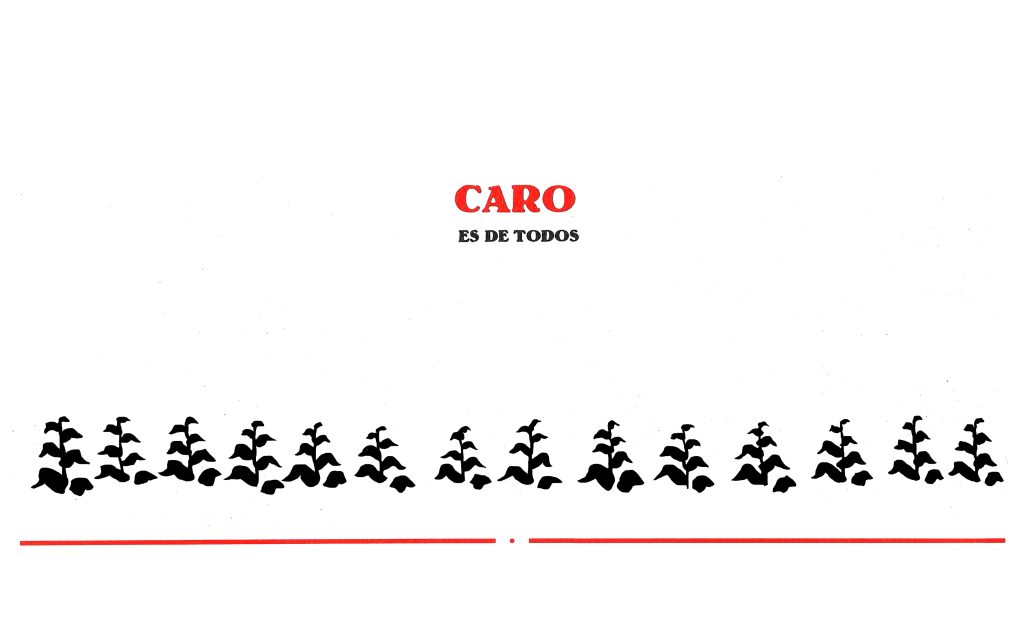
Antonio Caro. Caro es de todos (Caro Belongs to Everyone). Version for the postcard book, 2014. Fundación Humana Integral.
Caro is and will always be for everyone.
I am still missing you.
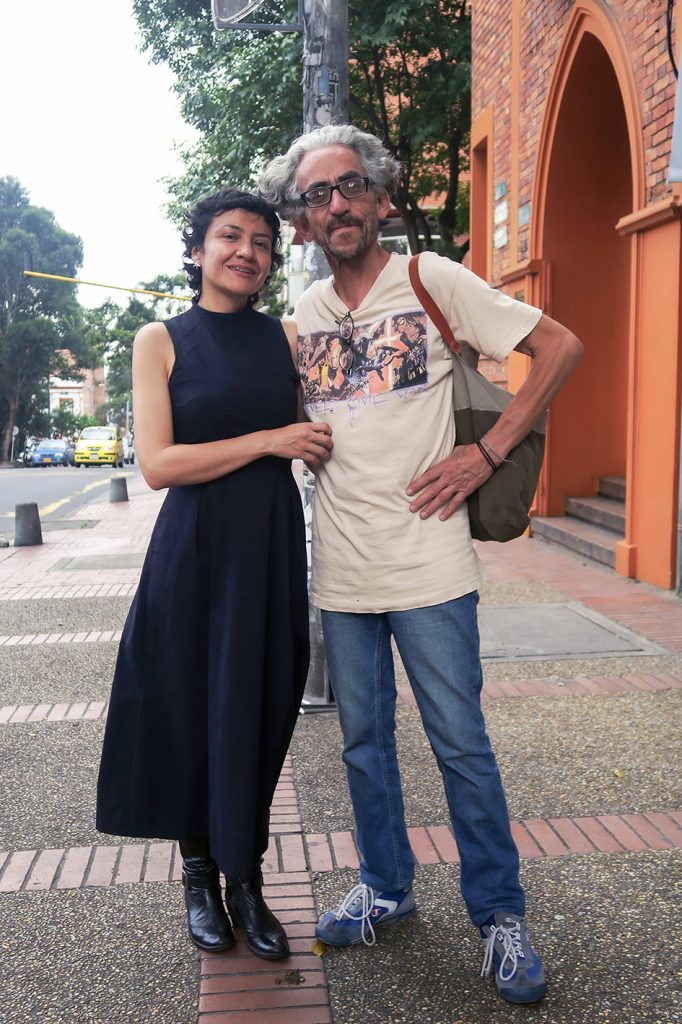
Yohanna M Roa and Antonio Caro. Bogotá, Colombia. 2019. Photo, Jorge Lozano