By Wei Huang
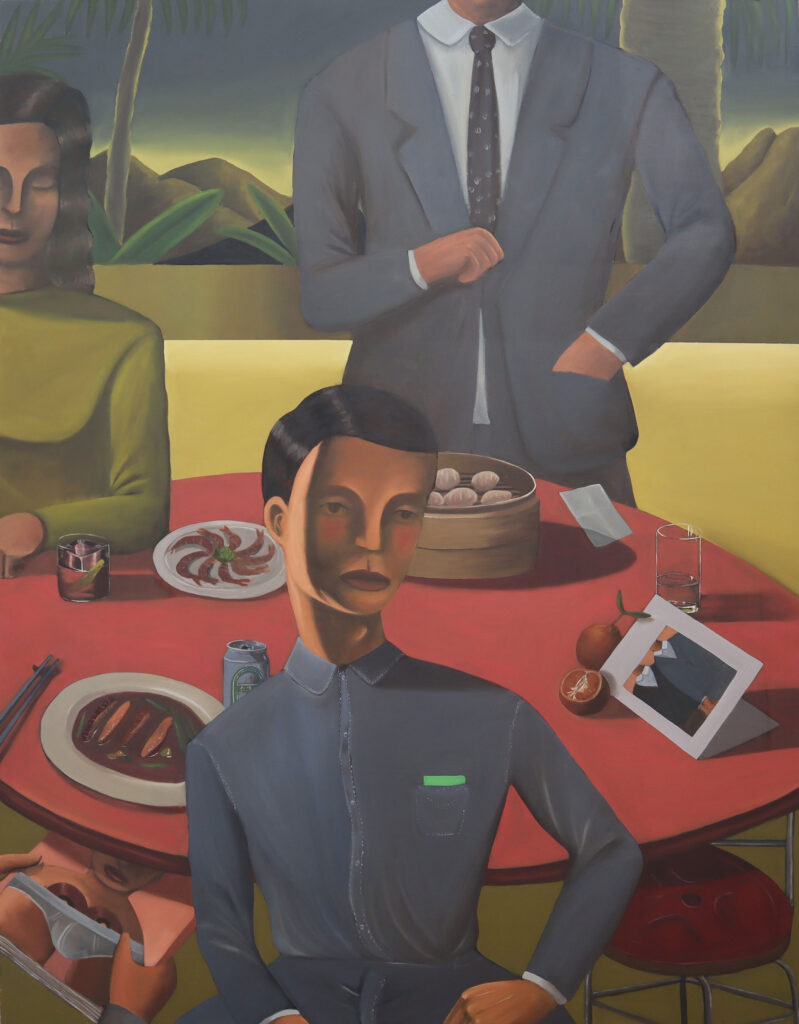
Skyler Chen, Finally, My Banquet on the Street, 2025. Oil on linen, 180 × 140 cm. Courtesy TFAM.
“[The] practices of representation which prioritize positioning over essential identities elide the ways there might still exist a yearning for something resembling home,” cautioned urban geography scholar Julie Ren in her study on the history of the Taipei Biennial[1]. In her analysis, Ren recognized the Biennial’s capacity to destabilize Western hegemonic narratives, yet she warned that the pursuit of global visibility for a marginalized region within the art world might exact its own price. Five years after Ren’s observation, the 14th edition of the Taipei Biennial, Whispers on the Horizon, organized by the Taipei Fine Arts Museum (TFAM), foregrounds “yearning” as its thematic axis, defined in the curatorial statement as “the ache of migration, the longing for home, the search for identity, [and] the hunger for futures yet to unfold.” The resonance across time is striking.[2] Is the Taipei Biennial finally fulfilling the institutional ambition it has long articulated, or do Ren’s words linger less as commentary than as a warning?
To approach art in instrumental terms may seem reductive. Yet biennials—particularly those operating from positions deemed peripheral within the global art ecosystem—have always functioned, in part, as mechanisms of cultural repositioning. Their neutrality is illusory. TFAM articulates this agenda openly, emphasizing its role in “elevating the international visibility of Taiwan’s contemporary art and successfully reeling Taipei into the network of Asian and global contemporary art.”[3]
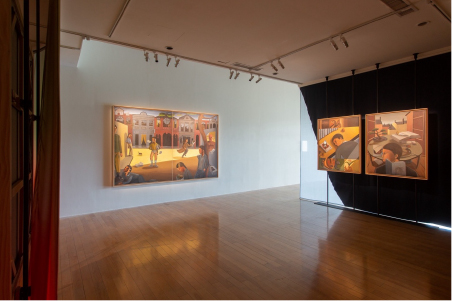
Curated by Sam Bardaouil and Till Fellrath, co-directors of Hamburger Bahnhof, this edition marks the first since 2016 without Taiwanese curators. The decision continues a historical pattern in which internationally recognized, predominantly European, curators are enlisted to legitimize a biennial rooted in Taiwan’s contemporary art. One proposed corrective has been the incorporation of TFAM’s permanent collection, ostensibly allowing foreign curators to engage more directly with Taiwan’s art historical context.[4] Whispers on the Horizon is the first iteration to formally implement this strategy alongside its roster of 54 invited artists.
The exhibition draws explicit inspiration from three Taiwanese sources: a 1993 documentary on a pioneering glove puppeteer, a 1960 short story about a disillusioned, idealistic young man who commits suicide, and a 2017 novel centered on the search for a stolen bicycle as an allegory of Taiwan’s colonial memory.[5] As a conceptual triangulation, the framework promises depth and historical grounding. In practice, however, these references operate more as rhetorical scaffolding than as structural anchors within the curatorial logic.
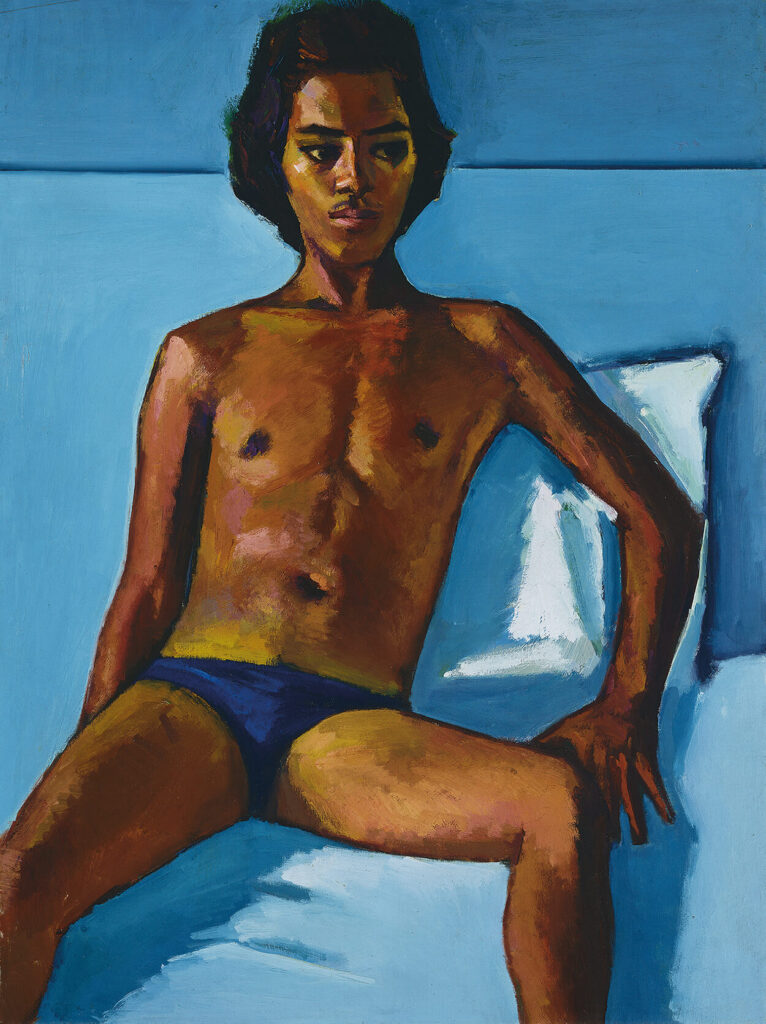
Shiy De-Jinn, Young Man with Long Hair, 1975. Oil on canvas, 100 × 74 cm. Courtesy TFAM.
The introductory photographic triptychs installed across the Biennial’s three floors crystallize this discrepancy. Each floor features three historical Taiwanese photographs drawn from TFAM’s collection, aligned with one of the three literary inspirations. Yet attempting to undergird an exhibition of roughly 150 works with nine images proves an ambitious, perhaps overextended, curatorial gesture. The connections remain largely analogical: a 1942 street photograph of a bicyclist gestures toward the novel of the stolen bicycle; a portrait of a contemplative schoolchild recalls the troubled protagonist of the short story; and so forth. With wall texts offering minimal interpretive depth, the correspondences remain formal rather than discursive. The result feels like the curators’ game of charade that provides little room for dialogue.
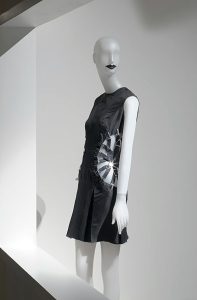
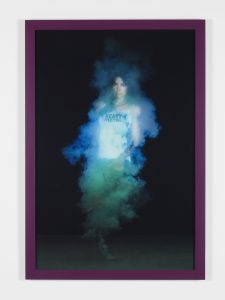
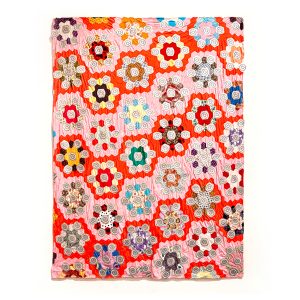
The rigid framing of these photographic triptychs reveals a deeper instability. The exhibition vacillates between works that articulate yearning with conceptual clarity and others whose inclusion appears tenuously connected to the stated theme. The dilemma Ren identified resurfaces: Taiwan’s art negotiating a precarious equilibrium between political assertion and the desire—perhaps the yearning—to transcend that very condition. What emerges is not incoherence, but unevenness. The exhibition shifts abruptly in tone and register: from the assertive queerness of Shiy De-Jinn’s male portrait to Hera Büyüktaşçıyan’s rolled-up rugs invoking the forced displacement of Greek communities by the Turkish state in 1955, and onward to the radiant luminosity of Rohini Devasher’s solargraph series. Without sufficient principle in the transitions, what could have been productive friction registers more as curatorial disarray.
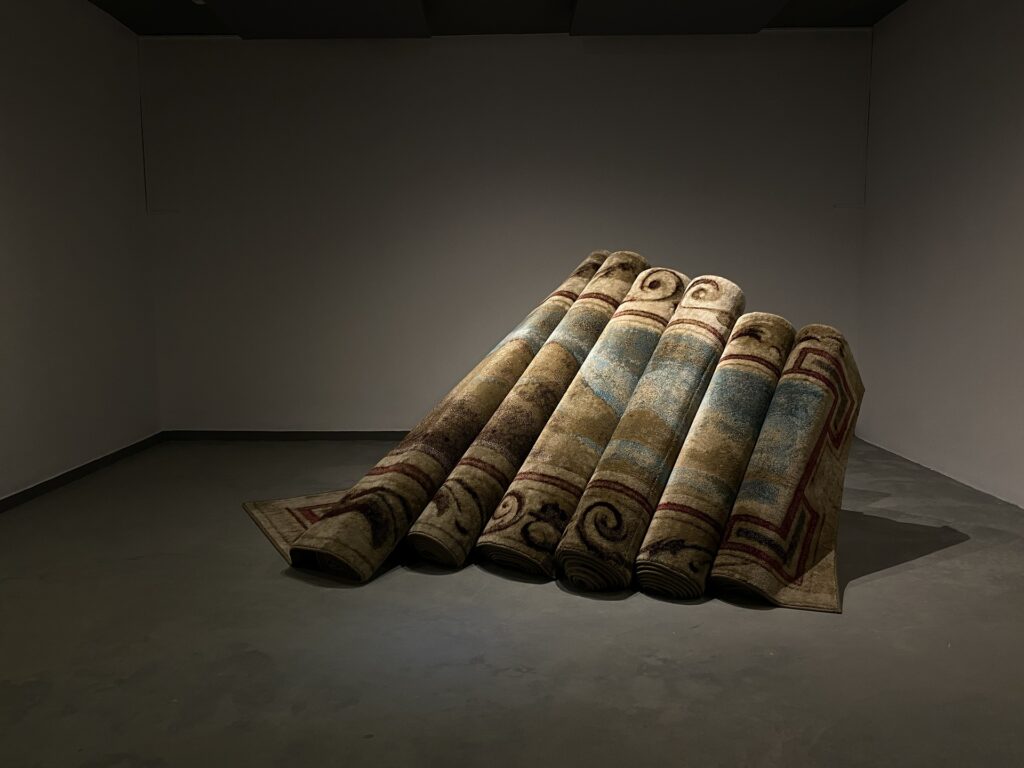
Hera Büyüktaşçıyan, Destroy Your House, Build Up A Boat, Save Life, 2015. Print on carpet, dimensions variable. Courtesy TFAM.
Ironically, in an exhibition some observers have characterized as apolitical, yearning resonates most powerfully in works that confront historical rupture. Korakrit Arunanondchai’s Love after Death (2025), set in an abandoned factory in Lopburi, Thailand—now inhabited by monkeys believed to embody ancestral spirits—articulates this tension with conviction. The film’s invocation “not let the past disappear” and to move “beyond the threat of the modern world” frames yearning not as nostalgia but as insistence.[6] Projected on a monumental screen before a ruin-like backdrop intermittently illuminated by flickering light, the installation underscores the Biennial’s strength in spatial dramaturgy. Upstairs, Skyler Chen’s recent paintings interrogate the intersection of queer history and Taiwan’s own past by reintroducing queer presence into scenes drawn from the Martial Law period (1949–1987). Through saturated chromatic intensity, anachronistic and at times deliberately provocative iconographies, and muted Balthus-esque figures, Chen’s canvases engage oppression and liberation with greater thematic coherence than the exhibition’s introductory framing devices.
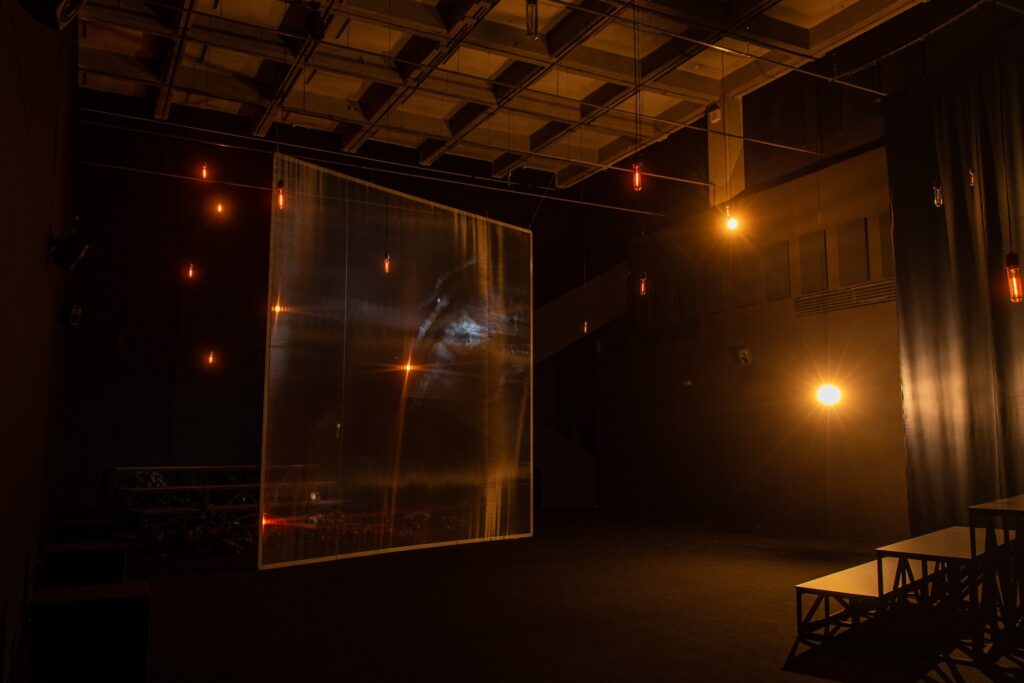
Korakrit Arunanondchai, Love after Death, 2025. Installation view, HD film and mixed media, 47 min. loop, dimensions variable. Courtesy TFAM.
Yearning articulated from an intimate vantage point likewise emerges as one of the exhibition’s more compelling threads. On the second floor, Fuyuhiko Takata’s The Princess and the Magic Birds (2025), presented at the end of a spiraling curtain corridor adorned with bird and cage sculptures, reframes the fairy-tale narrative through erotic and gender-fluid voices. Adjacent to this installation, Ni Hao’s assemblage of sculptural elements, purchased commodities, and transaction documentation extends the inquiry into fetish economies. Acts as quotidian as putting on or removing socks—and objects as banal as diapers—become conduits for examining desire’s infrastructural undercurrents. Together, these works gesture toward a more layered exploration of yearning. Yet the gallery’s threshold, marked by Chen Cheng-Po’s 1927 street painting, reasserts historical gravitas in a manner that unsettles the spatial and conceptual rhythm that follows.
The 14th edition of the Taipei Biennial is undeniably rich in spectacle. Immersive installations and meticulously crafted works unfold across three floors of TFAM. Yet the curatorial voice rarely rises above modulation. In her statement, TFAM Director Loh Li-chen describes the exhibition’s focus as addressing issues with which people deeply resonate.[7] The claim is not unfounded. The Biennial refracts a collective Taiwanese yearning: to articulate identity, to assert cultural specificity, and to situate that specificity within global circuits. What remains unresolved is how such yearning negotiates the persistent friction between international validation and local self-definition. The Biennial’s intention is sincere. Its execution suggests that whispering may no longer be enough.
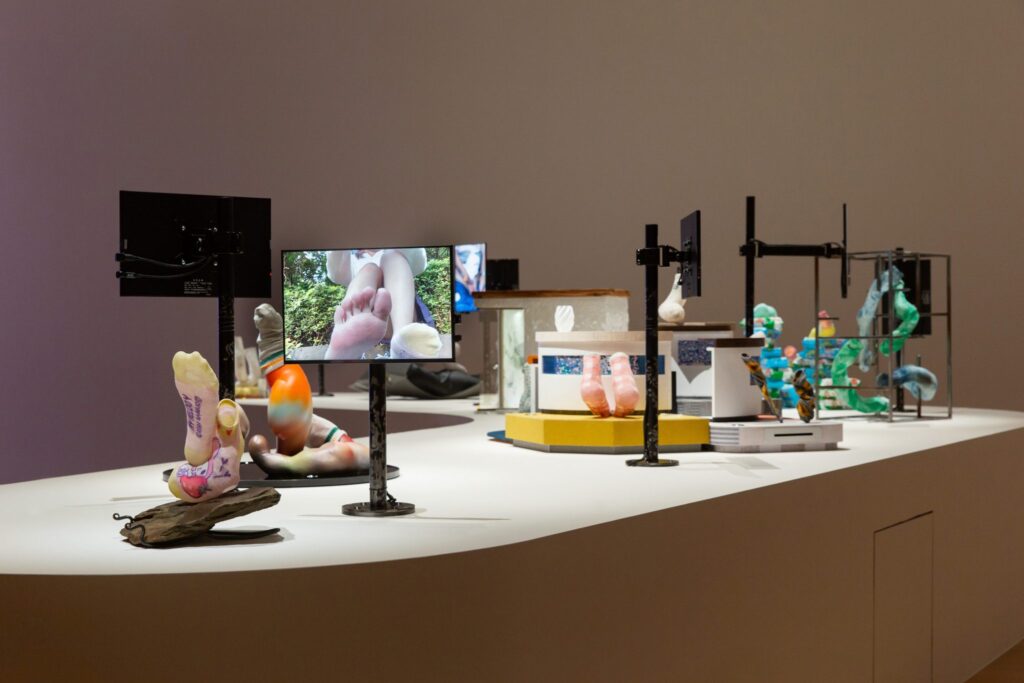
Ni Hao, The Bloom That Holds Her Shadow, 2025. Mixed media installation with video, approx. 97 × 68 × 57.5 cm. Courtesy TFAM.
[1] Footnote 1: Julie Ren, “Obscuring Representation: Contemporary Art Biennials in Dakar and Taipei,” Geographica Helvetica 76, no. 2 (2021): 111.
[2] Taipei Fine Arts Museum (TFAM), Curatorial Text, Whispers on the Horizon, referencing the 1993 documentary, 1960 short story, and the 2017 novel.
[3] From the official website of the Taipei Biennial. (the quote here is only available in the Mandarin version of the website) https://www.taipeibiennial.org/
[4] Nobuo Takamori (Lin Hsin-nan), “Difficulties and Possibilities of the Taipei Biennial,” Journal of TFAM 28, no. 2 (2014): 67–68.
[5] Taipei Fine Arts Museum (TFAM), Curatorial Text, Whispers on the Horizon, referencing the 1993 documentary, 1960 short story, and 2017 novel.
[6] Korakrit Arunanondchai, Love after Death (2025), artist’s voiceover: “not let the past disappear” and “beyond the threat of the modern world,” quoted from the film script/screening.
[7] Page 5 from the official guidebook. https://www.taipeibiennial.org/2025/storage/files/2025/TB25-guidebook-en.pdf