This text was written jointly by Natalie Edgar Pavia and Yohanna M. Roa. First-person passages are retained only when Natalie speaks from her personal experience.
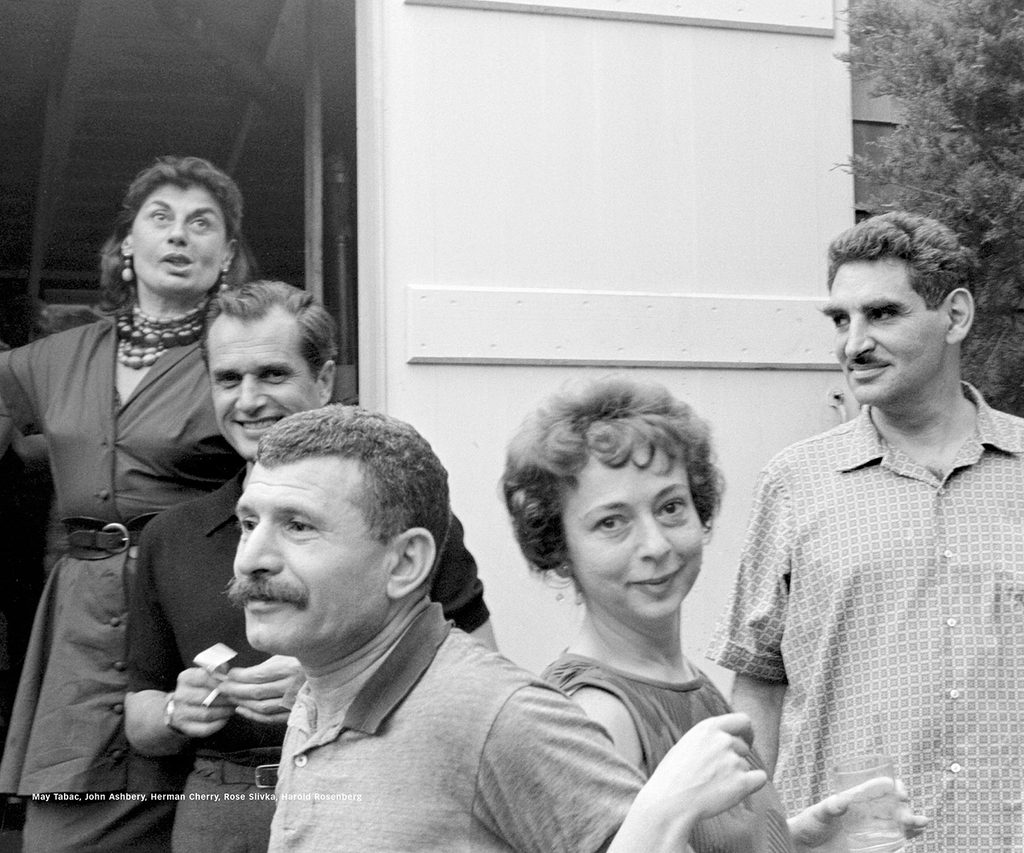
May Tabac, John Ashbery, Herman Cherry, Rose Slivka, and Harold Rosenberg. From Club Without Walls: Selections from the Journals of Philip Pavia, edited by Natalie Edgar (Midmarch Arts Press, 2007).
Abstract Expressionism has often been characterized as a predominantly male, even macho, movement. The description has been repeated so frequently that it risks becoming an accepted historical judgment rather than a proposition to be examined. A recent review by Holland Cotter, [1] concerning Lee Krasner and Jackson Pollock, raises this problem once again. Its subtitle introduces Krasner as an artist who “had to settle for the kitchen as her studio” and is only now receiving her share of recognition at the Metropolitan Museum of Art. Although the review acknowledges the strength of her work, this framing begins with her subordinate circumstances rather than her artistic achievements, inadvertently reinforcing the very narrative of marginalization it seeks to correct. We believe it is time to reconsider such assertions in light of the historical record, particularly when documents that complicate this familiar narrative have long been available.
There is no question that women artists faced discrimination, unequal opportunities, and obstacles to recognition. These conditions were hardly unique to Abstract Expressionism. Yet women had a significant and documented presence in Abstract Expressionism from its formative years, participating as artists and also in the discussions and collective activities through which the movement developed. Their involvement challenges the predominantly masculine image through which the movement has often been represented. There is an essential distinction between the unequal conditions under which women worked, their actual participation in an artistic movement, and the recognition subsequently granted to them by critics, museums, galleries, and art historians. To confuse these questions is to risk repeating the very exclusions we should be examining.
I approach this question not only as an abstract artist who has worked for decades, but also from my experience as an art critic for ARTnews, where I covered important exhibitions of Abstract Expressionism in New York, and as the editor of Club Without Walls: Selections from the Journals of Philip Pavia, published in 2007. My husband, the sculptor Philip Pavia, was a founder and central organizer of the Eighth Street Artists’ Club, established in 1948, and later the publisher of It Is magazine. His extensive notes, manuscripts, and records, which I worked with over many years in preparing the book, are now preserved at Emory University in Atlanta[2].
These records offer a perspective that differs considerably from the simplified image of an exclusively male movement. From my experience, one of the defining characteristics of early Abstract Expressionism was that the movement developed through an active community of artists who met to discuss, question, and debate the meaning of painting and art itself. Women took part in these exchanges not only as painters, but also as intellectual contributors who defended their own artistic positions and challenged those of their colleagues. This is why I consider the records of the Eighth Street Artists’ Club and the discussions documented in Club Without Walls particularly important, since they allow us to examine that formative moment before museums, galleries, the art market, and academic institutions exerted greater influence over public recognition and historical interpretation.
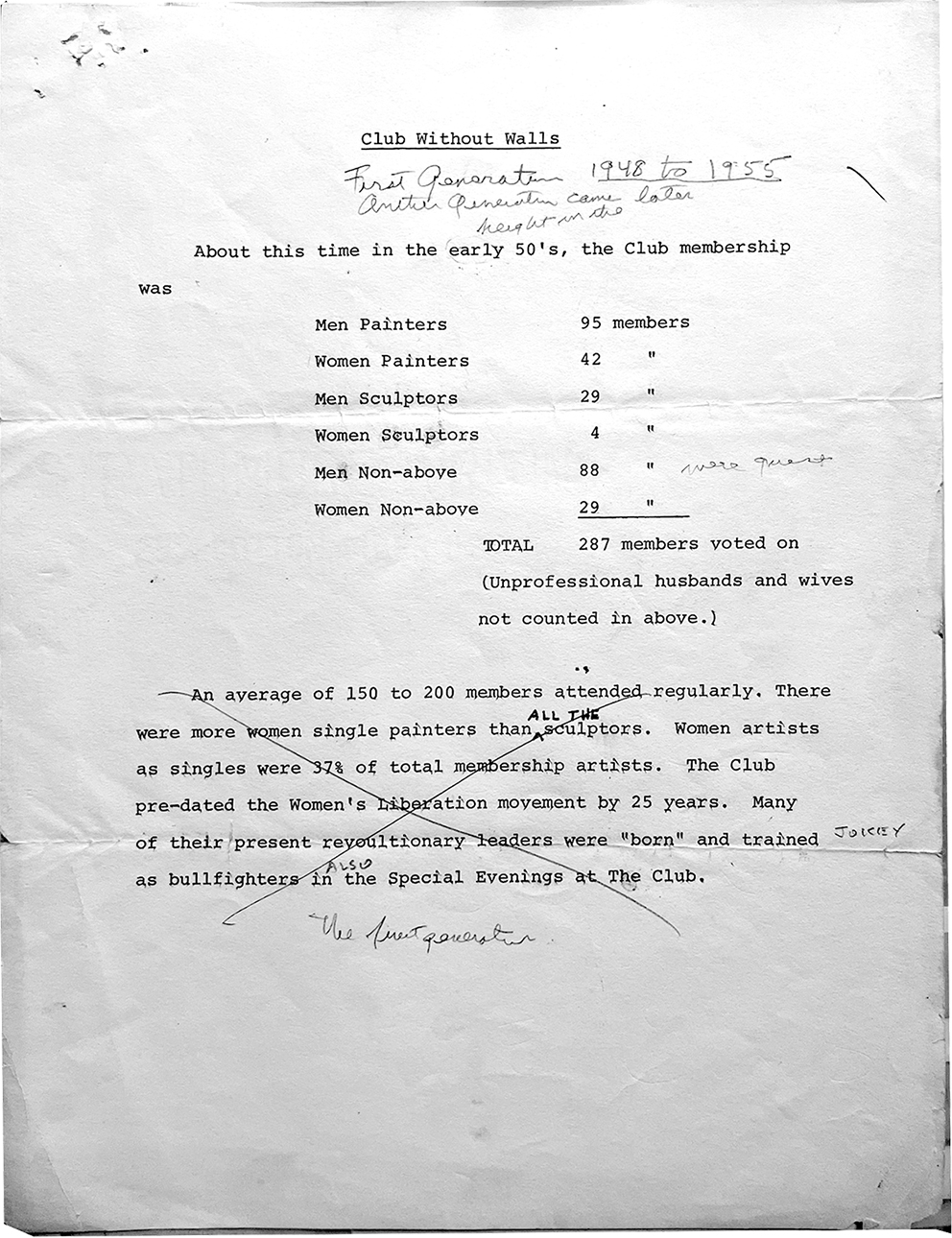
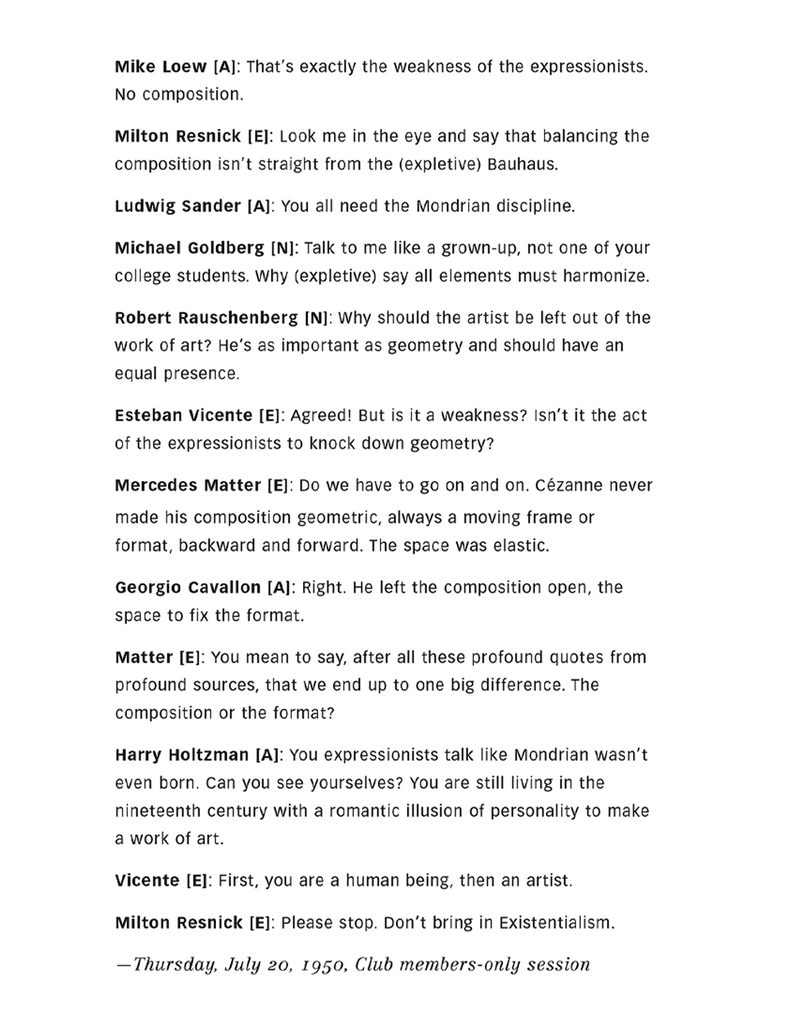
Left: Archival document recording the Eighth Street Artists’ Club membership in the early 1950s, with handwritten annotations. Pavia Edgar Trust Collection. Right: Excerpt from a discussion on composition, geometry, and Expressionism held during a members-only session of The Club on July 20, 1950. Participants included Mercedes Matter, Esteban Vicente, Milton Resnick, Michael Goldberg, and Robert Rauschenberg.
According to documents preserved in Philip Pavia’s personal archive, as shown in the image above, the Club’s membership had a community of 150 – 200 regular members, 46 (25% aprox) of whom were women. The figure does not establish equality or excuse discrimination, but it complicates the characterization of the movement as an exclusively male enterprise. The question is not whether women achieved numerical parity with men. They did not. It is what they contributed, how they participated, and why their work did not receive comparable visibility.
One of the defining characteristics of Abstract Expressionism, as with other artistic movements that emerged through collective practices, intellectual exchanges, and sustained debate among artists, was that its principles and artistic positions were developed within the community itself. In these formative environments, women played substantial roles, not necessarily in equal numbers, but through the strength of their artistic, intellectual, and organizational contributions. The records of the Eighth Street Artists’ Club provide concrete evidence of this participation. It is therefore essential to distinguish the actual formation of Abstract Expressionism from the predominantly masculine narrative subsequently constructed around it.
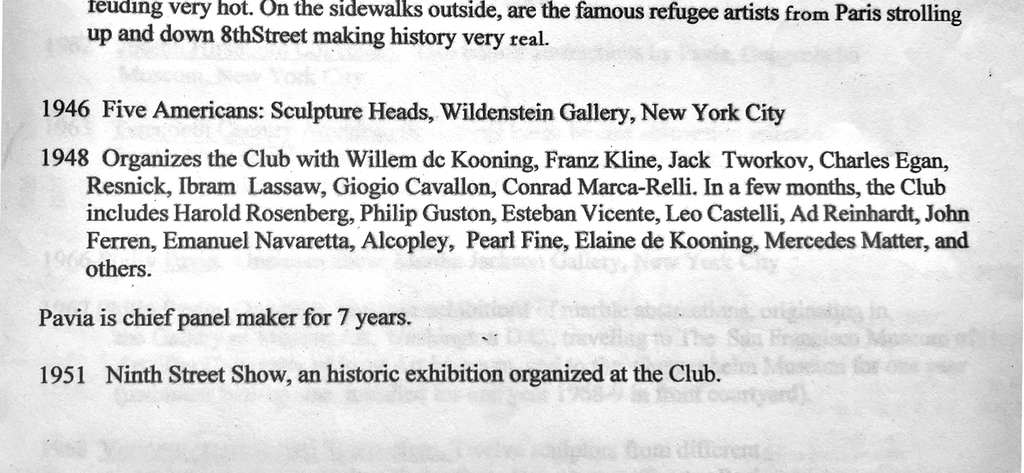
Archival document by Philip Pavia recording the organization of the Eighth Street Artists’ Club in 1948, identifying its initial organizers and artists who joined in the following months. Among the latter are three women: Perle Fine, Elaine de Kooning, and Mercedes Matter. Pavia Edgar Trust Collection
That narrative was shaped, in part, by critics and art historians who privileged the achievements of male artists, as well as by longstanding social and institutional structures that afforded men greater access to galleries, museums, commercial representation, and professional recognition. Women faced more limited opportunities for exhibition, visibility, and market participation. Their unequal representation in the historical canon should not be mistaken for a lack of agency or influence in the movement’s development. The history of who shaped Abstract Expressionism is not the same as the history of who was subsequently recognized for shaping it. The persistence of this historical imbalance is particularly evident in the Metropolitan Museum of Art’s decision to present Krasner alongside Pollock rather than devote an independent retrospective to her work. Whatever the curatorial rationale for the joint exhibition, the decision raises a pointed question: why, even now, must an artist of Krasner’s stature share the institutional stage with her husband to receive this level of recognition?
Philip’s accounts identify Elaine de Kooning, Alice Mason, Ernestine Lassaw, and Florence Grippe among the women who participated in the early discussions held at the Waldorf Cafeteria[3]. He also describes the practical restrictions that limited women’s attendance during the war years, particularly the dangers of traveling at night. After the war, he observed, women had greater freedom to participate[4]
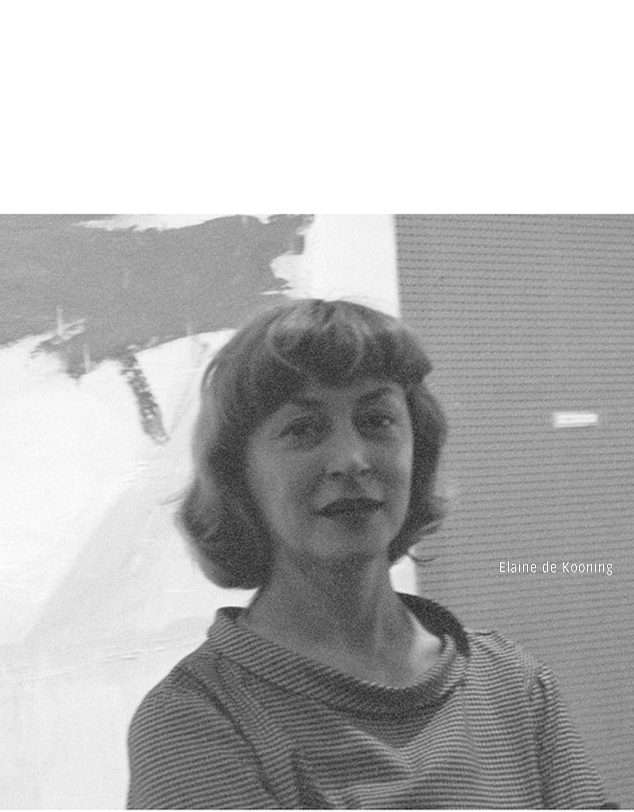
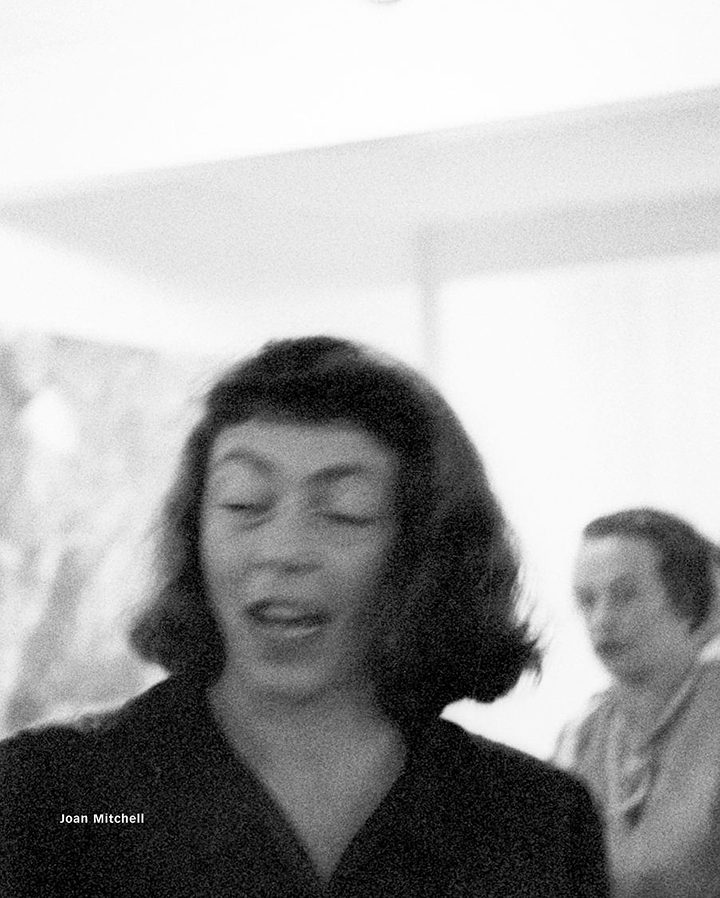
Elaine de Kooning (left) and Joan Mitchell (right). Photographs reproduced in Club Without Walls: Selections from the Journals of Philip Pavia, edited by Natalie Edgar.
The Club’s records provide concrete evidence of women’s engagement in its intellectual life. Joan Mitchell moderated “The Figure in Painting” on March 27, 1953, directing a panel of eight men. Elaine de Kooning participated in “Integration of Art and Architecture” and “Problems of the Engaged Artist” in April 1952, and sponsored “New Poets” the following month, a session that included Barbara Guest. On October 31, 1952, M. C. Richards presented a session on Artaud, introduced by John Cage. These discussions extended beyond painting into architecture, poetry, and philosophy. Equally significant is Philip’s own account of Mercedes Matter, Elaine de Kooning, Rose Slivka, Alice Yamin, May Tabak, and Grace Hartigan, whom he identifies as participants who repeatedly questioned and challenged speakers from the floor. Their participation was not peripheral but part of the continuing exchange through which the Club’s artistic ideas developed[5].
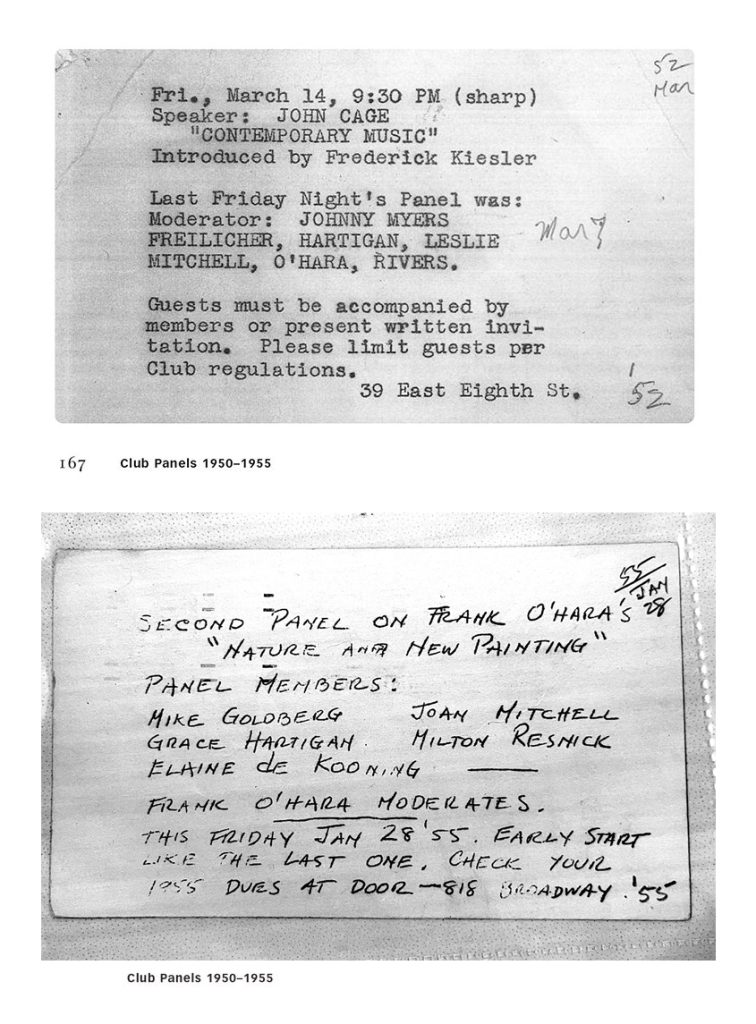
Archival announcements of The Club’s discussion panels, including “Abstract Expressionism”. Top: (January 25, 1950), featuring Elaine de Kooning, Perle Fine, and other artists. Documents reproduced in Club Without Walls. Bottom: Archival program card for the Eighth Street Artists’ Club’s second panel on Frank O’Hara’s Nature and New Painting, January 28, 1955, moderated by Frank O’Hara, with Michael Goldberg, Grace Hartigan, Elaine de Kooning, Joan Mitchell, and Milton Resnick. Handwritten document. Pavia Edgar Trust Collection.
From my own experience with Philip and several of these women, I would suggest that their participation extended beyond these exchanges to the organization and continuity of the Club itself. Mercedes Matter and Elaine de Kooning, in particular, exercised a form of leadership that was not necessarily reflected in formal positions. Philip asserts about Elaine: “She, from the first, showed an independence that was copied and modeled later by many women.”[6] Elaine worked closely with Philip in sustaining the artistic community, while maintaining a strong commitment to her own independence. She held a clear conviction that women should determine the conditions of their own lives, a position she sought to practice in both her personal relationships and her artistic work.
These experiences document both women’s active participation in the movement and the unequal circumstances under which they exercised their artistic autonomy and authority. The obstacles they encountered cannot be used retrospectively as evidence of their absence or marginality.
A more difficult question concerns the relationship between that participation and their subsequent professional opportunities and recognition. Did the women associated with the Club have opportunities to exhibit their work with the same frequency and prominence as their male colleagues? Were they represented equally in galleries, museum exhibitions, critical reviews, and collections? Membership figures and personal testimonies alone cannot answer these questions. A broader examination of archival and institutional records, extending beyond the Club and into subsequent decades, is needed to establish how gender shaped artistic opportunities, professional trajectories, and historical recognition.
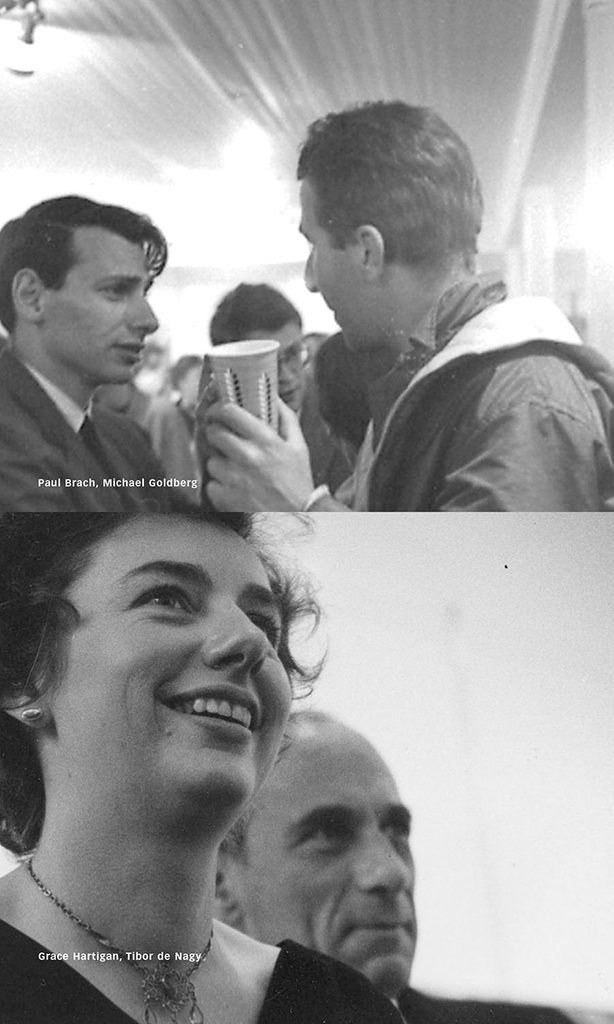
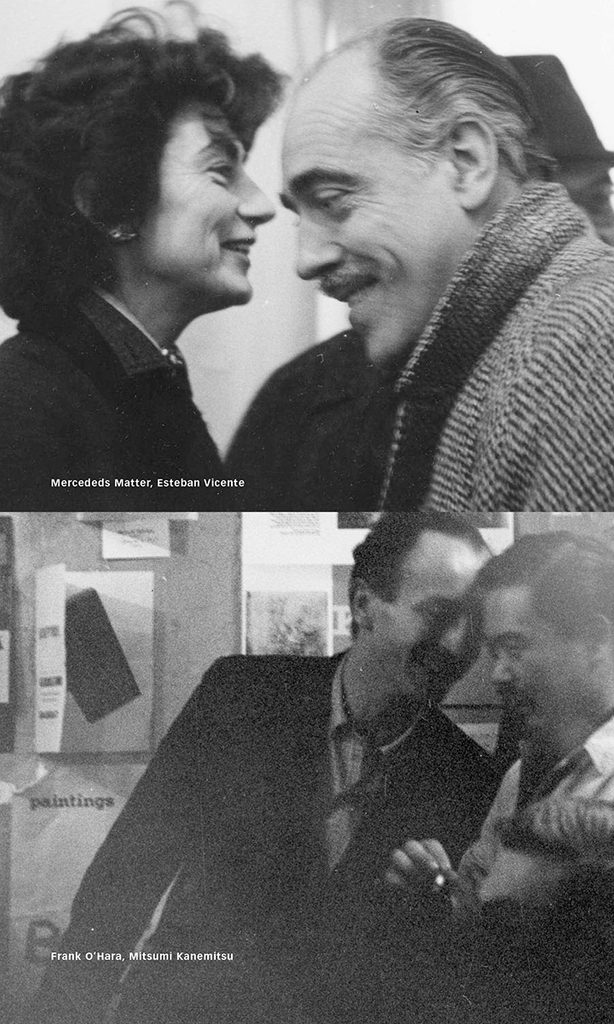
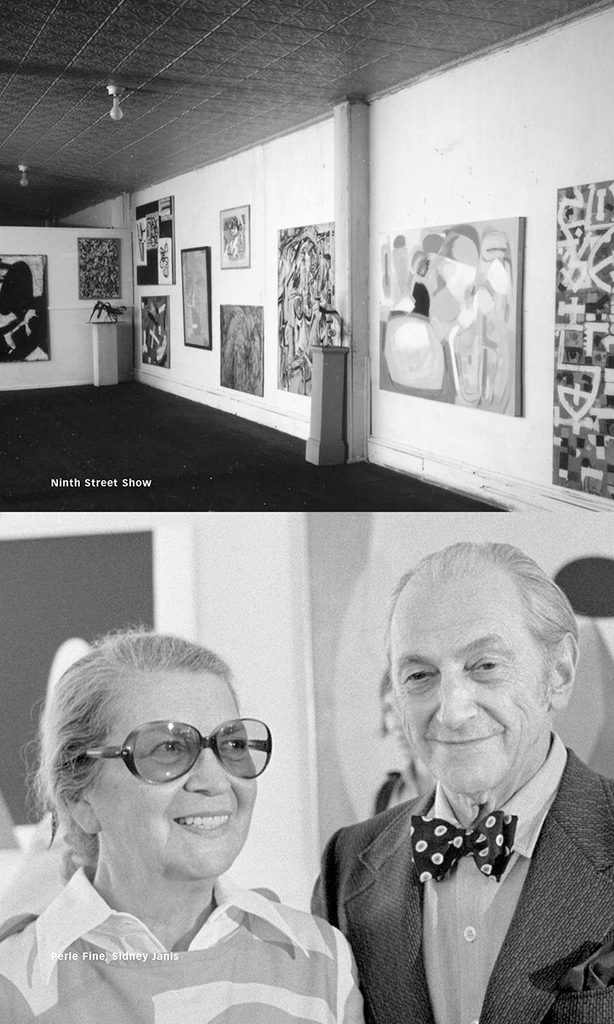
Archival photographs of the Abstract Expressionist community: Paul Brach and Michael Goldberg; Grace Hartigan and Tibor de Nagy; Mercedes Matter and Esteban Vicente; Frank O’Hara and Mitsumi Kanemitsu; an installation view of the Ninth Street Show (1951); and Perle Fine with Sidney Janis. Reproduced in Club Without Walls: Selections from the Journals of Philip Pavia, edited by Natalie Edgar.
The 1951 Ninth Street exhibition marked a turning point. Organized through the initiative of artists themselves, it brought together a community whose work would transform New York’s international artistic position. Women were among its participants. Elaine de Kooning, Lee Krasner, Grace Hartigan, Helen Frankenthaler, and Joan Mitchell are among the artists whose achievements have made women’s contributions to Abstract Expressionism impossible to disregard. Mary Gabriel’s Ninth Street Women has brought renewed attention to five of these figures, but they were not the only women involved.[7]
The Waldorf Cafeteria and the Artists’ Club were important spaces for these exchanges. As Abstract Expressionism gained international prominence, museums, galleries, universities, and critics increasingly determined which artists would become visible and enter the historical canon. The movement’s early history and its subsequent institutionalization, however, are not identical.
This distinction extends beyond Abstract Expressionism. Art history has repeatedly privileged certain artists while neglecting others, particularly women, but also men whose contributions did not fit the narratives that eventually prevailed. A history written primarily through those who achieved institutional recognition risks reproducing the mechanisms that produced their visibility.
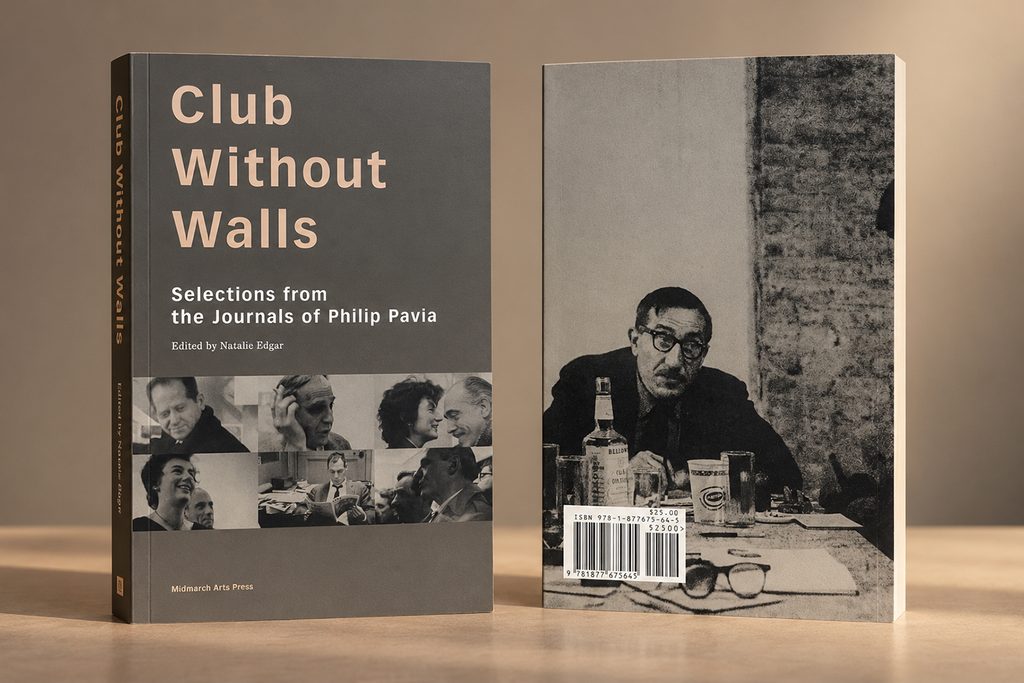
Front and back covers of Club Without Walls: Selections from the Journals of Philip Pavia, edited by Natalie Edgar (New York: Midmarch Arts Press, 2007).
The Club archives offer an opportunity to reconsider Abstract Expressionism beyond the reputations of its most celebrated representatives. They provide evidence that complicates established art-historical classifications and allows us to examine how the movement’s history has been constructed.[8]
The current discussion surrounding the presentation of Lee Krasner alongside Jackson Pollock belongs within this broader problem. There are legitimate curatorial reasons to examine the relationship and artistic dialogue between two major painters. But why should Krasner’s work continue to be framed through her marriage to Pollock when his artistic standing has long been established independently of hers? A joint exhibition may illuminate their distinct practices, but it should not imply that Krasner requires Pollock’s presence to justify her own. The more consequential issue is the historical assumption behind the review. If women’s contributions are judged primarily through the institutional recognition they received, rather than through evidence of their actual participation and achievements, the history of the movement remains incomplete.
Abstract Expressionism was not a movement of equal opportunities. Nor was it a movement without women. These are two different historical propositions, and they should not be treated as interchangeable. The surviving records do not resolve the question of gender inequality in Abstract Expressionism. Rather, they offer evidence from which a more extensive historical inquiry can begin, one that considers women’s participation in the movement’s formation alongside the conditions that shaped their professional trajectories in subsequent decades. Such an inquiry would require moving beyond the Club and beyond established narratives of artistic recognition, without replacing one simplified account with another. The history of a movement cannot be reduced to the history of its most celebrated representatives.
[1] Holland Cotter, “A Knockout Show Resets the Record With ‘Krasner and Pollock’,” The New York Times, September 29, 2026.
[2] The Philip Pavia and Natalie Edgar papers are held at the Stuart A. Rose Manuscript, Archives, and Rare Book Library, Emory University, Atlanta, Georgia.
[3] Before the establishment of the Eighth Street Artists’ Club in 1948, artists gathered informally at the Waldorf Cafeteria, at Eighth Street and Sixth Avenue. These wartime gatherings provided the social and intellectual foundation from which the Club emerged. Once the Club had its own premises, it became the principal venue for their meetings, discussions, and organized panels, replacing the cafeteria in that role. Philip Pavia, Club Without Walls: Selections from the Journals of Philip Pavia, ed. Natalie Edgar (New York: Midmarch Arts Press, 2007), pp. 3–10, 51–55. See also “The Club IT IS: A Conversation with Philip Pavia,” The Brooklyn Rail (February 2001).
[4]Pavia, Club Without Walls, pp. 9–10.
[5] Pavia, Club Without Walls, pp. 172–173 (Joan Mitchell); pp. 169–170 (Elaine de Kooning and Barbara Guest); pp. 170–171 (M. C. Richards and John Cage); p. 61 (Pavia’s account of women participating in discussions from the floor).
[6] Pavia, Club Without Walls, p. 10. See also p. 43, where Pavia retrospectively discusses the emergence of women as leaders in the American art world.
[7] Pavia, Club Without Walls, “The Ninth Street Show,” pp. 99–108. See also Exhibition Announcement: 9th St. (1951), Museum of Fine Arts, Houston, accession no. 98.220, https://emuseum.mfah.org/objects/39020/exhibition-announcement-9th-st (designed by Franz Kline).
[8] Pavia, Club Without Walls, pp. viii–ix, 51–61, 158–178.