Cambridge, Massachusetts / London: The MIT Press, 2026. 280 pp.
By Yohanna M. Roa
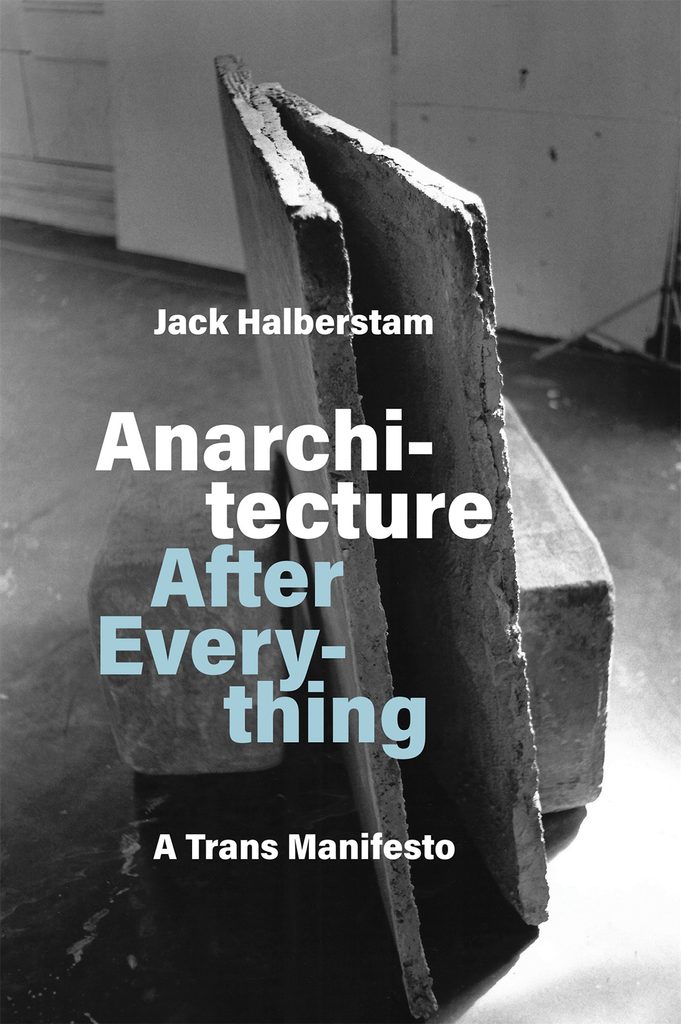
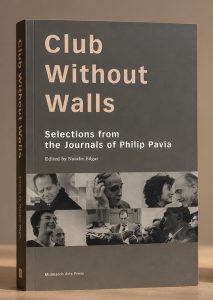
Jack Halberstam, Anarchitecture After Everything: A Trans Manifesto, MIT Press, Cambridge, Massachusetts, 2026. Book cover.
I began reading this book on a flight from New York to Cali, Colombia. I was traveling to see my mother, who had experienced a health problem and was hospitalized. As I traveled, I kept thinking about her aging woman’s body in a hospital. On August 10, 2026, a magnitude 7.4 earthquake had struck western Colombia, causing severe damage in Cali, the city where I grew up. Upon arriving and moving through the city, I encountered collapsed buildings, others threatening to collapse, and some that would have to be demolished. There were people who had lost their homes, some camping in parks. As I physically moved through a devastated city, I was reading this book, which proposes thinking through destruction, ruin, emptiness, and the possibility of inhabiting the scar.
Halberstam’s proposition brings the trans body and anarchitecture into relation as a way of imagining forms of existence beyond established demands for bodily integrity, coherence, or permanence, as well as the gender binary and heteronormativity. His engagement with slavery, colonialism, racism, and the practices of racialized artists makes this political dimension particularly significant to me. Although he does not directly address the concept of humanitas, his proposition gave me a sense of freedom, as though it were possible to pulverize the cement hardened by centuries of control and biopolitics. From this perspective, I would venture to suggest that what his argument allows us to question is the very concept of the “human.” This leads me to ask what happens when anarchitecture enters into dialogue with humanitas, the Western construction of the human and the colonial hierarchies through which humanity has been defined. If the trans body allows us to think beyond established norms, might anarchitecture also unsettle the racial and colonial boundaries of the human, opening a space for bodies and forms of existence that Western thought has historically excluded or designated as monstrous?
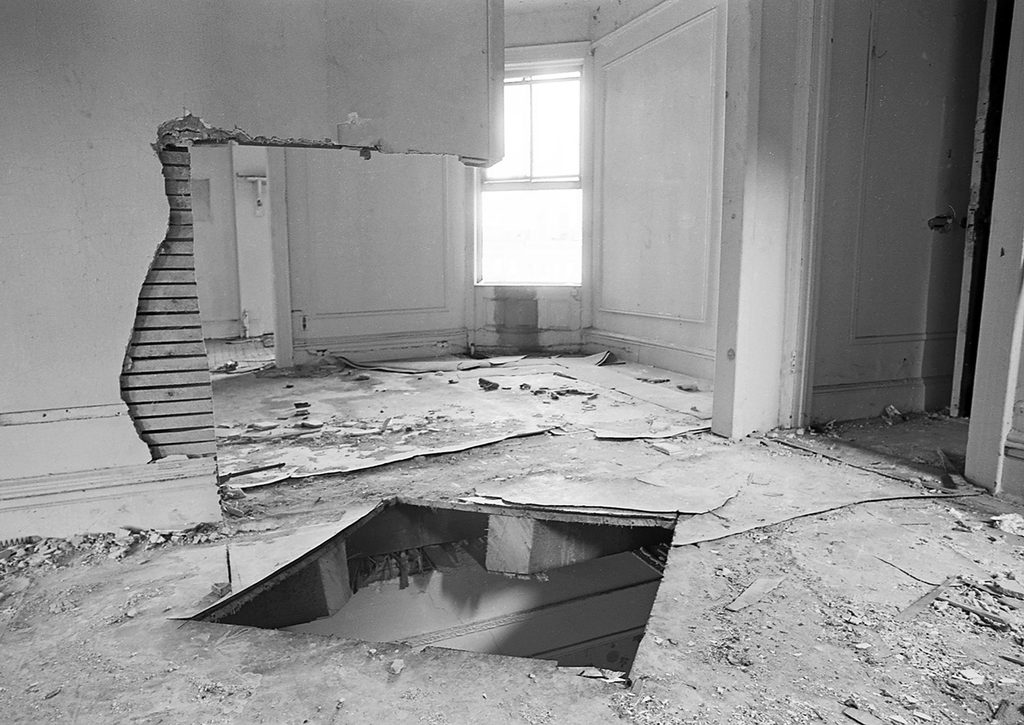
Gordon Matta-Clark, Bronx Floors, 1972–1973. © The Estate of Gordon Matta-Clark / Artists Rights Society (ARS), New York.
The book unfolds across five chapters, moving from the unmaking of gender to an aesthetics of collapse and the art of demolition, before turning to feminist practices of dereliction and, finally, the possibilities of anarchitecture within language. This progression extends the concept beyond the built environment, allowing the author to examine how different artistic and cultural practices challenge established structures of meaning, embodiment, and social organization.
The author develops his argument through art, revisiting Gordon Matta-Clark’s interventions and extending his reading to other practices that engage with cutting, absence, collapse, and indeterminacy. He distinguishes between urban demolition and demolition as artistic intervention. The former often serves real estate speculation: buildings are demolished to clear land, increase its value, and construct new properties. The latter, by contrast, can interrupt that logic and reveal the power relations that sustain architecture. Matta-Clark is central to this distinction. His cuts were not intended to produce collectible objects or permanent monuments. The artistic event consisted of intervening in a structure and altering its meanings, even when the building was destined to disappear.
There is a work that Halberstam presents in the introduction that I find particularly extraordinary in the way it brings architecture into relation with the body’s innards. It is Studio/Theater, by Yve Laris Cohen, a trans artist who, after the fire that destroyed the Doris Duke Theatre in Massachusetts in 2020, recovered some of its remains, pipes, beams, and fragments of a burned wall and brought them into a space at the Museum of Modern Art in New York. There, he presented two alternating performances, Conservation and Preservation, in which a structure of pipes was slowly raised and lowered. The artist was not attempting to reconstruct the theater or restore it to its previous condition. He was introducing the organs of a destroyed architecture into another, allowing its exposed innards to acquire a new presence. A theater within another theater, a structure that had lost its original function and yet continued to exist through its remains. Halberstam finds in this operation a relationship to the trans body, its transformations and its scars. What particularly interests me is that the work does not simply represent destruction: it makes destruction materially present. The innards are there, exposed, supported by another structure, without any need to restore them to their former shape.
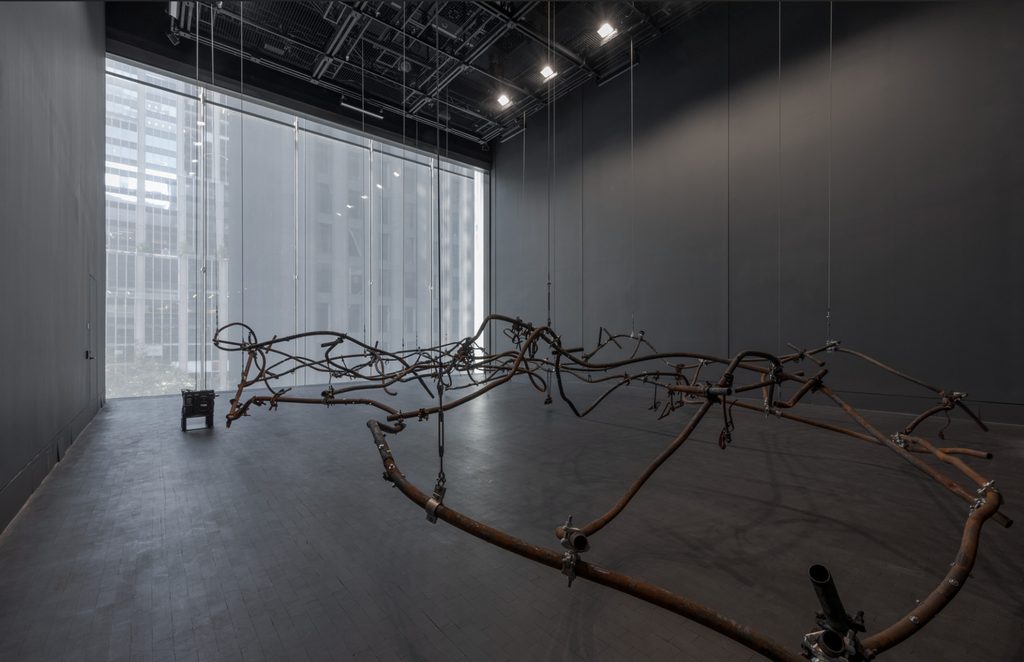
Yve Laris Cohen, Studio/Theater, 2022. Installation view, The Museum of Modern Art (MoMA), New York, October 8, 2022–January 1, 2023. Photograph by Emile Askey. Courtesy of The Museum of Modern Art, New York. Source: MoMA
The Templo Mayor of Mexico-Tenochtitlan expanded through seven successive stages, each involving the erection of a larger temple over the previous one, enclosing earlier structures within an increasingly monumental pyramid. This monumentality was made possible by political and economic power, sustained by an imperial system that subjugated other communities and demanded tribute. During the Spanish conquest in 1521, the temple was destroyed, its upper structures dismantled, and its materials reused to build the colonial city over its remains. Systematic excavations beginning in 1978 revealed the successive layers of the pyramid. Today, visitors can walk through the archaeological site, moving among the remains of these different stages and observing what had previously been concealed. It is like entering its innards, physically walking through what had been hidden.
But here a fundamental difference emerges in relation to Laris Cohen’s work: those innards were not exposed as the result of an artistic decision about conservation or transformation, but through a history of conquest, destruction, and, subsequently, archaeological excavation. There is violence inscribed in that opening. Yet the successive transformations of the Templo Mayor also remind us that altering a structure does not necessarily challenge the power that sustains it; its expansions could reinforce the authority and monumentality of the Mexica imperial order, while its later destruction formed part of the violence of Spanish conquest. This is where the comparison with Laris Cohen becomes politically significant: exposing the innards of architecture cannot, in itself, tell us whether we are witnessing an act of preservation, an assertion of power, or the consequences of its violent destruction.
The opposition between the architect and the anarchitect is fundamental to understanding the political dimension of this book. Halberstam examines how modernist urbanism, from Le Corbusier to Robert Moses and Philip Johnson, conceived of architecture as an instrument capable of ordering the city and solving its social problems, frequently through the imposition of models of life, spatial hierarchies, and criteria of functionality. In contrast to the architect who assumes the capacity to build and organize the world, the anarchitect examines structures in order to undo them. His cuts do not seek to replace one form with another, but to destabilize the systems that determine what a body, a house, or a city should be.
This proposal takes on particular complexity when Halberstam examines Gordon Matta-Clark. Halberstam notes that Matta-Clark’s biography offers little evidence of a queer sensibility and acknowledges the tensions between the artist and the gay men who frequented the piers on Manhattan’s West Side. During the making of Day’s End (1975), Matta-Clark restricted access to Pier 52, a space used for sexual encounters between men. Drawing on Jonathan Weinberg’s research, Halberstam reconsiders that relationship and proposes a queer and trans reading of the cuts, ephemeral temporality, and rejection of monumentality present in Matta-Clark’s work, without retrospectively attributing a political identity to him.
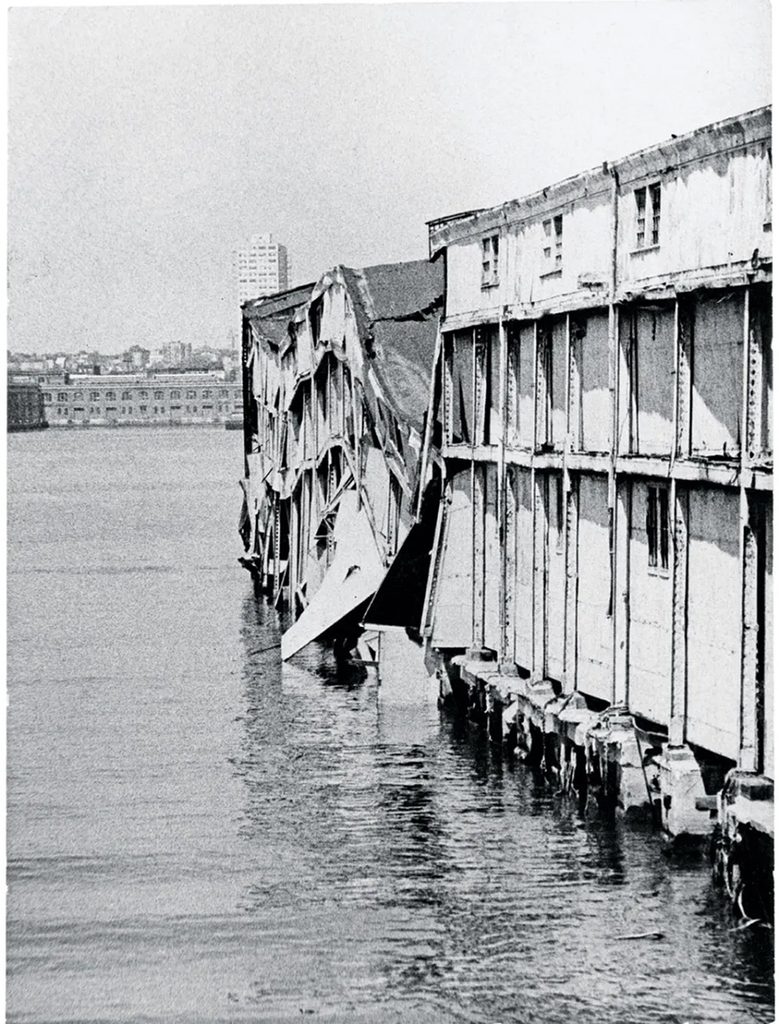
Alvin Baltrop, Untitled, The Piers (Collapsed Warehouse), c. 1975–1986. Silver gelatin print. © 2025 The Alvin Baltrop Trust / Artists Rights Society (ARS), New York.
Halberstam’s reading of these artistic practices raises questions that particularly interest me from the perspective of art history: how far can we interpret a work through perspectives its author did not necessarily share? And what experiences have been excluded from the narratives that establish certain artists as heroic figures of the avant-garde? Halberstam questions Matta-Clark’s centrality within an originally collective practice and brings artists such as Alvin Baltrop and Beverly Buchanan into the discussion, challenging the racial hierarchies through which certain practices have been recognized while others have remained marginal. His analysis also extends to Raphael Montañez Ortiz, who produces sounds by dismantling a piano in Duncan Terrace Piano Destruction Concert; Thomas Hirschhorn, who presents an architecture in collapse in In-Between; and Hans Haacke, whose Shapolsky et al. Manhattan Real Estate Holdings exposes the relationships between property, real estate speculation, and urban deterioration. These different practices question the integrity and function of objects and structures, while inviting us to reconsider how art-historical genealogies are constructed, whose experiences they privilege, and what relations of power remain inscribed within them.
Now, thinking through rupture, fissure, and dismantling, as Halberstam proposes, allows us to shift attention from the destruction of the object to the social conditions of its production and use. The book discusses Food, the restaurant and collective project developed by Matta-Clark, Tina Girouard, Carol Goodden, Suzanne Harris, and other artists, which challenged conventional distinctions between artistic production and everyday life, producers and consumers, and art and its audiences. While In-Between makes collapse visible, Food experiments with a form of social organization centered on food and collective gathering.
But what happens to ways of inhabiting that did not emerge from the order anarchitecture seeks to undo, where mutual care, food, and communal life already shaped relationships between body, territory, and space? Why must we necessarily think through ruin or dismantling? This is one of my critical questions about the book. This question leads me to challenge the modern Western separation between artistic, functional, and ceremonial objects. In different pre-Hispanic societies, these dimensions could be articulated in other ways, without disregarding their hierarchies and conflicts. I am not interested in treating these experiences as precursors to the queer or idealizing them, but in recognizing other genealogies from which to think about architecture and collective life, not by rejecting functionality or material needs, but by questioning their subordination to the logic of capitalist productivity. Considering them from this perspective would allow us to extend the concept of anarchitecture beyond the historical and cultural frameworks of the Western tradition.
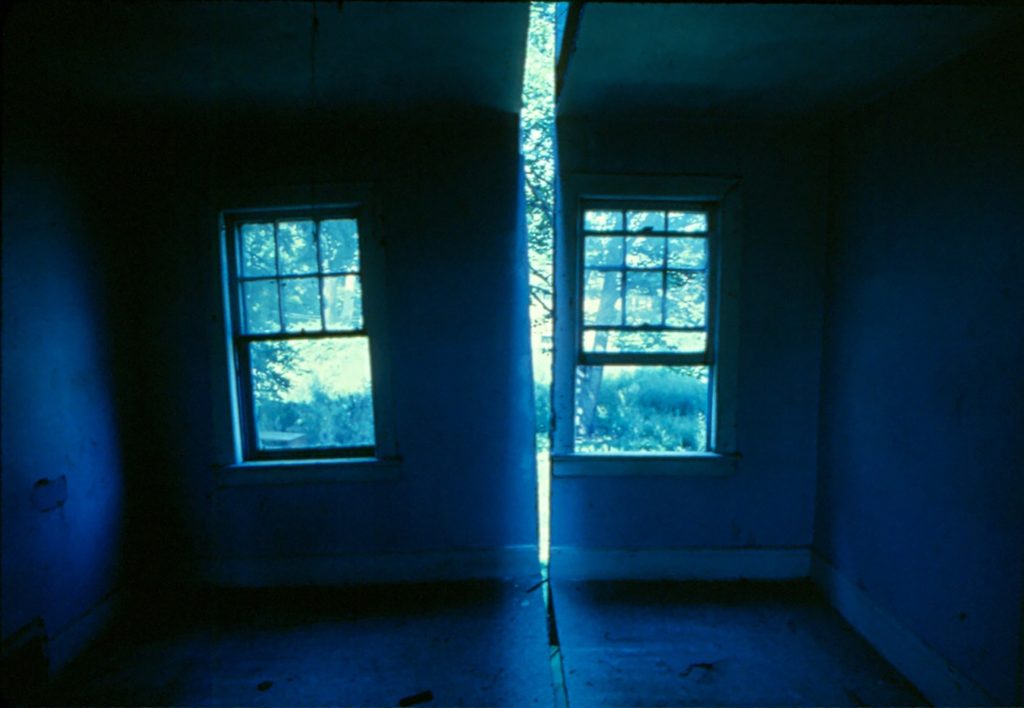
Gordon Matta-Clark, Splitting, 1974. © The Estate of Gordon Matta-Clark / Artists Rights Society (ARS), New York.
This discussion takes on a concrete dimension when the author revisits Matta-Clark’s desire to leave the studio and take to the streets. I see this as a revolutionary gesture that shifts art away from its status as an object and the centrality of its author toward direct intervention in social relations. Taking to the streets means occupying space, making oneself present, and existing outside assigned places and functions. Freedom, then, cannot be reduced to the institutional recognition of trans, queer, or nonwhite bodies that fall outside heteronormative norms; it requires transforming the conditions that determine where, how, and under what terms they can live.
This understanding of freedom beyond institutional recognition also informs Halberstam’s discussion of the spaces of collective thought explored by Fred Moten and Stefano Harney, and Ursula K. Le Guin’s novel The Dispossessed, in which freedom is no longer equated with possession. Together, these examples suggest social relations organized beyond property, productivity, and the normative family.
Halberstam explicitly acknowledges that anarchitecture is speculative and does not offer a political program. He distinguishes Matta-Clark’s material voids, which challenge the art market and real estate speculation, from Lee Edelman’s queer negativity, directed against the reproduction of the social order. He also discusses the communal living arrangements of queer and trans immigrants in precarious conditions, as studied by Martin Manalansan, whose collective reorganization of domestic space challenges normative conventions without eliminating the material conditions in which they live. Nevertheless, I believe his proposition contains the seeds for questioning a social order founded on the distinction between the human and the nonhuman. From my perspective, its greatest potential lies in the possibility of imagining a society beyond the Western conception of the human, historically racialized, white, and heteronormative. Here I find an emancipatory possibility, although I do not want to approach it with naive optimism. A fundamental question remains: are we capable of assuming the responsibility of building ways of living together, among ourselves and with the nature in which we are immersed and of which we are part, while recognizing all the complexities and contradictions this entails?
With my mother doing much better, I left Cali after a couple of weeks. The city had changed little, and many people were still living in camps. I returned to New York with the questions raised by the book and the images of collapsed buildings that, until recently, had been people’s homes. The battle with insurance companies to get them to begin paying for repairs had already begun.
In Anarchitecture After Everything, Halberstam proposes that fissures, wounds, and scars do not necessarily demand repair. Through anarchitecture, he approaches the trans body not as something to be corrected or accommodated within the structures that have historically excluded it, but as a body whose transformations challenge the very notion of a fixed human identity. Perhaps it is not trans, nonbinary, racialized, and other bodies excluded by dominant norms that must adapt to the existing social order, but that order that must be reconsidered through an understanding of human existence as continually changing. Halberstam brings this proposition into the field of art, connecting the dismantling of architectural structures with the transformation of bodies and social relations. From feminist, queer, and trans perspectives, he revisits established artistic genealogies and reconsiders how art, its spaces, and its histories might be understood beyond the expectations of permanence, integrity, and repair.
I propose two complementary readings of the book: one that recognizes its contribution to art criticism and historiography, and an expanded reading that brings anarchitecture into a broader dialogue with the Western construction of the human and its racial and colonial hierarchies. Halberstam already engages with these questions, but his proposition also allows us to consider artistic and cultural practices, conceptions of the body, and ways of inhabiting space that emerge from other historical and cultural genealogies, including those that do not necessarily begin with destruction or dismantling. What would it mean to rethink ourselves and our relations with others without taking these inherited definitions and hierarchies as our point of departure? It is in this possibility that I locate the book’s emancipatory potential.
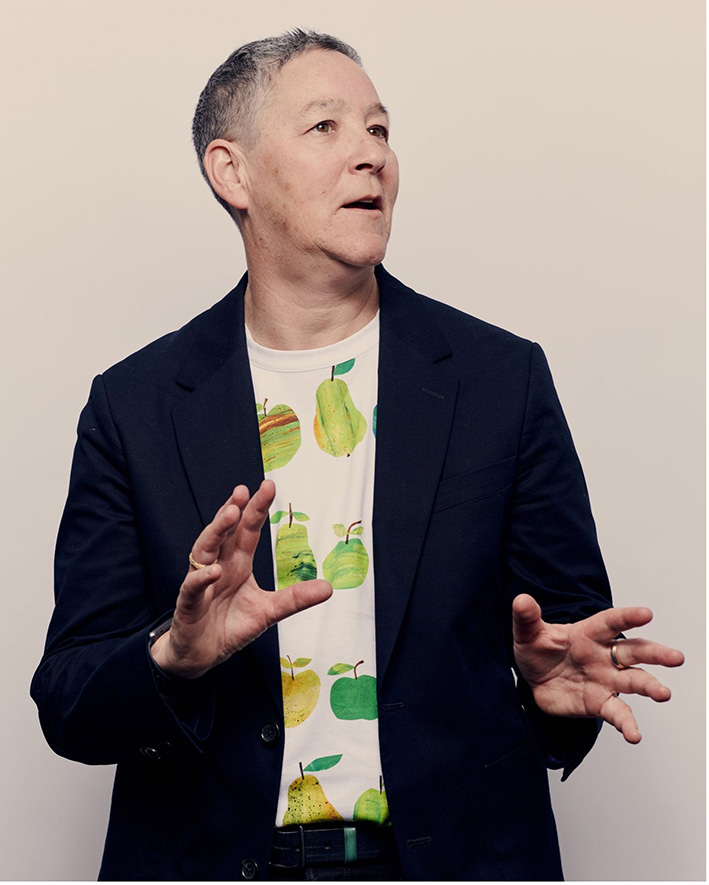
Jack Halberstam is the David Feinson Professor of Humanities at Columbia University in New York. His research spans queer theory, gender and sexuality studies, visual culture, film, and feminist theory. He is the author of Female Masculinity (1998), In a Queer Time and Place (2005), The Queer Art of Failure (2011), Gaga Feminism (2012), Trans: A Quick and Quirky Account of Gender Variance (2018), and Wild Things: The Disorder of Desire (2020), among other books.
In 2018, he received the Arcus/Places Prize for his contributions to public discussions of gender, sexuality, and the built environment, and in 2024, he was awarded a Guggenheim Fellowship. His most recent book, Anarchitecture After Everything: A Trans Manifesto (MIT Press, 2026), examines the relationships between anarchitecture, transformations of the trans body, and the material and social structures that organize space.