Ghosts: Visualizing the Supernatural at the Kunstmuseum Basel
By Nekane Aramburu
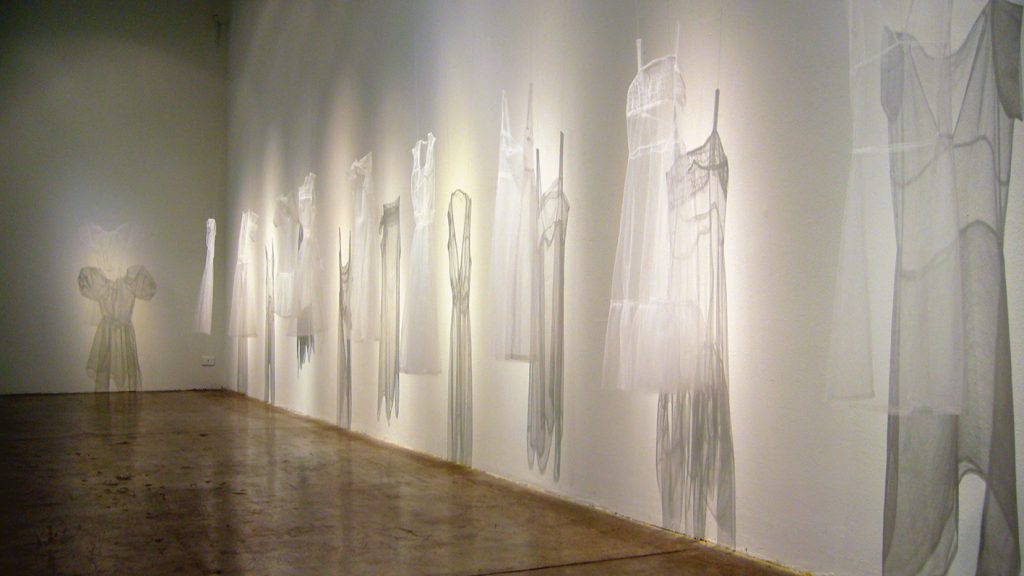
Claudia Casarino. Desvestidos [Undressed], 2005. Eight tulle dresses, variable dimensions. Collection of the artist. Photo: Claudia Casarino.
This March marks the closing of the exhibition Ghosts: Visualizing the Supernatural at the Kunstmuseum Basel. It is always a pleasure to return to this city and visit its museums, beyond the traditional pilgrimage to Art Basel in June, since, among other art institutions, the Kunstmuseum stands as a cultural pillar housing, within its vast space, the oldest public art collection, consolidated since the 17th century and in constant dialogue with the present. It is therefore unsurprising that the museum has opted to produce an engaging exhibition that alternates historical works with contemporary pieces, curated by its chief curator Eva Reifert, who brought together two experts on the subject of spirits: the British historian Susan Owens and the German Andreas Fischer, a specialist in the field of ghost photography, or spirit photography.
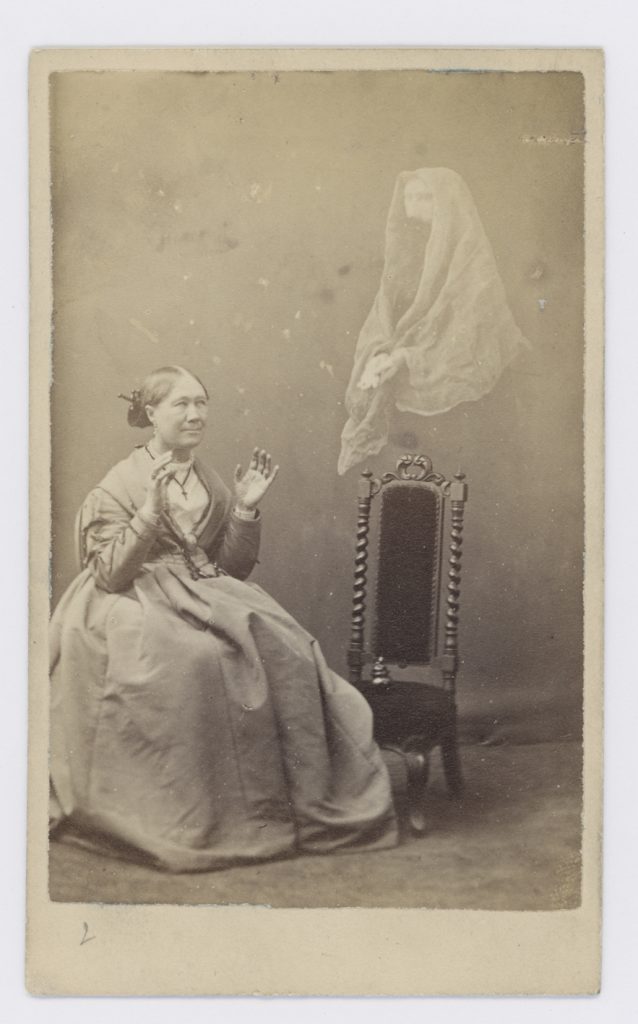
Frederick Hudson. Georgiana Houghton with a Spirit, ca. 1874. Albumen print mounted on card, 10.4 × 6.3 cm. Institut für Grenzgebiete der Psychologie und Psychohygiene, Freiburg i. Br. Photo: Institut für Grenzgebiete der Psychologie und Psychohygiene.
Nevertheless, the Basel project does not reach the depth of that other major encyclopedic exhibition on the invisible and the supernatural entitled Europe des esprits ou La fascination de l’occulte (1750–1950), which I had the opportunity to see at the Musée d’art moderne et contemporain in Strasbourg in 2011. That exhibition, co-produced with the Zentrum Paul Klee in Bern, explored the influence of the occult on art, thought, and the sciences, introducing spiritualism, theosophy, and anthroposophy as elements that shaped European modernity and influenced the genesis of modern art and abstraction. Moreover, in recent years there has been a curatorial exploration of the invisible that has opened the field to exhibition projects of diverse kinds across a wide range of institutions[1].
As for the exhibition in Basel, it is primarily oriented toward the visual representation of ghosts and the traces of the supernatural in art, focusing especially, from an iconographic standpoint, on the image of specters, something that took root in Western visual culture through the late 18th-century Gothic revival and in the Romantic and spiritualist movements of the late 19th century. The earliest work in the exhibition is Benjamin West’s painting Saul and the Witch of Endor (1777), which introduces one of the project’s central axes: sheeted spirits. The representation of ghosts draped in the typical white sheet recurs throughout the exhibition (alternating with ectoplasms of various kinds) in different contemporary versions, for example in the striking Geist und Blutlache (1988) by Katharina Fritsch, alongside works by Ryan Gander (Tell My Mother Not to Worry, 2012), Tony Oursler (Fantasmino, 2017), and Erwin Wurm (Yikes. Substitutes, 2024)
In contrast to these explicitly rendered forms, some conceptual works “appear,” among them the poetic installation by Claudia Casarino, Desvestidos [Undressed] (2005). As in previous projects, the Paraguayan artist suspends dresses in the air that float like empty apparitions, moving as passersby disturb the surrounding atmosphere. In Casarino’s case, this bodily stripping also directly alludes to issues that confront us with violence against women embedded in patriarchal systems, feminicide, and glass ceilings. It is not the first time that Claudia, far removed from “esoteric” themes, has been included in an exhibition of this kind alongside Georgiana Houghton. In 2023 they coincided in Georgiana’s Echoes, a contemporary art exhibition with Victorian roots that I curated at Centro de Arte La Regenta and at Instituto Canarias Cabrera Pinto.
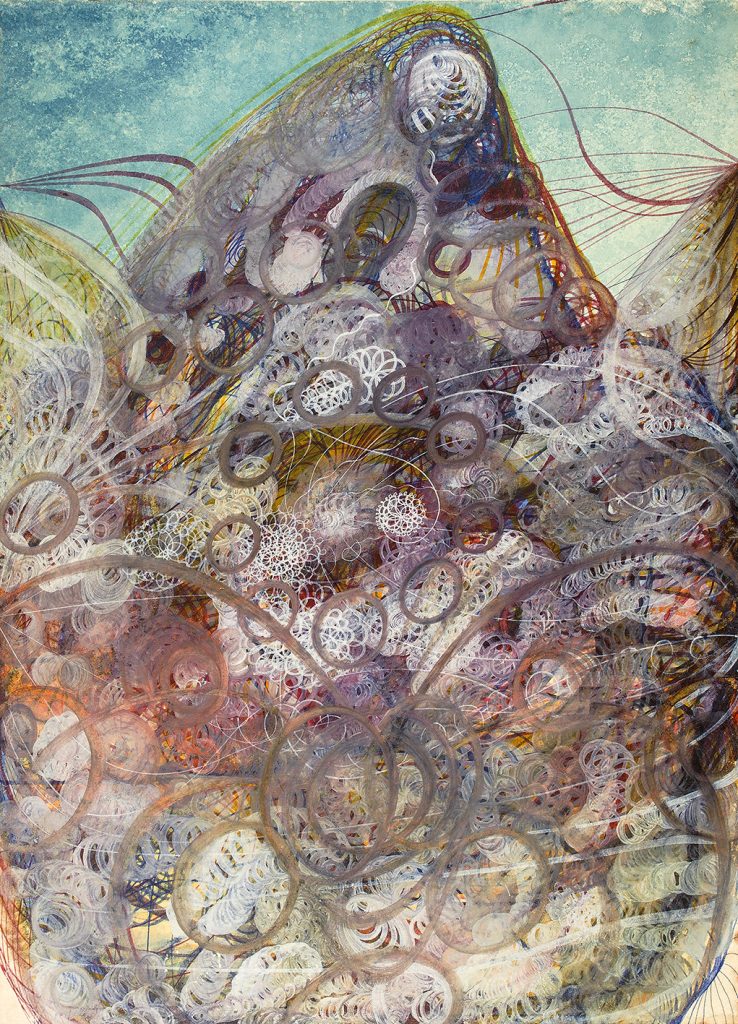
Georgiana Houghton, The Spiritual Crown of Annie Mary Howitt Watts, 1867. Watercolor and gouache with pen and ink on paper mounted on board, 33 × 24 cm. Collection of Vivienne Roberts, London. Courtesy of Vivienne Roberts.
I would therefore like to focus particularly on Georgiana’s work, which has only recently begun to receive recognition, much like Hilma af Klint’s—both for similar reasons: being overlooked women, practicing abstraction in a pioneering way, and working as artist-mediums[2]. Georgiana Houghton was born in Las Palmas de Gran Canaria in 1814 and died in London in 1884. From 1851 onward she developed an intense artistic production, primarily drawings and watercolors, while cultivating an interest in spirit photography. She had been advised, during a séance in a medium’s home, to obtain her own planchette, and from that point she began introducing color into her artistic practice, continuing tirelessly in absolute solitude[3].
In 1872 she met Frederick Hudson, a professional photographer who gained some fame for his spirit images, although he was soon accused of fraud and expelled from mediumistic circles in 1874, which consequently affected Georgiana’s reputation, as she had agreed to participate in his photographs. (The exhibition includes a large-scale reproduction of her posing for Hudson.)
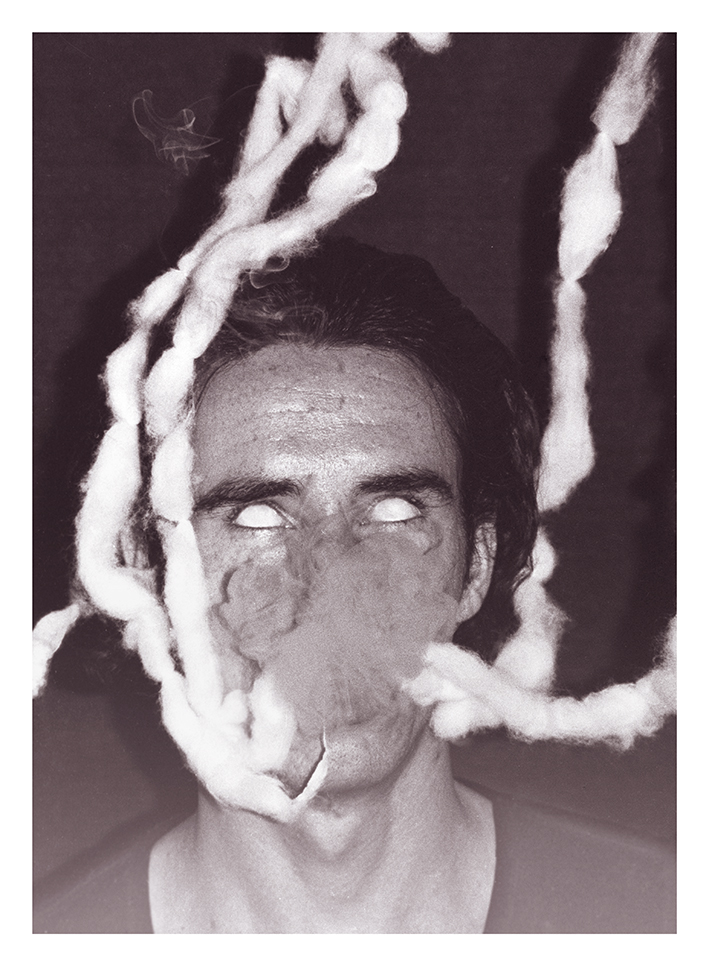
Mike Kelley, Ectoplasm Photograph 5 (1 of a series of 15 photographs), 1978/2009. Chromogenic print, edition of 5 (+1 AP), 50 × 40 cm. Courtesy Mike Kelley Foundation for the Arts. © Estate of Mike Kelley.
In any case, it is worth recalling that in the 19th century, spirit photography reached a high level of interest, particularly following William H. Mumler’s first self-portrait in Boston (1861), produced through double exposure on daguerreotype plates. Photographic practices such as superimposition in stereoscopic series multiplied within a few decades, expanding exponentially alongside popular enthusiasm for doctrines and gatherings of channelers. Thus, we find statements such as: “Photography is a medium placed at the disposal of spirits, so that they may provide irrefutable proof of their presence among us,” written by Pierre Gaëtan Leymarie, editor and successor to Allan Kardec. A philosophy and a set of communicative forms that remain to be fully explored, and through which certain basic concepts are conveyed, as Vilém Flusser reminds us: “image–apparatus–program–information.”[4]
Georgiana’s work presents two distinct lines of interpretation: the painted piece, always small in scale, and the reverse side, where she indicates the guiding spirits that accompanied her in its channeling. Despite the difficulty of locating her work, it has been possible to include an extraordinary piece, The Spiritual Crown of Annie Mary Howitt Watts (1867), belonging to one of her principal collectors, the specialist Vivienne Roberts.
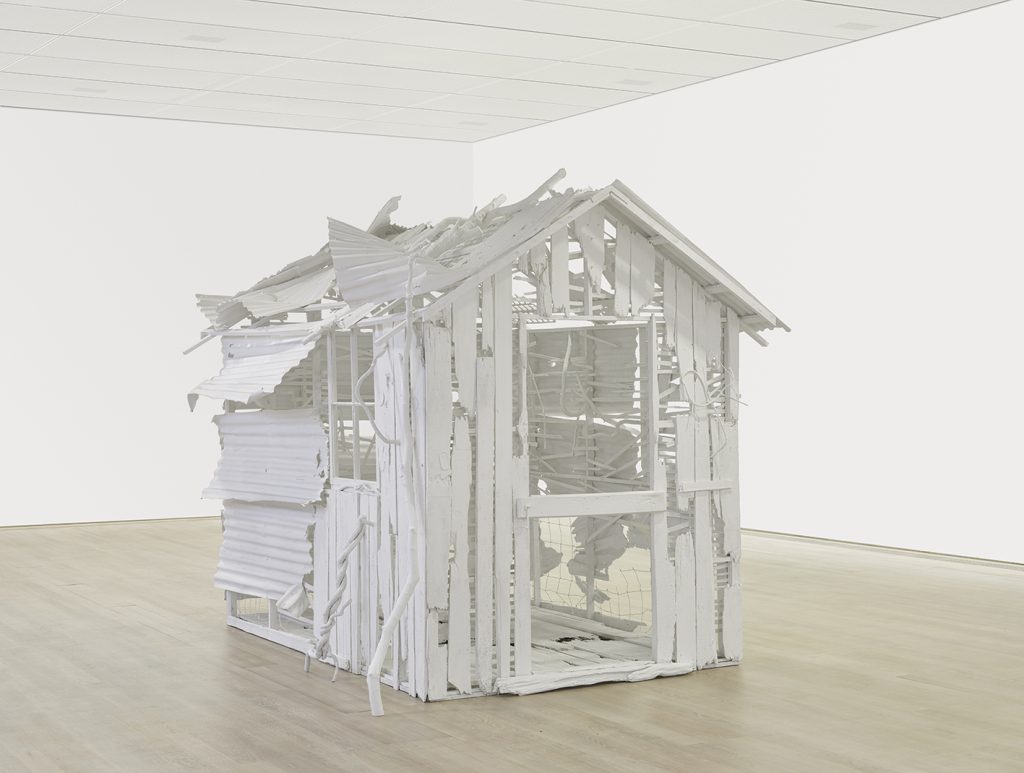
Rachel Whiteread. Poltergeist, 2020. Corrugated steel, beech, pine, oak, domestic paint and mixed media, 305 × 280 × 380 cm. Fondation Beyeler, Riehen/Basel. Photo: Robert Bayer, Basel.
Madge Gill’s work is also guided by spirits, like Georgiana’s; in her case, under the name Myrninerest, we encounter faces emerging from patterns resembling textiles. Similarly, Susan MacWilliam, in her video work The Last Person (1998), revisits the relationship with the ectoplasms of the medium Helen Duncan (the last person in Great Britain to be tried and convicted in 1944 under the Witchcraft Act of 1735).
Beyond these shared features, the curatorial narrative also focuses on the energetic resonances of past memories contained within buildings. This is clearly manifested in works such as PsychoBarn (Cut Up) (2003) by Cornelia Parker, which presents a fragmented replica of the set of Psycho[5], suspended along the walls of a museum gallery. For this reason, given the proximity to these themes, it was inevitable to include a project by Rachel Whiteread, who in 1990, at the age of 27, created Ghost (a key work in art history manuals) by casting the interior of a Victorian living room in plaster. Here, Poltergeist (2020) is presented, another significant work produced in a later phase, in which she has abandoned her technique of casting negative space in favor of a method of direct assemblage.
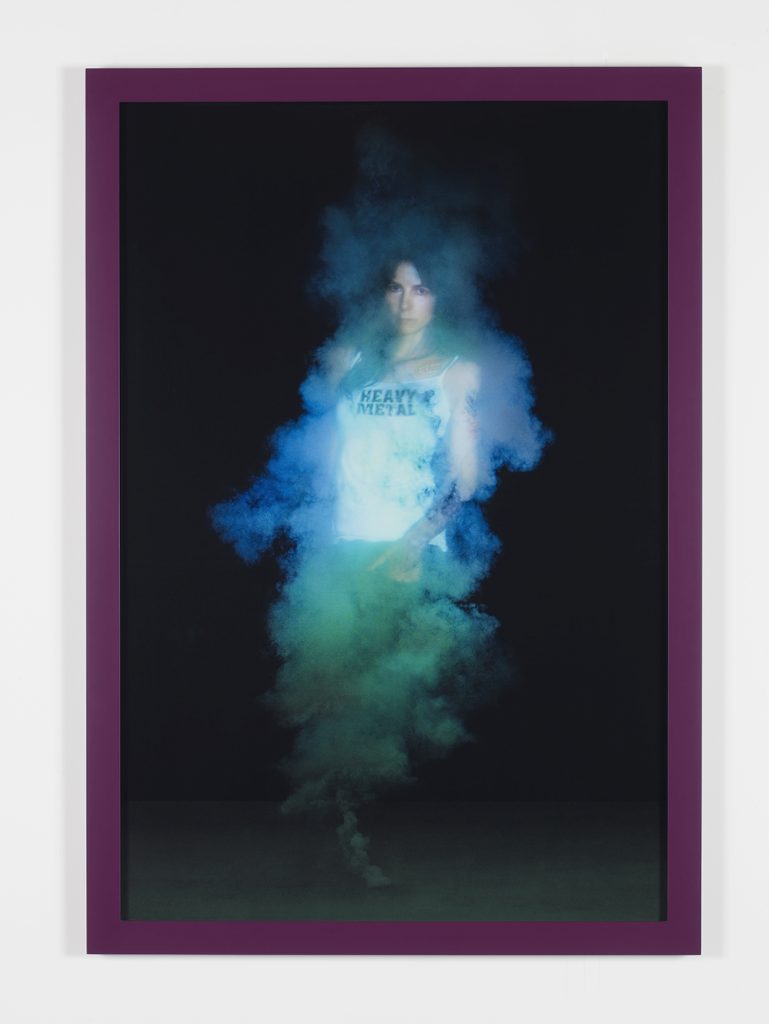
Gillian Wearing. Me as a Ghost, 2015. C-type print, 131.5 × 91.5 cm. Lent by the Royal Academy of Arts, London. © The Artist. Photo: Prudence Cuming Associates Ltd.
In summary, this is a broad visual panorama exemplifying the cultural integration of communications between the world of the dead and that of the living, now normalized in literary and cinematic fictions, and ultimately incorporated into the art system through renewed readings of the work of medium-artists and other creators who address situations linked to invisible parallel realities. And yet, one still misses the spectral appearance of Catherine Earnshaw in the recently released film adaptation of Wuthering Heights, directed by Emerald Fennell (based on a subjective reinterpretation of Emily Brontë’s novel—if only to add a touch of humor), as well as a deeper revision of so-called “Art History” through broader and more transversal critical frameworks.
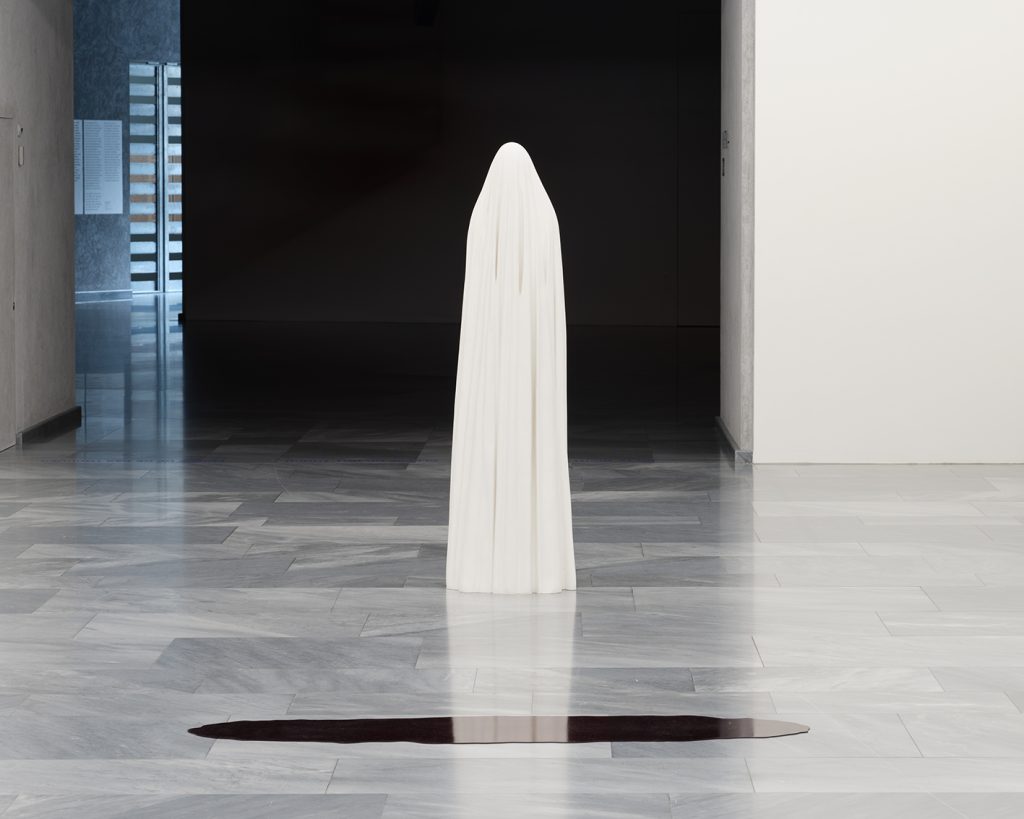
Katharina Fritsch. Geist und Blutlache, 1988. Painted polyester and lacquered plexiglass, 200 × 61 × 61 cm (figure); 3 × 209.4 × 53.2 cm (blood pool). Philadelphia Museum of Art: Promised Gift of Keith L. and Katherine Sachs. © 2025 ProLitteris, Zurich. Courtesy Matthew Marks Gallery.
[1] Consider, for instance, the 55th Venice Biennale, directed by Massimiliano Gioni, which presented Il Palazzo Enciclopedico, bringing together more than 150 artists engaged with spiritual themes and marking a significant opening within the art system toward such lines of inquiry. Similarly, in 2019, the exhibition Alma was presented at Es Baluard Museum—its first appearance in Europe—curated by Pilar Bonet, and featuring 17 European women artists born in the decades preceding the end of the First World War (1918), under the premise of spiritualities informed by esoteric practices.
[2] Her artistic production, only partially recovered, remains incomplete; a body of work that in recent years has captivated a range of intellectuals and artists. In general, she has been positioned as a pioneer of abstract art (arguably as early as 1859), given that she chronologically predates Hilma af Klint (1862–1944).
[3] Houghton’s work destabilizes abstraction—a concept that remained unknown to her during her lifetime—therefore rendering any attempt to classify her work through later artistic frameworks and historical constructs
[4] Flusser, Vilém. Towards a Philosophy of Photography. London: Reaktion Books, 2012.
[5] The design is a scaled replica of the iconic house from Alfred Hitchcock’s Psycho, itself inspired by Edward Hopper’s painting House by the Railroad.