By Wei Huang
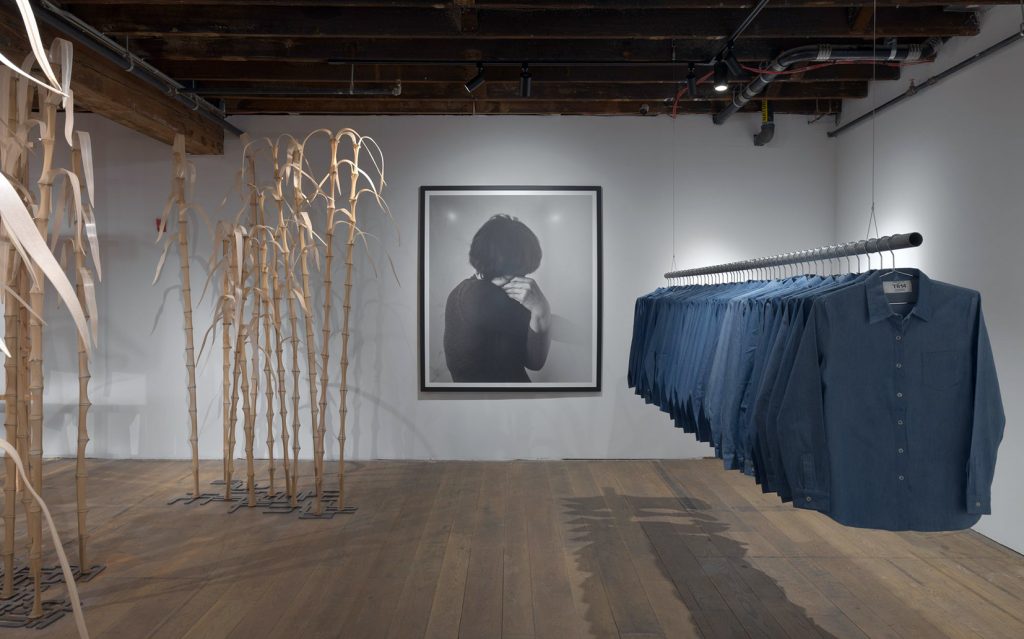
(Left) Serena Chang, Sweet Water, 2024. Hosiery, steel, PETG plastic, dimensions variable. (Center) Huang Po-Chih, Blue Elephant—Mother, “Wanting falls around me. Heavy garment, but I can be a floating elephant in my dream.”, 2018. Photograph, 140 × 160 cm. (Right) Huang Po-Chih, Production Line—Made in China & Made in Taiwan, 2014. Denim and mixed media, dimensions variable. Courtesy of Pioneer Works.
What lies in the intersectional locus of history, diaspora, and fashion? At Pioneer Works in Red Hook, Brooklyn, the former iron warehouse raises this question with The Endless Garment: Atlantic Basin, the third and latest iteration of curator Jeppe Ugelvig’s Endless Garment series. Aimed at critically approaching the fashion industry as a convergent network of culture, society, and economy by assessing the making of “Asianness” from supply chain to distribution, the two previous editions, which took place at the X Museum in Beijing, examined how new styles are shaped by the globalization of the fashion industry and sought to dispel the orientalistic gaze on the “Asian aesthetic” monolith.1 Honoring Red Hook’s past as a center of international freight transportation and the crucial contribution of Asian immigrants to fashion manufacture, the exhibition at Pioneer Works foregrounds the interlocking histories of New York’s textile industry and Asian immigration as a thematic anchor of its diasporic narrative.
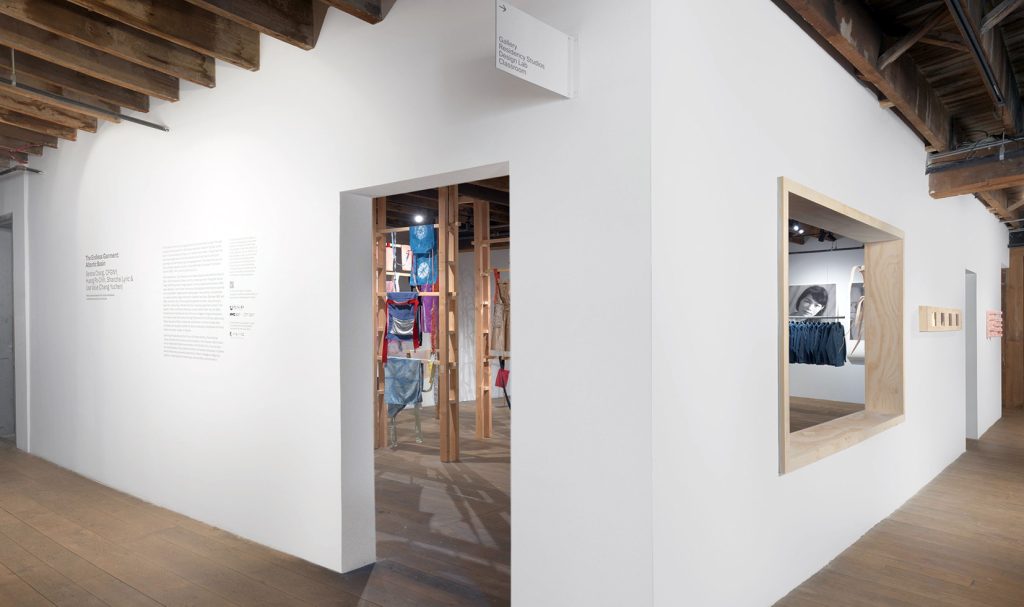
Installation view, The Endless Garment: Atlantic Basin, Pioneer Works, New York. Courtesy of Pioneer Works.
The exhibition presents a relatively compact roster of five participating artists and artistic collectives, alongside four designers. Spread across two floors are Serena Chang’s installations. Born a second-generation immigrant whose Taiwanese father established the family’s hosiery brand after immigrating to Queens, Chang’s works construct an identitarian narrative of race, labor, fashion, and migration. Scattered across the exhibition are her apparitional sculptures, Sweet Water (2024), which assume the silhouettes of sugarcane shaped by hosiery and supported with metal skeletons. The work establishes a material and historical relation between sugarcane, a major profit crop of Taiwan in the early twentieth century, and a local crop of Chaozhou, China, where Chang’s father is originally from, and hosiery, part of the textile industry that consolidated Taiwan’s economy in the 1950s. This relation situates the work within a longer history of industrial and familial entanglement.
In the multi-part Marathon (986-P3) (2025), a plastic shell encases an intricate ensemble of wires, printed circuit boards, and cardboard wrapped with hosiery advertisement prints, embedded with a video vignette of her family’s hosiery factory. Evoking commercial packaging, the work frames cargo shipping as a metaphor for the expansion of familial and diasporic histories. The final component of Marathon is an immersive sound installation situated in the stairwell. It complements the sculptures by drawing analogies between the physical and the psychological, transforming the transitional space into a liminal site of Chang’s mindscape.
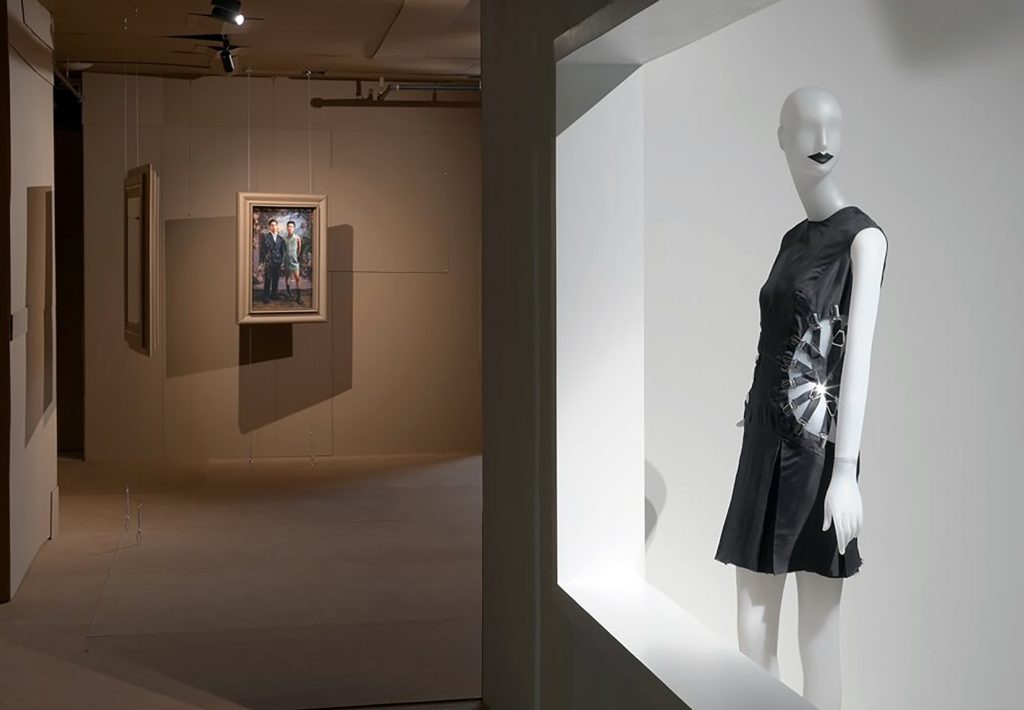
Installation view, The Endless Garment: Atlantic Basin, Pioneer Works, New York. Courtesy of Pioneer Works.
Drawing on her familial affiliation with the textile industry to trace lineage, Chang’s works condense the exhibition’s broader attempt to articulate diaspora through lived experience. However, as Annette An-Jen Liu notes in her review, the exhibition materials repeatedly omit relevant information about the artists and the works.2 The unusual metal bases of the Sweet Water sculptures, for instance, are fragments of “me” and “you” in Chinese seal script, referencing a typographic form used between 700–200 BCE. While this gesture invokes deep historical and cultural roots, its relation to Taiwan as a site of inherited memory remains largely implicit. Similarly, the sound installation of Marathon includes the call of the Taiwan barbet, a bird endemic to the island, an element that remains unarticulated within the exhibition’s interpretive framework. Under these conditions, Chang’s layered synthesis of labor, economy, migration, and lineage risks becoming partially illegible.
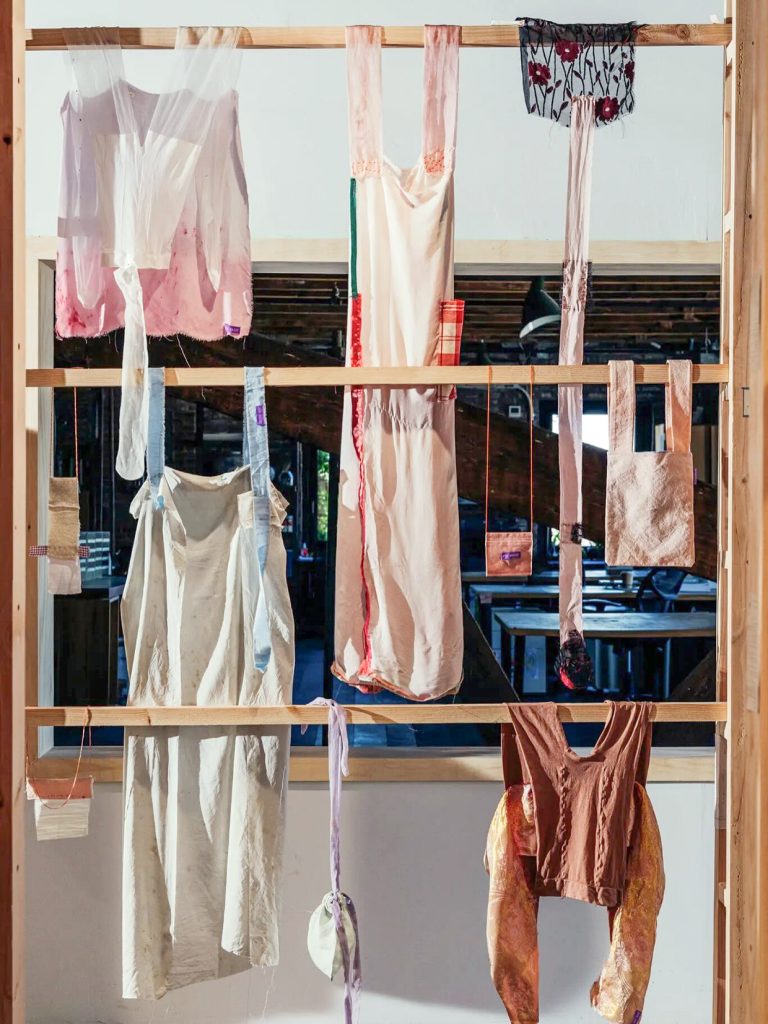
Chang Yuchen, Use Value, 2016–26. Hand-sewn garments, paper ephemera, and wood, dimensions variable. Courtesy of Pioneer Works.
Accompanying Chang’s ensemble, Chang Yuchen and Huang Po-Chih’s works are placed in direct dialogue in the main gallery, each addressing distinct dimensions of textile production. Working under the moniker Use Value, Chang Yuchen presents hand-sewn garments annotated with sticky notes detailing their cost. These calculations account for stages of production, including both physical and mental labor, alongside the hourly wage she earned at the time of making. The practice foregrounds the often-invisible labor embedded in intimate objects such as aprons, dudous, and pouches.
Paralleling this approach, Huang Po-Chih’s installation assembles texts, photographs, and ready-made clothing. Centered on Production Line, Made in China & Made in Taiwan (2014), which consists of a series of identical denim shirts, Huang draws on his mother’s experience as a factory worker and Taiwan’s textile history. Surrounding the garments are photographs and a textual account describing how factory labor shaped her identity and daily life. While the dialogue between Chang Yuchen’s quantification of labor and Huang’s human-centered narrative is compelling, the exhibition materials once again omit key contextual details, limiting the curatorial framework’s capacity to sustain this exchange.
Originally exhibited at the 2014 Taipei Biennial, Production Line involved garments partially manufactured in Shenzhen and completed by Huang’s mother on site, mapping the historical shift of textile production from Taiwan to China. Hung on a rack marked “Made in USA,” the standardized shirts reflect the dispersed geography of global textile manufacturing. In Blue Elephant—Mother (2018), Huang’s mother mimics the posture of an elephant, echoing a nearby account in which she compares her swollen legs to those of the animal. This association extends to Lin Wang, a war elephant later relocated to Taiwan, whose symbolic status oscillates between labor endurance and state propaganda.3 While Huang’s work excavates the historical depth of Taiwan’s textile industry through lived experience, the limited curatorial framing weakens its legibility.
On the second floor, the exhibition concludes with a showroom displaying the archives of the collective Shanzhai Lyric, formed by Ming Lin and Alex Tatarsky. The duo gathers garments bearing altered luxury brand names, treating these items not merely as counterfeits but as propositions that unsettle conventional notions of authorship, ownership, and taste. Yet access to the viewing room is restricted, and the altered texts remain only partially legible from a distance, echoing the instability of authenticity that the works themselves address.
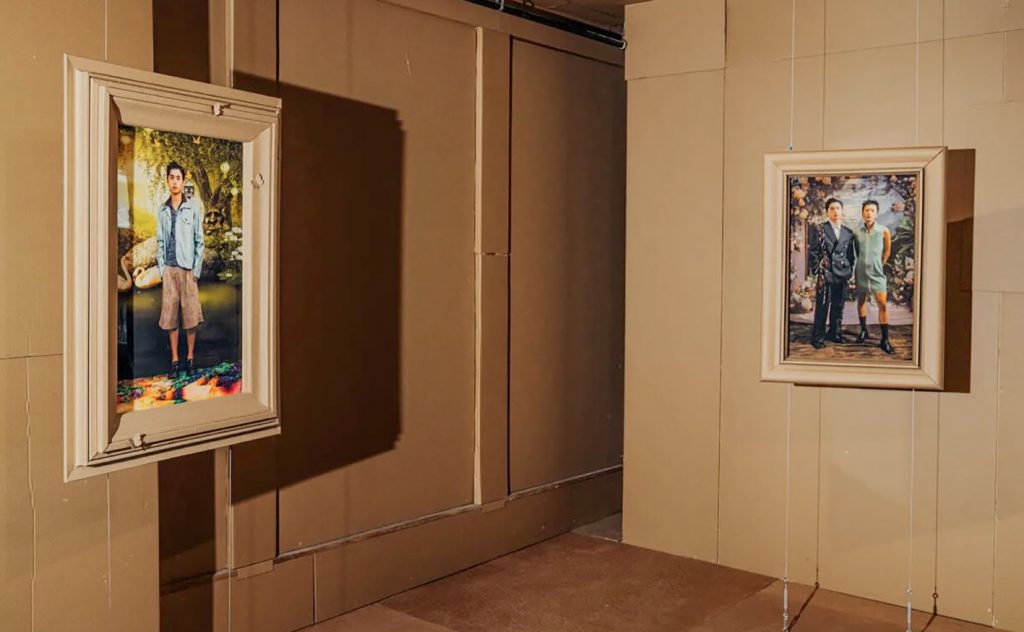
CFGNY, Studio Quý Nguyễn and (VI) Studio Quý Nguyễn (II), 2025. Digital print with cardboard frame, dimensions variable. Courtesy of Pioneer Works.
The third floor presents the work of the Asian American collective CFGNY, known for its “Vaguely Asian” lens on diasporic identity. Displayed against cardboard structures that evoke freight circulation, the installation includes photographs taken in Ho Chi Minh City alongside garments produced by designers engaging similar questions of identity and migration. However, the collaborative dimension of the project is insufficiently articulated: the garments were produced by local Vietnamese tailors, some of whom contributed creatively.4 While the title Studio Quý Nguyễn signals this participation, the exhibition materials largely attribute authorship to CFGNY. As a result, the project’s attempt to foreground the relationship between artists and labor is partially obscured, placing it in tension with the exhibition’s stated aims.
Despite its modest scale, the exhibition assembles works that carry significant conceptual potential. Through personal narratives, they trace the entanglement of labor, migration, and textile economies, suggesting how fashion operates as a site where identity is both constructed and transformed. Yet the limited contextualization across the exhibition constrains the development of these connections, weakening the coherence of its broader argument. The Endless Garment: Atlantic Basin gathers a set of myriad yet compelling thematic threads, but the framework needed to articulate their intersections fully remains only partially unraveled.
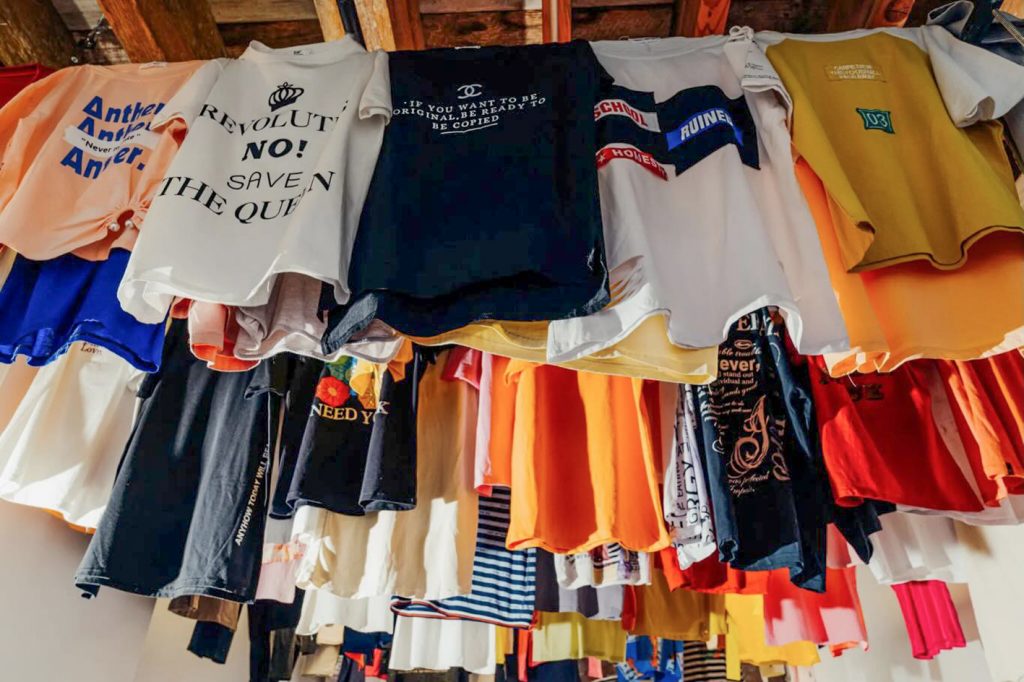
Shanzhai Lyric, Untitled, 2015–26. Garments and mixed media, dimensions variable. Courtesy of Pioneer Works.
- From the curatorial statements of the previous exhibitions at X Museum, Beijing: https://xmuseum.org/en/exhibition/the-endless-garment-research-station/ ↩︎
- Annette An-Jen Liu, “The Endless Garment: Atlantic Basin,” The Brooklyn Rail, March 2026, https://brooklynrail.org/2026/03/artseen/the-endless-garment-atlantic-basin/ ↩︎
- From the artist page of Huang’s representing gallery: https://yiriarts.com.tw/en/art-fairs/88/ ↩︎
- Ming Lin, “A ‘Vaguely Asian’ Clothing Enterprise,” Yin Xiang, vol. 1, May 2021. ↩︎