Jeremias Rumpl, Diego Azzola, and Huang Zhe. Curated by Fanfan Yuxuan Fan at AAIE Center for Contemporary Art, Rome.
By Serena Hanzhi Wang
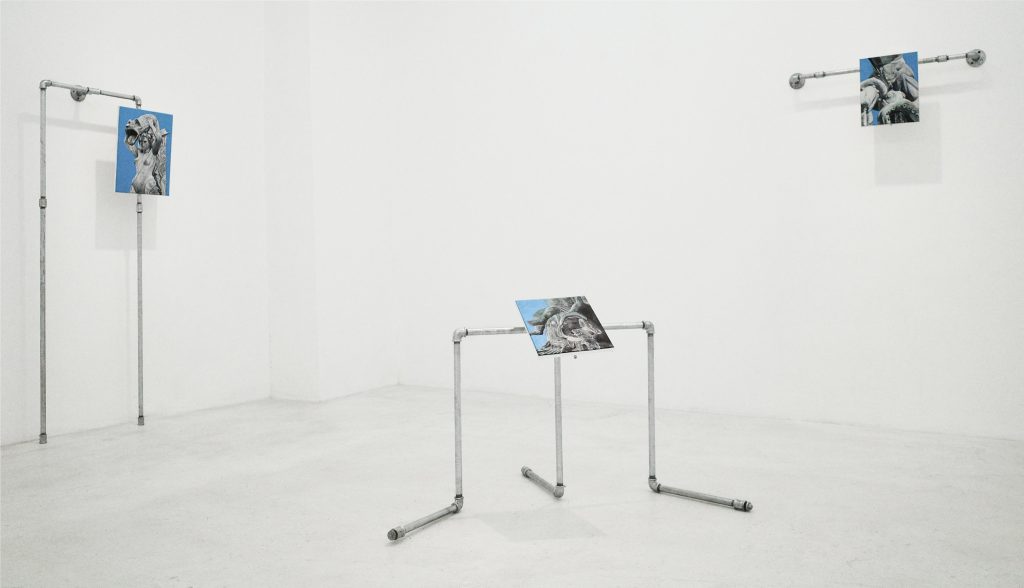
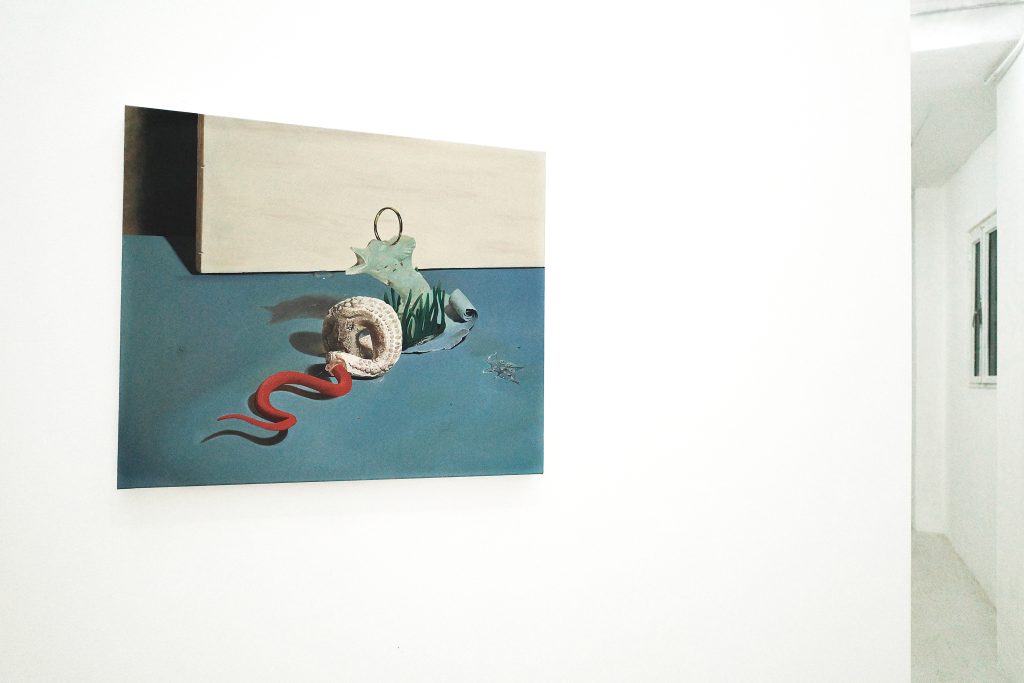
Installation view of He Spoke To The Birds, Rome. Artist: Diego Azzola. Curated by Fanfan Yuxuan Fan. Courtesy of AAIE and FanFlus.
Italy is often imagined through the monuments of its past. Ancient ruins, Renaissance architecture, and luxury fashion have become inseparable from the country’s image abroad. In recent years, however, like much of the Western world, Italy’s history has become an increasingly contested political terrain, as debates surrounding migration, sovereignty, and historical memory have returned to public life. Few cities embody this paradox more fully than Rome, where order has always emerged through accumulation rather than resolution. Ancient aqueducts still carry water beneath contemporary streets, imperial ruins interrupt the urban fabric, and infrastructures separated by centuries remain in daily use. It is within this historical landscape that He Spoke To The Birds, curated by Fanfan Yuxuan Fan at AAIE Center for Contemporary Art, returns to Arte Povera.
It is easy to forget that Italy once imagined its future through factories, highways, hydroelectric projects, and mass production. During the postwar Italian Economic Miracle, steel, reinforced concrete, electricity, and hydraulic engineering became the material language of modernization. Industrial production promised a society organized through technological progress. By the late 1960s, however, that confidence had begun to fracture. Student movements, labor unrest, and growing skepticism toward industrial capitalism transformed Italy into one of Europe’s principal sites of political and cultural unrest. It was within this context that Germano Celant coined the term Arte Povera in 1967.
Fan loves Arte Povera less as a historical movement than as a way of organizing materials. Throughout the exhibition, zinc, smoke, and water function not as quotations from the movement but as active agents whose physical transformations exceed stability and control. That logic extends into the exhibition architecture itself. Galvanized pipes weave through the gallery, linking Diego Azzola’s paintings into a spatial network that quietly recalls both the industrial infrastructures from which Arte Povera emerged and Rome’s much older hydraulic systems.
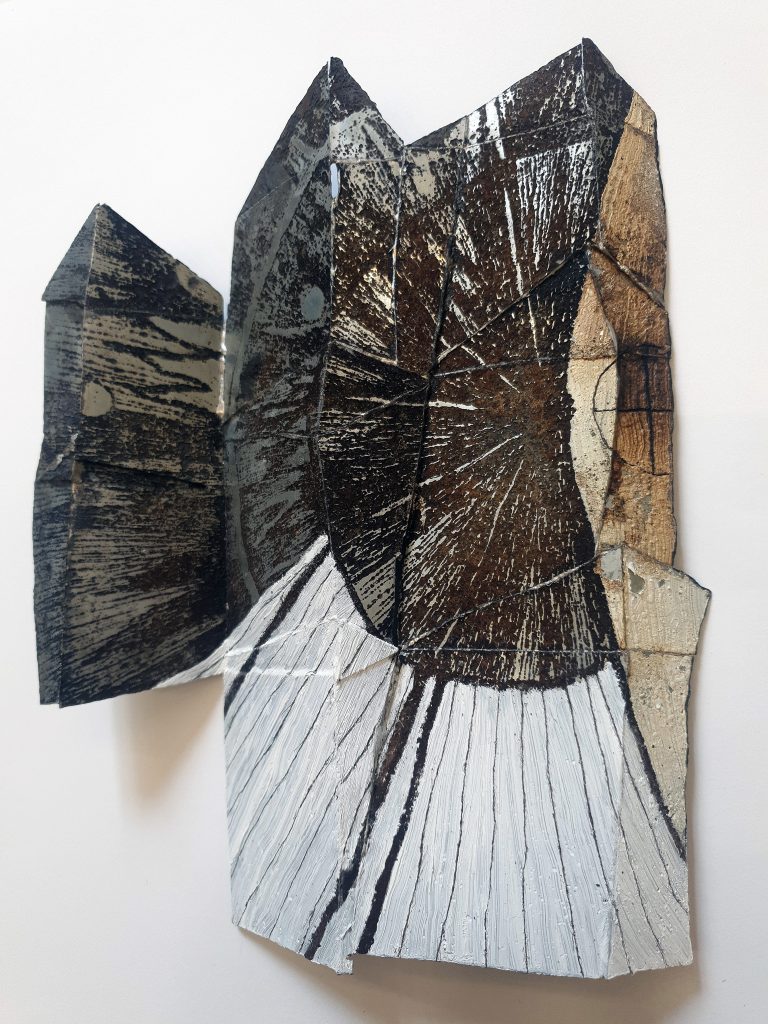
Jeremias Rumpl, Apartment block, 2024. Oil on zinc plate, 7 9/10 × 9 2/5 in.
Austrian artist Jeremias Rumpl (b. 1992), who lives and works in Vienna, approaches painting less as image than as process. His zinc works are shaped as much by oxidation as by drawing. Images of houses gradually emerge from weathered metal surfaces, allowing corrosion to become another form of mark-making. In Rumpl’s paintings, zinc becomes the medium, but time remains the true instrument of composition.
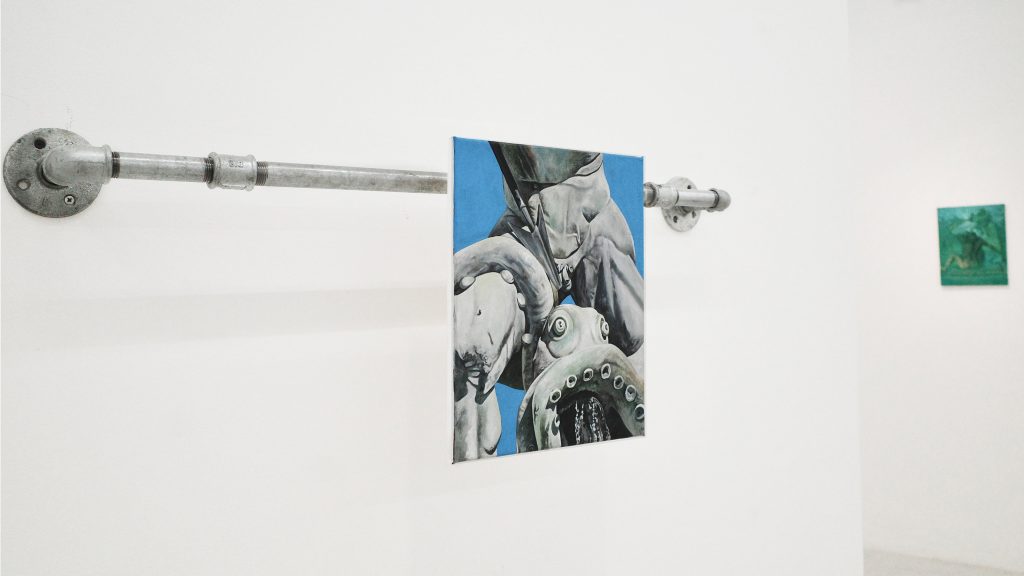
Installation view of He Spoke To The Birds, Rome. Artist: Diego Azzola. Curated by Fanfan Yuxuan Fan. Courtesy of AAIE and FanFlus.
Based in Italy, Diego Azzola (b. 2000) brings together fragments of classical sculpture, marine life, and architectural ornament within the same pictorial field. Fountains, octopus tentacles, and archaeological relics dissolve distinctions between nature and infrastructure, suggesting that water is less a natural element than a material through which human environments are continuously organized—and reorganized.
Chinese artist Huang Zhe (b. 1994), who lives and works in Florence, treats smoke less as a symbol than as a painterly condition. Anonymous figures linger within monochromatic green interiors, their contours repeatedly interrupted by translucent veils of incense. Figures drift in and out of visibility as smoke blurs the boundaries between bodies, interiors, and landscapes. Rather than concealing the image, smoke suspends perception in a state of continual becoming. If Rumpl allows corrosion to shape the image and Azzola traces history through infrastructure, Huang approaches painting as an atmosphere in which visibility itself remains unstable.
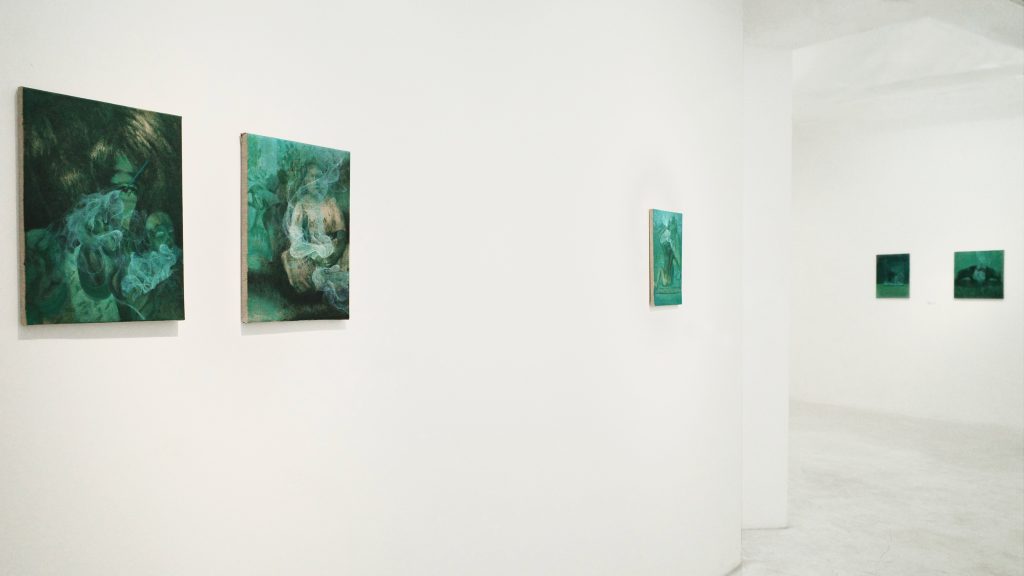
Installation view of He Spoke To The Birds, Rome. Artist: Huang Zhe. Curated by Fanfan Yuxuan Fan. Courtesy of AAIE and FanFlus.
Every historical period imagines that it has mastered the material conditions of the future. During Italy’s postwar industrial expansion, steel, reinforced concrete, electricity, and hydraulic engineering embodied a widespread confidence that technology could reorganize society. Today, artificial intelligence, automation, and algorithmic systems occupy a comparable position as emblems of technological progress within the contemporary imagination. The historical conditions have changed; the confidence invested in technological progress remains strikingly familiar. He Spoke To The Birds returns instead to zinc, smoke, and water. Long before they became the materials of Arte Povera, they were substances through which modern Italy articulated its capacity to shape the world. Yet zinc continues to corrode. Smoke continues to disperse. Water continues to alter its course. Their transformations unfold according to temporalities only partially available to human intention.
He Spoke to the Birds, curated by Fanfan Yuxuan Fan, was presented at AAIE Center for Contemporary Art in Rome from June 17 to July 28, 2026.
All images courtesy of the author, Serena Hanzhi Wang.