By Yohanna Magdalene Roa
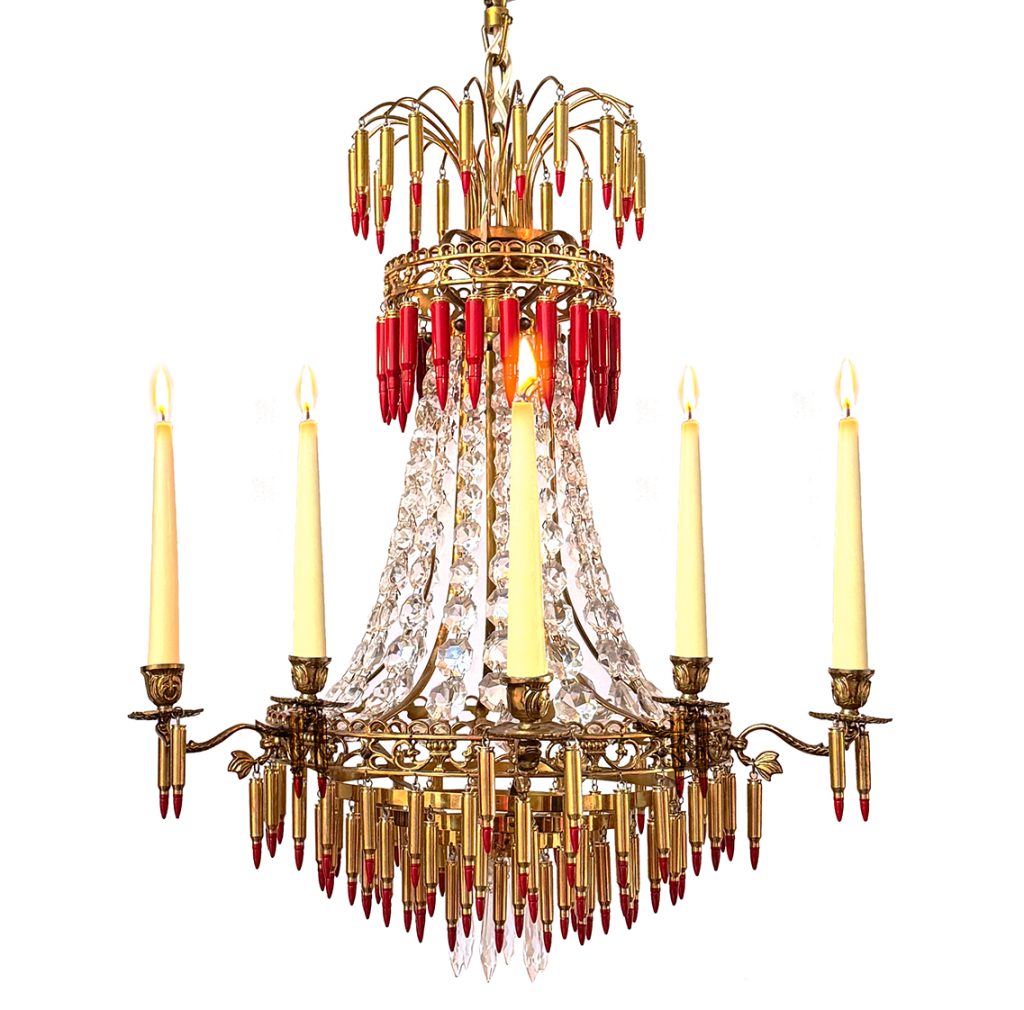
Michele Pred, Ice Storm, 2026. Vintage Swedish chandelier, bullets, candles, nail polish. 30 × 18 × 19 inches. Courtesy of Nancy Hoffman Gallery.
Nancy Hoffman Gallery
A chandelier hangs from the ceiling. Gold. Red. Slightly pink. It could belong to the domestic repertoire of luxury: an elegant dinner, a festive gathering, a room perhaps overly decorated. Yet it could just as easily hang in a space of power, a formal reception room, or even the Oval Office. The object oscillates between these two registers.
The droplets hanging from its structure are not crystals. They are bullets.
In Ice Storm (2026), Michele Pred preserves the ornamental form of the chandelier, the object that is meant to illuminate a room. Yet here the small bullets point downward, as if the entire object were suspended in the instant before an attack. The gloss of nail polish and the saturated red of the metal produce a strange effect: decorative elegance and threat at the same time. The object that should cast light now seems to mark the site of impact. The piece unsettles a seemingly stable distinction: the one separating the domestic object from the public one. The chandelier belongs to the imaginary of the bourgeois interior, yet also to the architecture of power. What illuminates a family table may just as easily illuminate a space of political decision.
This is where the work begins to operate.
The exhibition Projecting Democracy, presented at Nancy Hoffman Gallery, unfolds this same logic through a group of works spanning different moments in the artist’s career. More than a retrospective survey, the exhibition functions as a political assemblage in which objects, projections, and installations converge around an urgent question: how to respond, through art, to a historical moment marked by the erosion of democratic rights and the resurgence of authoritarian discourses that particularly affect women’s autonomy.
Many of the works gathered in the gallery were created at different times, some even more than two decades ago. Yet the way they speak to one another today reveals the persistence of certain structural tensions: the expansion of state surveillance mechanisms, the fragility of reproductive rights, and the continued juridical and political contestation of the female body. For instance, Confiscated Stack (2002–2026) assembles objects confiscated at airports after September 11. What began as a reflection on the new global security regime now reads differently: confiscation no longer seems to affect objects alone, but bodies as well.
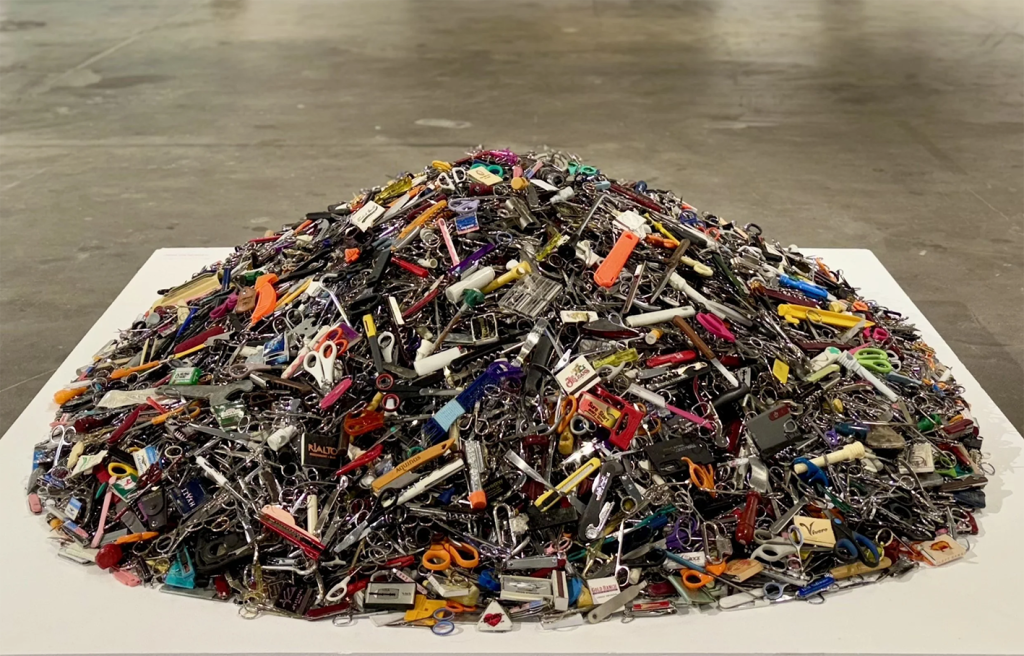
Michele Pred, Confiscated Stack, 2002–2026. Confiscated airport items. Variable dimensions. Courtesy of Nancy Hoffman Gallery.
In Pred’s practice, objects never appear detached from their historical context. They function as surfaces where layers of political meaning accumulate and shift over time. Much of the work in Projecting Democracy is constructed from found or everyday objects: vintage purses, quilts, domestic tools, contraceptive pills, and confiscated airport items. This procedure enters into dialogue with the long tradition of the ready-made and object-based artistic practices. Yet in Pred’s work, these materials are not presented as neutralized forms stripped of history. On the contrary, what the artist activates are precisely the social narratives embedded within them.
Pred’s operation belongs to a more complex genealogy linked to feminist artistic practices that, since the second half of the twentieth century, have displaced the ready-made toward domestic, bodily, and everyday territories. Since the 1970s, artists such as Martha Rosler, Judy Chicago, Betye Saar, and Mierle Laderman Ukeles have shown that everyday objects, domestic utensils, textiles, and maintenance tools contain a social history that does not disappear upon entering the space of art. Marta Minujín, early on, explored the political potential of objects and materials drawn from everyday culture. Wangechi Mutu has used assemblage and found materials to interrogate colonial histories and representations of the female body. Kimsooja has transformed textiles and domestic objects into a critical language addressing migration, memory, and invisible labor.
In all these cases, ordinary objects do not lose their histories when they enter the space of art. On the contrary, those histories become visible. Within this context, Pred’s work can be understood as part of an expanded tradition of the feminist ready-made. The artist does not neutralize the object’s original function nor transform it into a purely aesthetic entity. Instead, she intensifies the social narratives already inscribed within it.
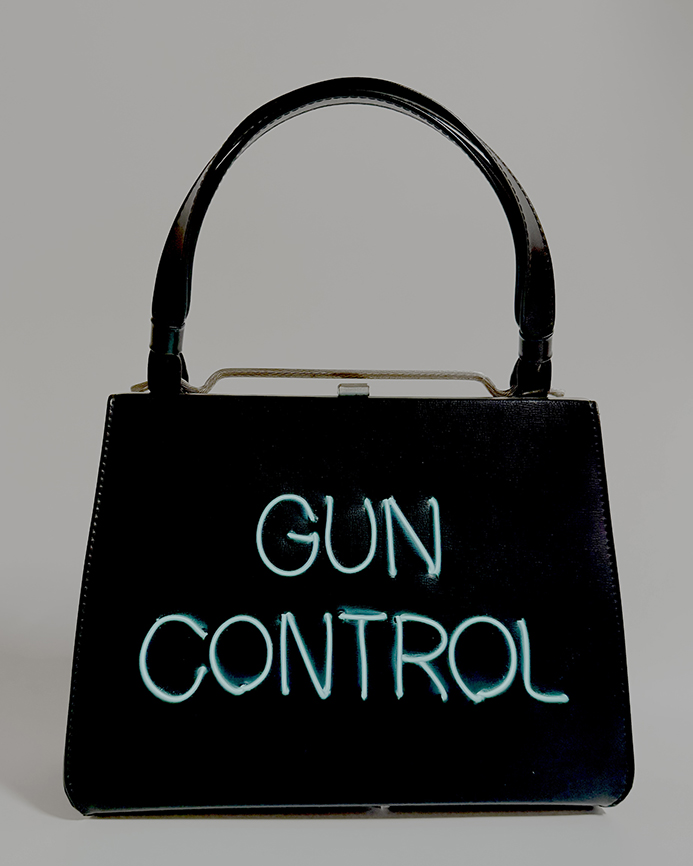
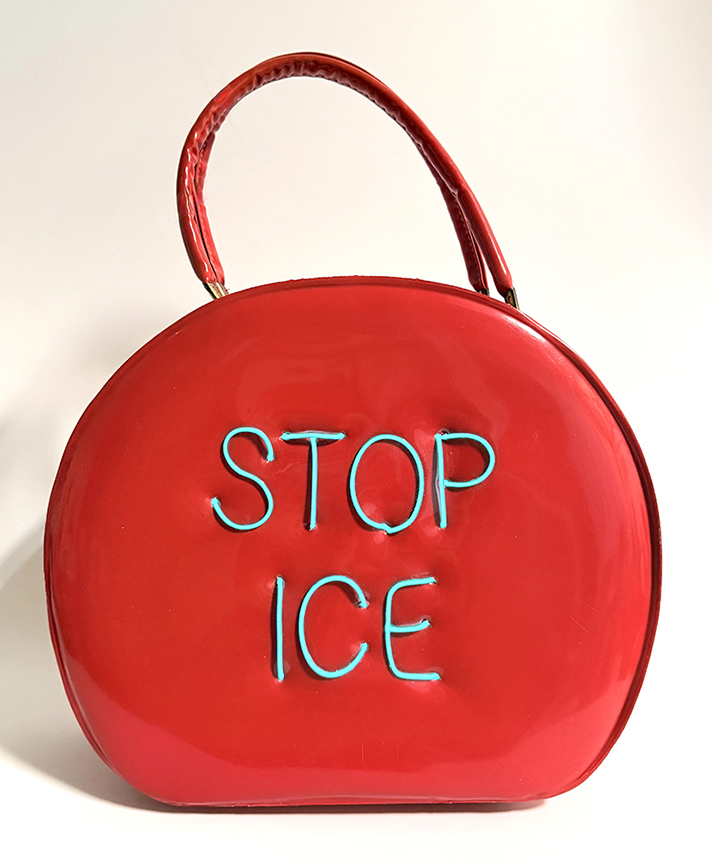
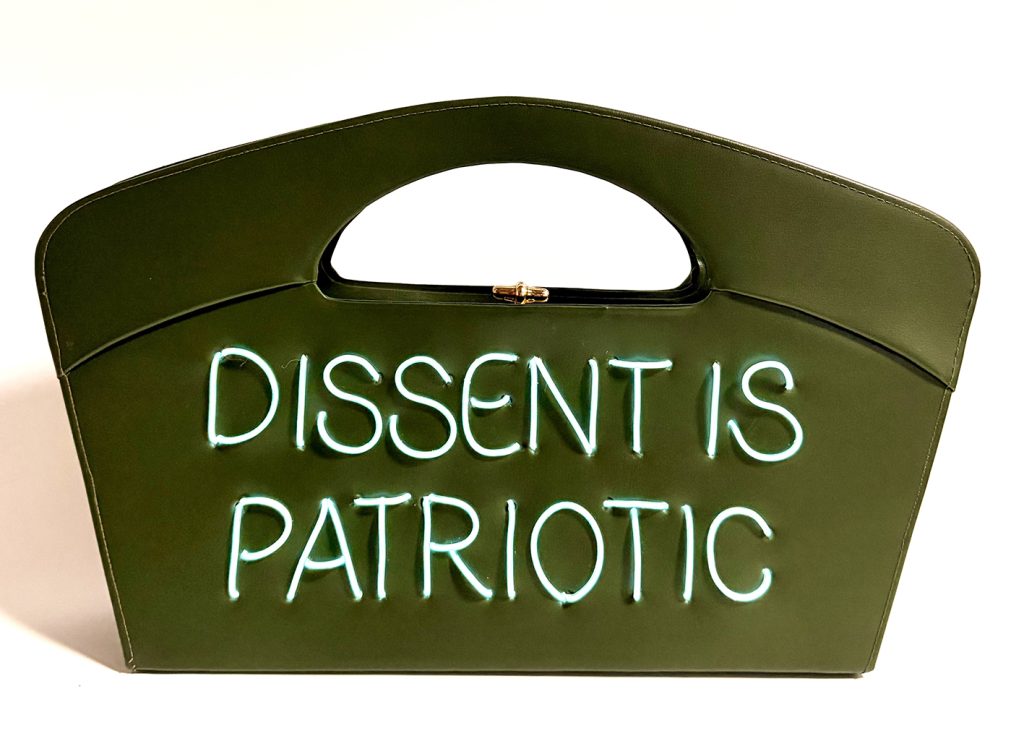
Michele Pred, Gun Control, 2026. Vintage purse with electroluminescent wire. 13 × 11 × 3 inches. Stop ICE, 2026. Vintage purse with electroluminescent wire. 16 × 12 × 3 inches. Courtesy of Nancy Hoffman Gallery.
One of the most eloquent series in the exhibition consists of vintage purses intervened with phrases rendered in electroluminescent wire: We The People (2025), Protect Trans Kids (2025), Gun Control (2026), Free Iran (2026), My Body My Choice (2022), and Good Trouble (2025). The purse is an object deeply saturated with cultural meaning. Historically associated with femininity, private life, and consumption, it functions as a container of everyday microeconomies: money, makeup, documents, cards—small belongings that organize daily life.
Michele does not destroy that meaning. Nor does she attempt to conceal it. She activates it.
By introducing luminous political phrases across its surface, the purse becomes a kind of portable sign. The gesture is simple, yet its implications are profound: an accessory traditionally associated with the social circulation of the female body becomes a device of political enunciation. The object remains recognizable as a purse; it still evokes economies of gender and class. Yet it now also operates as a support for political speech. The intervention creates a short circuit within the visual pedagogy of femininity.
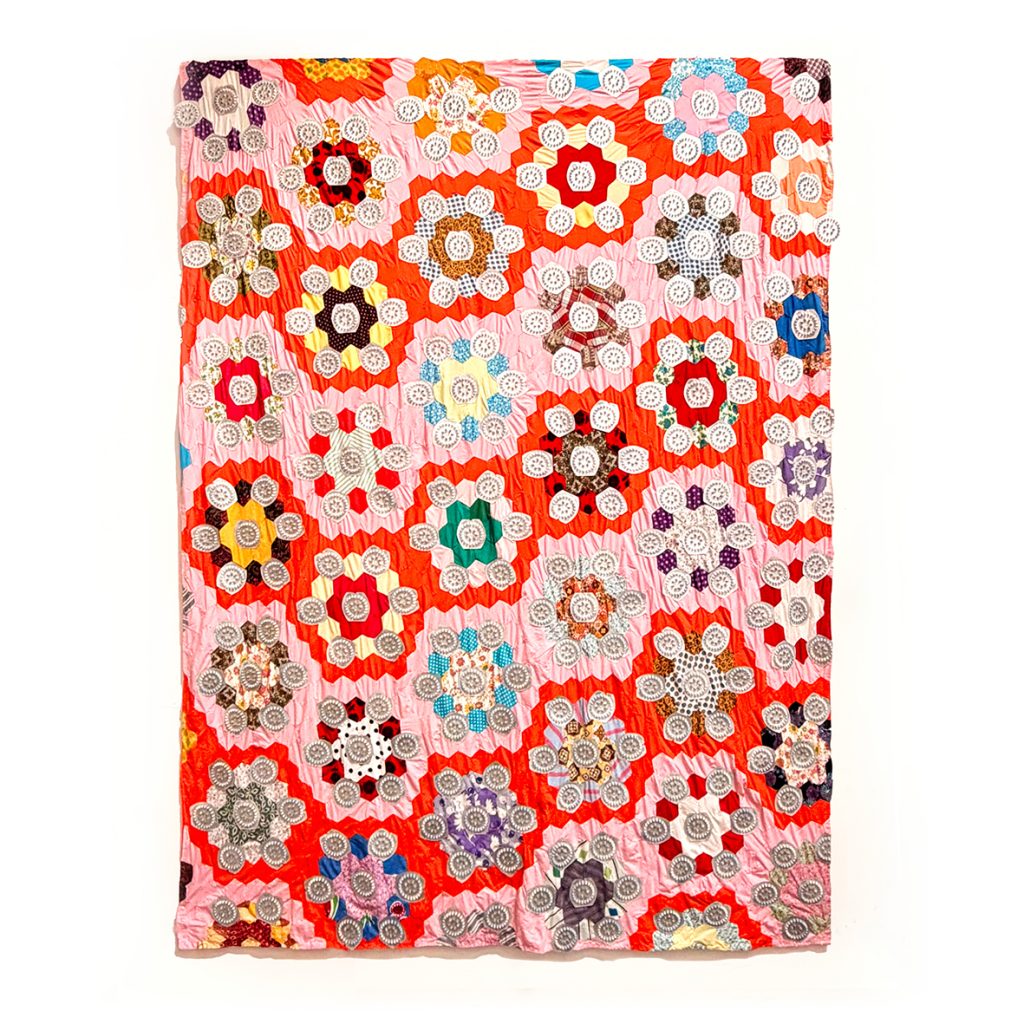
Michele Pred, Untitled (Vintage Quilt), 2026. Expired birth control and abortion pills. 81 × 58 × 2 inches. Courtesy of Nancy Hoffman Gallery
Something similar occurs in Untitled (Vintage Quilt) (2026), a vintage quilt from the 1960s intervened with contraceptive pills and expired abortion medication. The artist does not sew the quilt herself; she finds it, selects it, and intervenes upon it. This gesture is decisive because it preserves the object’s historicity. The quilt retains the memory of domestic labor and of textile traditions associated with family life. Yet the addition of the pills introduces another form of protection: that associated with reproductive autonomy. The work brings together two historical dimensions of women’s lives: domestic care and control over one’s own body. Within this superimposition lies the history of twentieth-century feminism itself.
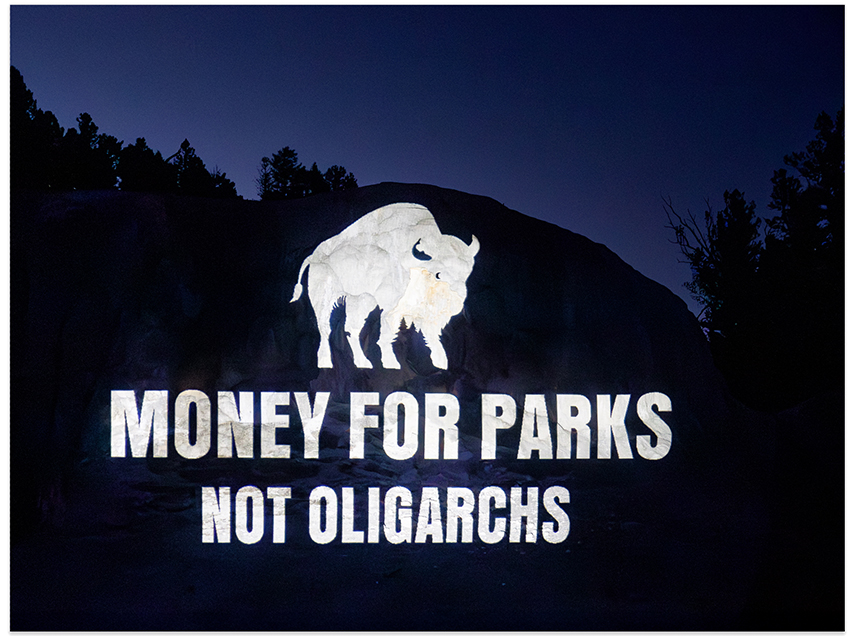
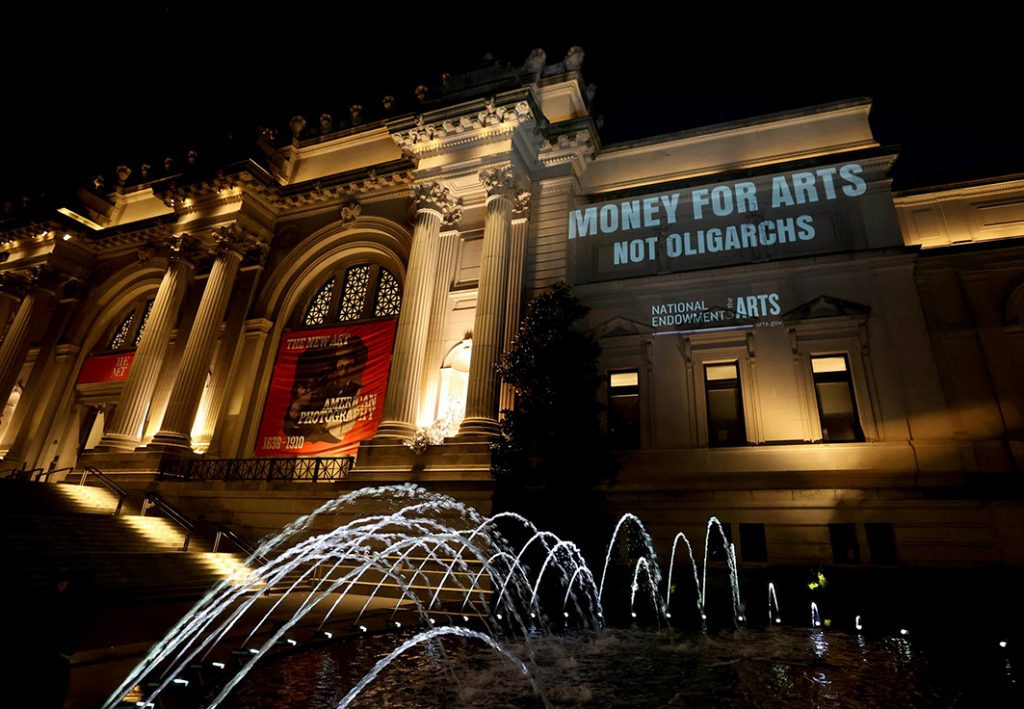
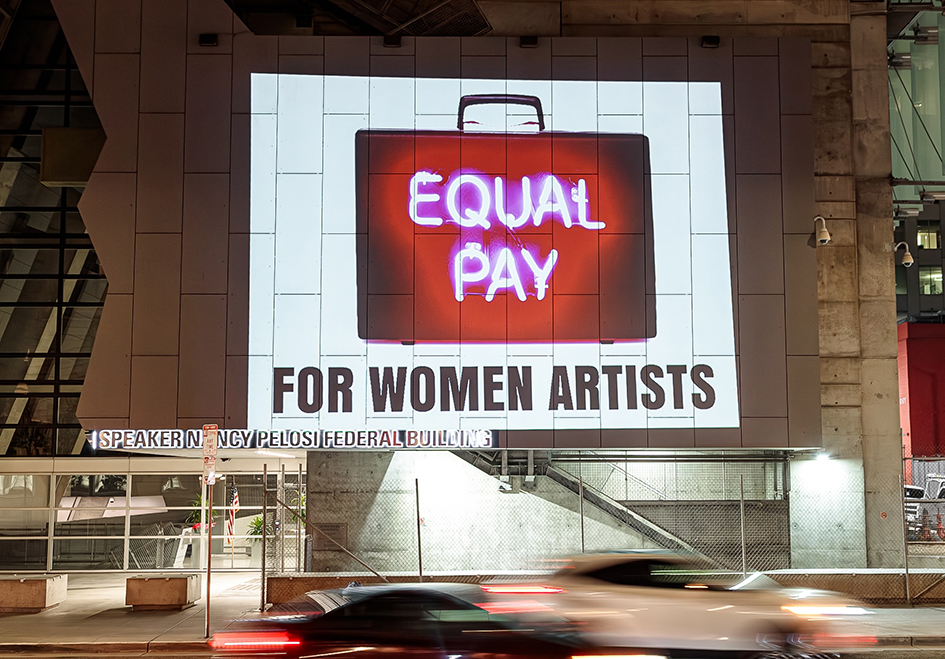
Michele Pred, Money for Parks Not Oligarchs: Yellowstone Park Projection, 2025. Projection in lightbox. 18 × 24 inches. Money for Arts Not Oligarchs: Met Museum Projection, 2025. Projection in lightbox. 30 × 40 inches. Equal Pay: Projection on San Francisco Federal Building, 2025. C-print photograph. 24 × 30 inches.Courtesy of Nancy Hoffman Gallery.
Another axis of the exhibition concerns the artist’s engagement with public architecture and national symbolism. Works such as Equal Pay: Projection on San Francisco Federal Building (2025), Forbidden DEI Words: Projection on Guggenheim Museum (2025), and Freedom to Learn, Learn About Freedom: Projection on Sproul Hall at UC Berkeley (2025) document interventions carried out through light projections onto emblematic buildings. The projection temporarily coats architecture with a new political inscription. The building remains visible beneath the luminous layer, yet for a moment it appears to speak in another voice. Museums, federal buildings, and university campuses are not neutral structures but symbolic surfaces where narratives of power and institutional legitimacy are produced. By projecting critical phrases onto them, Pred turns the monument into a site of dissent.
Something similar occurs in A Seat at the Table (2026), where a vintage chair, shoes, a judicial gavel, a fencing mask, and luminous elements compose a scene that evokes women’s participation in political life. The title suggests access to power, yet the objects reveal the historical tension that has shaped that access. Ultimately, what Projecting Democracy places into play is not the reinvention of the ready-made but its reconfiguration within a feminist tradition that understands the object as a social archive.
At a historical moment in which reproductive rights, freedom of expression, and the very forms of citizenship are under pressure, the exhibition reminds us that even the most ordinary objects can become instruments of political imagination.
A purse.
A pill.
A quilt.
The façade of a building.
They can become surfaces from which to rewrite the language of bodily autonomy and the right to exist as human beings.