An innermost essay by Zhen Guo
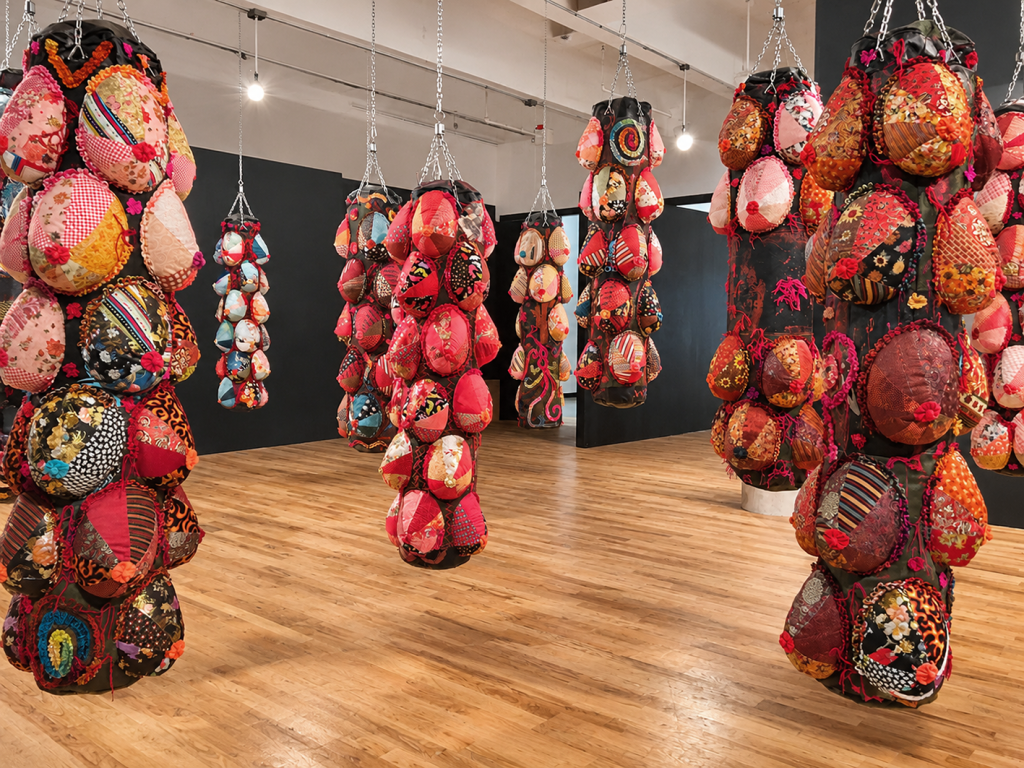
Guo Zhen, Punching Bags, 2018. Installation view, Mana Contemporary. 11 pieces, each 72 x 23 x 23” in.
A friend recently asked me, “How did you become a feminist artist?” I have given many lectures about my art and thoughts, and each time I have shown the transformation of my work. I gradually became a feminist through a process of self-reflection, but why?
In the summer of 1987, my husband (now my ex-husband) and I were invited to be visiting scholars at the School of Fine Arts at York University, in Toronto. I had immigrated to America in 1986 to prepare for a life together, while he, already a rising star in the new Chinese contemporary art scene, remained to concentrate on his work. By the time he joined me in Los Angeles a year later, I had started to adopt Western culture and manners, while he was caught in his traditional Chinese habits. He could not or would not give up his old ways, which led to conflicts and arguments.
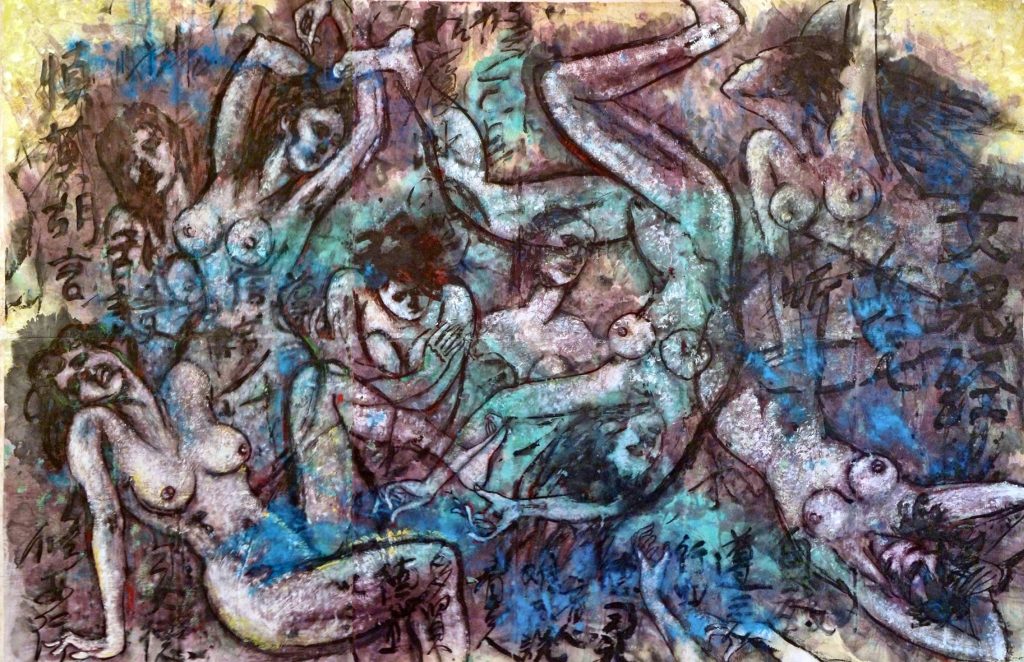
Guo Zhen, The Daughter Sutra, 2012. Acrylic and gouache on Japanese paper, 72.05 × 112.99 inches.
One day, in Toronto, I awoke lying on the floor and groaning in pain. I looked up and saw him sitting there, puffing on a cigarette and blowing smoke above me. I did not understand what had happened. Why was I on the kitchen floor with one arm pinned strangely behind my back like a chicken tied up for roasting? I looked at him again, confused and trying to remember.
He picked me up and said that he was a little scared and wanted to call 911, but then heard me cough a few times and knew I wasn’t dead. Hearing this, I suddenly recalled: we had another quarrel. I couldn’t remember why, only that he twisted my arm, pinned it behind my back, and threw me against the wall.
The next day, at a previously arranged lunch with our sponsor, Professor Bruce Parsons of York University, Bruce’s wife Mary asked me what was wrong when she saw my bruised face and arm, which I had tried, unsuccessfully, to conceal with my long hair to avoid embarrassment. I didn’t have time to answer, as my tears poured out uncontrollably first. By the time I could speak, she had pulled Bruce over and said, “Look what that Chinese artist you invited did!” I didn’t understand. How did she know where the bruises came from? Later she told me that there is a saying that “women’s bruises usually come from men.”
Concerned, Bruce asked me some questions. I don’t remember exactly what they were, but I recollect the phrase “domestic abuse.” This was the first time I had heard this expression, and I was a bit surprised, because I did not fully understand what it had to do with me. In my childhood, and in the tradition in which I was raised, we believed that the man is in charge and women should do everything for the family. Family disputes were seen as the fault of women, although, actually, it is mostly men who are responsible. In China, women are beaten and shamed all the time, but no one ever have called it “domestic violence.”
Bruce also said, “You could sue, and if you do, we can send him back to China.” When I heard this, I was startled and asked: “Is it that serious?” The shock to me at that time was huge, but the momentum of life, and my preconceptions, rooted in traditional ideas, still drove me to believe this was acceptable and to continue to live as before.
Later, I needed to return to the United States to satisfy a visa requirement, and Bruce drove my husband and me to the airport to see me off. I still hugged my husband, cried and felt sad to leave him behind. It was then that I saw Bruce’s eyes. They were difficult to describe in words. Regretful? Confused? Disdainful? Merciful? This made me uncomfortable. I later realized that this was the first stirring of my feminine mind in its infancy, a state of confusion and ambiguity about what was happening to me. This was confirmed in a later meeting with Bruce in New York City, where he said he knew very well that men in Chinese families often behaved violently toward their wives. For many years after, I continued to live in the shackles of traditional Chinese family feudalism.
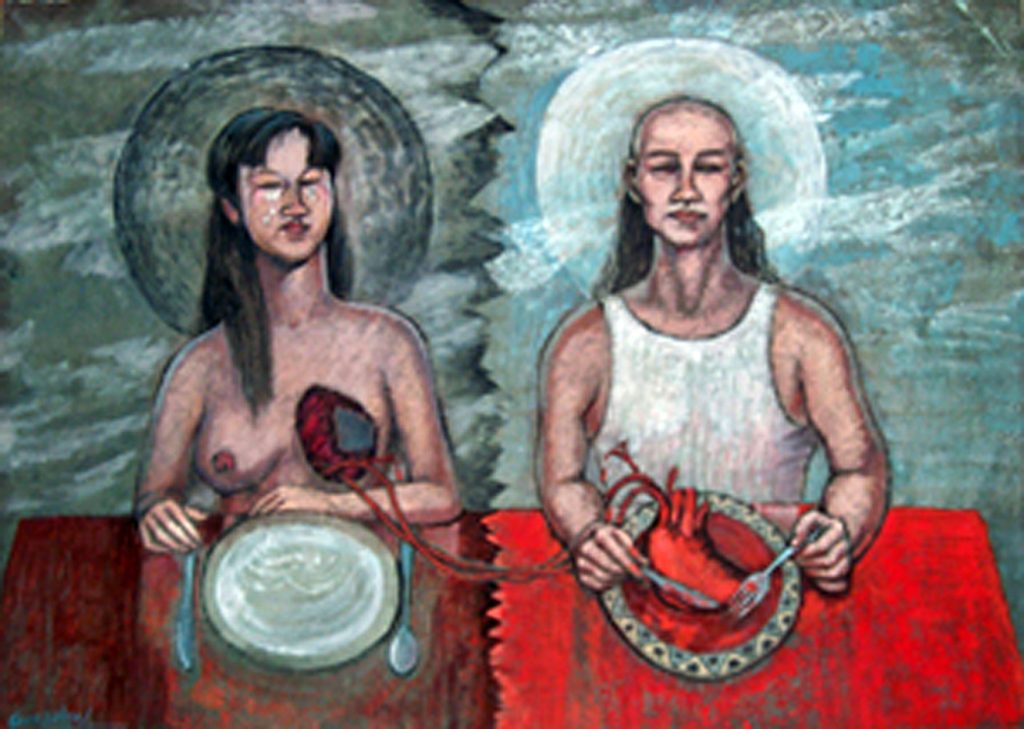
Guo Zhen, Supper, 2000. Acrylic and gouache on Japanese paper, 29.92 × 40.16 inches.
During the years we lived together in the United States, I initially did three things every day. I left home at 7:00 in the morning to go to school, which was necessary to remain a student. In the afternoon, I went to work as a waitress at a small Taiwanese restaurant, and I finished work at 6:00 PM and was home by 7:00. At that time, we were living in the house of a wealthy American businessman, rent-free in exchange for labor, so I had to clean their rooms every evening. After dinner, I did my schoolwork and went to bed at midnight or later. I was exhausted every day, and on weekends I did various odd jobs to earn money for my family. My husband did only one thing: attend school to learn English. In this way, I silently carried my family’s burdens, with the hope that my labors would be temporary, and that my efforts would help him be established in America, so that we would rise together.
While living in San Francisco, after returning from Toronto, I found gallery agents to sell my work, and life became a little easier, but because New York is the center of the international art world, my husband went there in a rush, leaving me behind again. I sent him money, helped him rent an apartment and paid his tuition. Everything seemed so natural and reasonable to me. Six months later, to save money, I changed to F-2 visa status and followed him to New York.
On a typical day there, I would paint at home while he went to an English language school. But the pictures that I drew were of a commercial nature and not the true art that I wanted to make. Still, I endured and told myself I could not give up my responsibility.
We had American friends who admired my ability to support the family by painting, because in America it is often difficult for artists to earn enough money to live, and most have regular or part-time jobs to sustain their pursuit of art. Those friends thought I was fortunate, but when I told them that the paintings I could sell were not what I liked to paint, they were surprised. They thought that there are many ways to make a living and that the responsibility of a family is to share the effort.
Hearing this, I began to feel that I carried too much, and my heart turned a bit sour. At the same time, though, I considered this to be the virtue of Chinese women: “Westerners don’t understand us,” I said to myself. “We Asian women are willing to work hard for the family, and to sacrifice.”
Thousands of years of traditional Chinese thought and ethics flowed in my soul, just like blood in my body, from my heart to every fiber. Traditional ways of thinking about womanhood, passed down through generations, silently ate away at my spirit, leaving me with a sense of grievance.
For my first few years in the United States, I was like a rickshaw porter for my family, with all my support and dreams loaded behind me. If you were to ask me: “What is the value of your life?” I would answer without thinking: “To give.” To give my body, my ideals, my youth, my career, in exchange for a coveted position to watch someone else in the spotlight.
How shameful it seems now! How can we evaluate a woman’s contribution to the family? It has always been a social equation that patriarchal society refuses to answer. In the end, women’s efforts are like a cleaning cloth, thrown into the trash after it is used.
This is how my previous marriage ended. Ten years of marriage left me with chicken feathers and ruins. I couldn’t believe it happened to me because I had really given it my all and didn’t understand what I had done wrong. I asked myself: “Why is my luck so bad?” Too much remorse made me slide into a deep depression and my desire to live wavered.
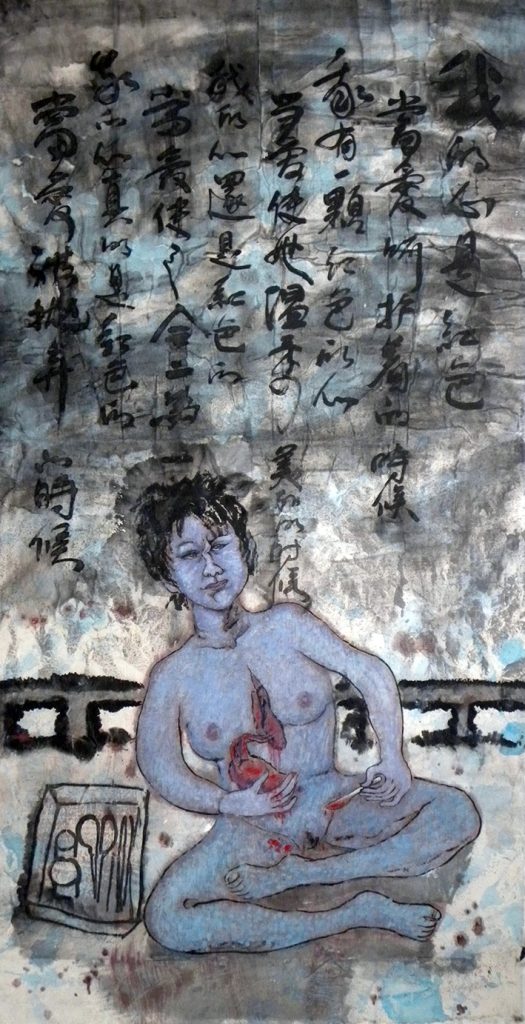
Guo Zhen, My Heart Is Red, 2011. Acrylic and ink on Japanese paper, 80.71 × 41.34 inches.
Why is that?
When I was 10 years old, I would fetch buckets of water from the well and carry them home. At two or three in the morning, I went to the compound where we lived to sweep the leaves blown about by the wind and rain and carried home firewood for cooking. Later, during the Cultural Revolution, when the neighbor’s children came to my door and called us the sons and daughters of capitalists, I would raise my fists and come to blows to protect my siblings. No child dared to bother me.
When I was 14, I was sent alone to the countryside to learn how to make clothes. At 16, I was assigned to a garment factory to live and work. Whatever money I made, I gave to my mother. Until she passed away, she remembered this and praised me for it. That’s how I tried to be a good child.
In 1978, after the Cultural Revolution, I entered the Department of Traditional Chinese Painting of the Zhejiang Academy of Fine Arts, the most respected fine arts college in China with a profound influence on traditional art. I cherished this opportunity and tried my best to create a positive mood for a day of learning every morning. After graduation, I was invited to teach. My appointment was a milestone as I was the first female teacher in the Chinese Painting Department after the reform and opening-up, and only the second female teacher since the founding of the People’s Republic. In this role and at school, I became a leader and, despite my youth, I met the challenges of my new life with confidence. In the years after, I participated in almost all national art exhibitions and received many awards. My life seemed to be moving with ease.
Everything changed the moment I started to fall in love.
The expectation of love is part of the existence of every person. In our time, people worship loyal, romantic love just as they worship life. What we think of love and how we face love will determine the life we will lead. The moment I entered the vortex of love, I lost myself. My female identity was set in place as a slave devotee, and this doomed my marriage to an unequal end.
My awakening to my own self-sufficient womanhood began entirely from questioning my personal experience. At first, I was unwilling to admit my lack of self-awareness. A good friend suggested that I use painting to explore my deep thoughts and display my inner entanglements, my pain and sorrow as truly as possible. During this time, I experienced an emotional suffocation; the primitive ecology of my feminine emotional life was strangled by the secular idea of male power.
Since ancient times, a woman’s life has been described as thinner than paper and more bitter than medicine. In the Chinese society in which I grew up, guided by Confucianism, the concepts of male dominance vs. female submission, male superiority vs. female inferiority, seriously restricted women’s human rights and social progress. Feudal society praises the husband, and the life of women is buried.
This thought entered me deeply, even though I grew up in post-liberation China, where women were told they could be “half the sky.” But when the family was put before me, I was pushed as if by an invisible hand into a woman’s traditional humble role.
In this process of reflection, I painted self-portraits. I wanted to deeply embed anger and hatred, resentment and submission in my art, as well as love and sorrow felt to the bone. When I began these self-portraits, I finally stopped painting what would sell and started painting what I felt, as truly as possible.
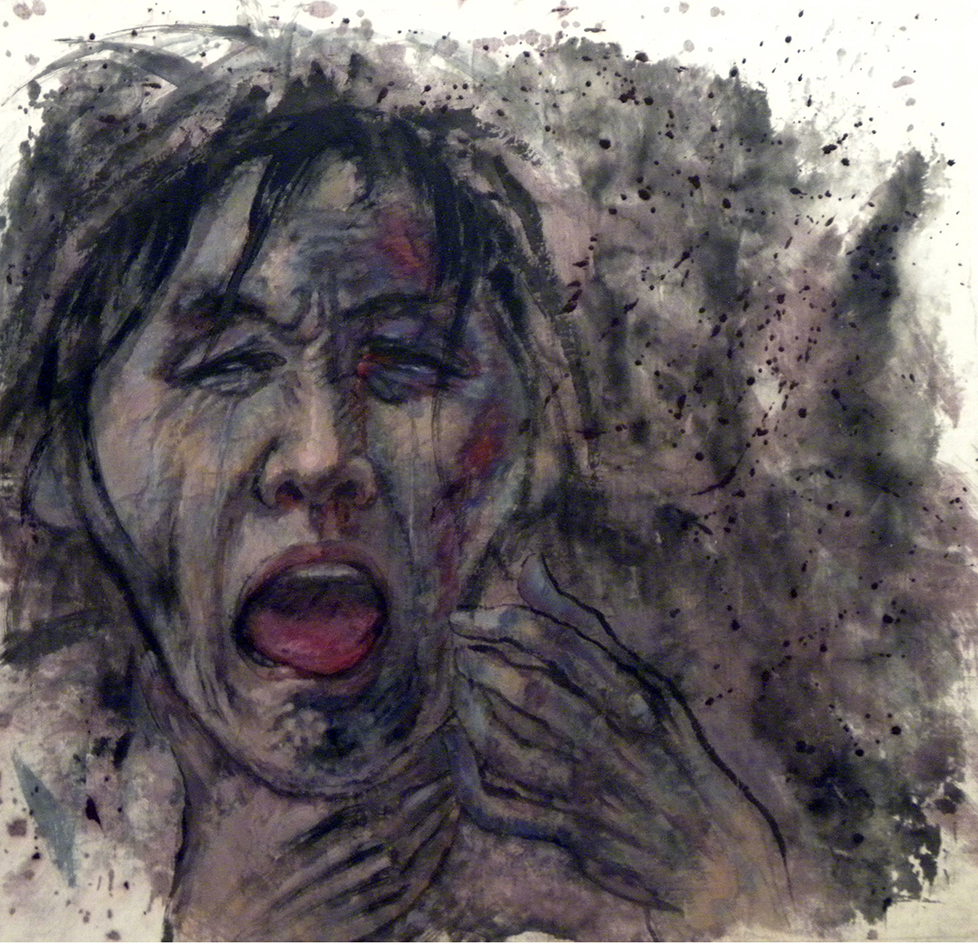
Guo Zhen, Choking Gray, 2011. Ink and acrylic on rice paper, 37.40 × 36.61 inches
The “Choking” paintings came from my own feeling of being strangled by the constraints and limits placed on my life, by duties and expectations from society. She works, she struggles, she suffers, but when she tries to speak, she has no voice. Without her voice, she feels worthless. Without her voice, she will die silently.
Appreciation of life is a gift to those who learn from pain, and pain makes us grow. I examined what happened to me, and what happens to women in many ways, times and places, and throughout, the source ideology and the root of social formation are the same. I have also seen this kind of objectification and discrimination against women from different faiths, races, and cultures all over the world. The ravages and destruction of women can be described as extreme and horrific.
Reading Simone de Beauvoir, I realized I had not been born the second sex; I had been made one, shaped, consciously and systematically, by a society that needed women unequal to keep its own power. That was the shackle I had lived in.
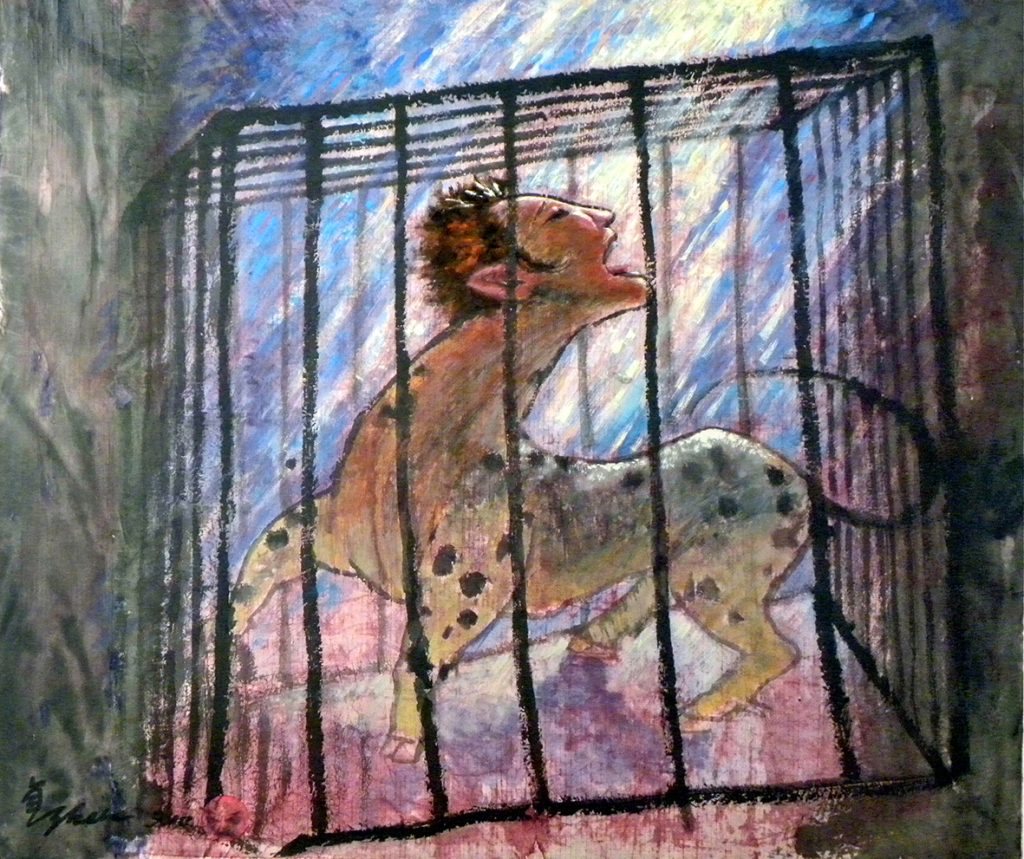
Guo Zhen, Self-Portrait as a Beast, 2011. Acrylic and ink on Japanese paper, 40.16 × 50 inches.
I realize that I am not the only victim here. What happened to me wasn’t something I did wrong or how unlucky I was. China’s famous author Xiao Hong, on her deathbed, said: “My life’s greatest pains and misfortunes are because I am a woman.” Because we are women, we are abandoned from birth, locked in a dark room of our consciousness, where we are kept dirty, with no right to visit and develop outside, and our sphere of activity is controlled.
Indeed, it reminds me of The Handmaid’s Tale by Margaret Atwood. In this story, after the Second American Civil War, women were objectified as mere tools of human procreation. It’s fiction, but it portrays what patriarchal thinking can do to women in practice. The basis for this reimagination of American society is very much rooted in what is happening now, particularly with respect to reproductive rights. For us to fight for the right to be human, we must eradicate this rule of thousands of years, which pollutes people’s hearts.
I believe that feminism is the only system of thought that can save women. Unfortunately, many women still don’t understand feminism well enough, and so they question and deny the system that saved them and the pioneers who died for it. The worst part was that for years I had not even recognized my own misfortune; I had mistaken it for virtue. Although much of my career has been devoted to portraying the condition of women, I have moved toward demonstrating women’s strength and their power to change their circumstances and the world.
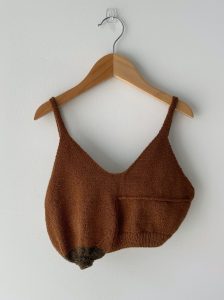
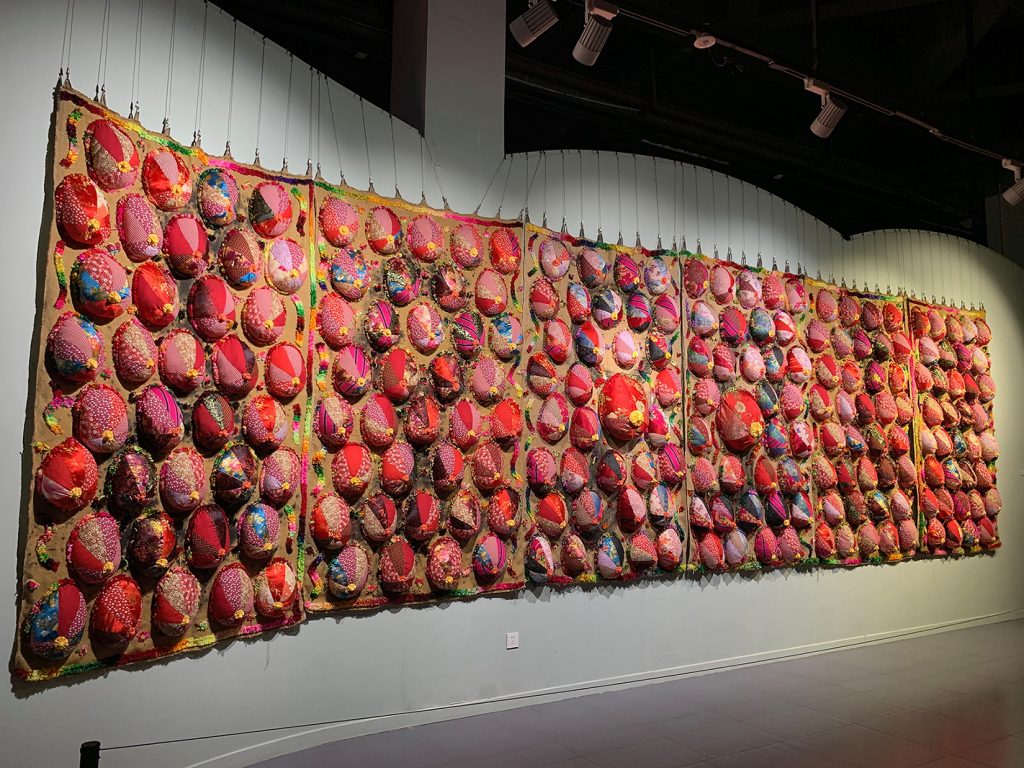
I have adapted the image of a woman’s breast, a highly visible part of her body, which captures her youth and reveals her aging; shows her chastity and her sexuality; and demonstrates her strength to sustain life and her vulnerability in defending it. I depict women’s breasts in soft fabrics, like quilts, gathered together to unite their power, as well as in hard, shiny sculptures. In other works, they confront the brutality of a heavyweight boxer’s punching bag, overcoming its coarse roughness.
More recently, I have drawn on the image of the Hindu goddess Kali to represent the potential strength of women. Often misunderstood, Kali embodies not only the power of destruction but also the courage to confront injustice and the potential of maternal love. She exorcises evil, subjugates demons, and extends boundless love to save all living beings.
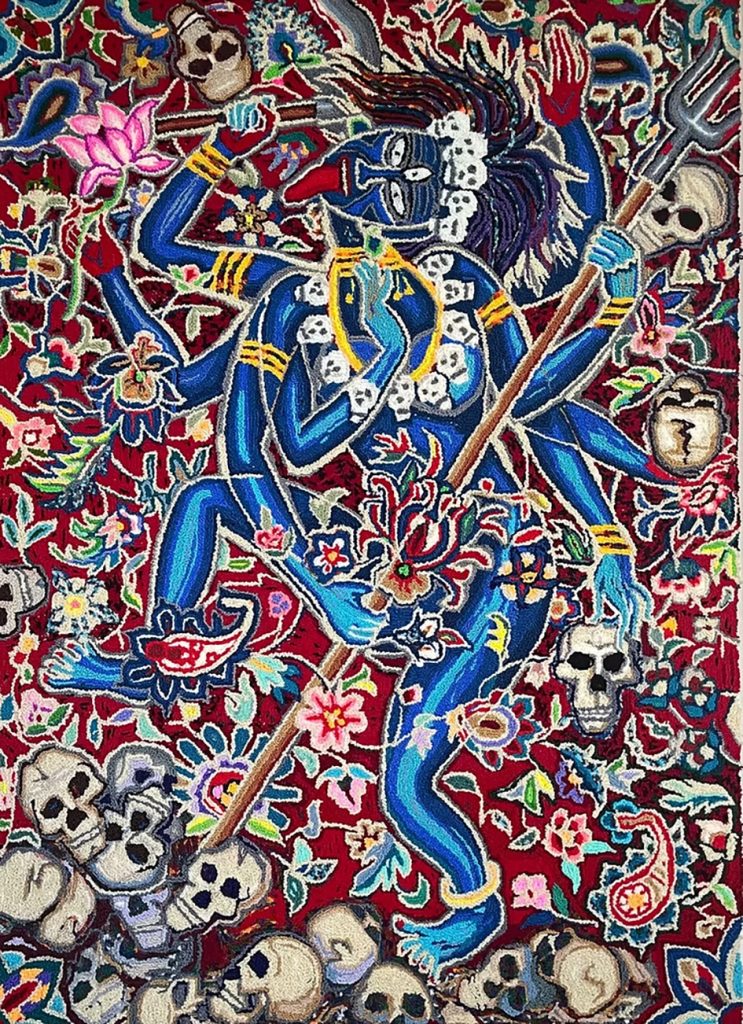
Guo Zhen, Dancing Kali, 2024. Tufted yarn, pearl, and fabric, 73.62 × 53.94 inches
The rise of women requires self-awakening. It is a call for women to fight for autonomy, freedom, and self-reliance.
I create feminist artworks, curate international art exhibitions, and have organized the Chinese Feminist Artists Alliance LLC in order to spread feminism and help women understand their own value.
I have always believed that the progress of human civilization is made possible by the participation of selfless, dedicated and humane philosophers, humanists, sociologists, psychologists, artists and every one of us.
In short, my life experiences have educated me and forced me to grow as a feminist; my thinking and observation have deepened me, making me a feminist; my hope and kindness have made me a feminist artist.
[1] I painted “Broken Butterfly” (from my “Women’s Function” series) in 2012, inspired by the Chinese book called Daughter’s Scriptures (女兒經). It is a guidebook for women, setting strict rules for what a woman should and should not do. In the painting, I wrote those rules across a woman’s body. The book teaches that sacrifice is a woman’s necessary quality and her virtue. A woman who gives everything is praised; a woman who asks for something for herself is shamed. Under such teaching, the awakening of the individual self is suppressed, and female self-awareness is destroyed. At the bottom of the painting, the butterfly’s wing is broken. It cannot fly and so is not complete.