D. Dominick Lombardi
Curated by Ray-Anthony Eddie, “African, American: The Art of Troy Jones” is a distinctive exhibition filled with powerful portraits of striking subjects. The influence of the contemporary artist Kehinde Wiley and the realist/modernist Édouard Manet, among others, makes a lot of sense in Jones’ work, since his subjects engage the viewer directly, with a strong sensation of recognition, especially regarding culture.
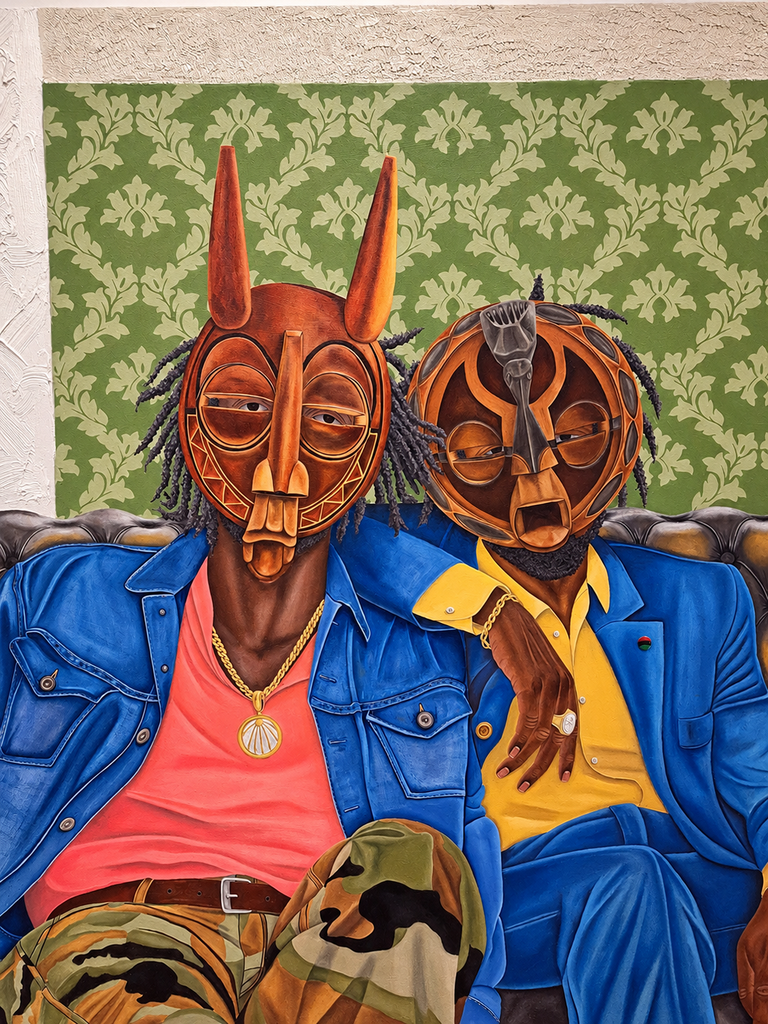
Troy Jones, rest assured, 2024. Oil on canvas, 60 × 48 inches. Courtesy of the artist.
Almost all of the individuals depicted in Jones’ paintings wear ancestral African masks, clearly mixing a classic African aesthetic with current American culture. For instance, In rest assured (2024), two friends relaxing on a leather couch, positioned in proximity, wear identifiable African masks. Once the viewer is drawn in, the finesse in the painted fabric and the detail in the masks by the artist completely captivates the onlooker. Moreover, the finely detailed floral wallpaper set behind the conventional couch adds additional texture that activates the slightly shifted, off-center scene.
As with all the paintings by Jones, fashion is key, as it sets a tone for what the curator, Eddie, asks in the wall panel/essay: “How do we finally say plainly what has always been true: African Americans are, simply, American, as fully and as rightfully as anyone born on this land?” This insight by the curator is key when viewing Jones’ art, particularly when studying the beauty of blackness (2025) or brothers keeper (2022), in which the attire covers a broad ‘look’ that embraces a multicultural, omni-era American style.
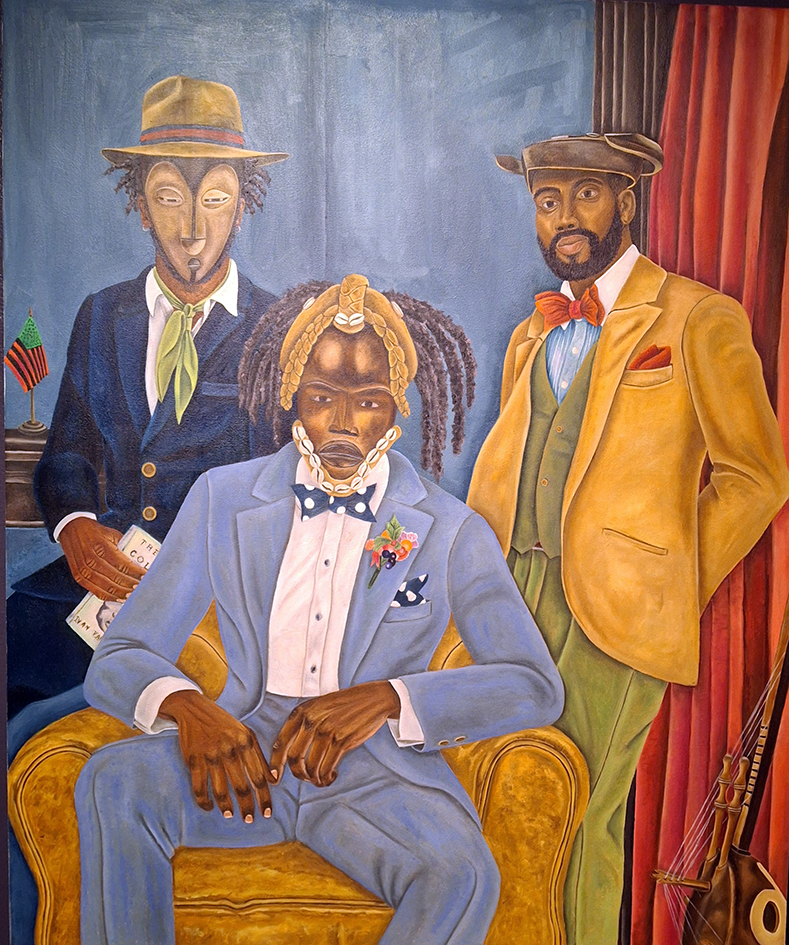
Troy Jones, modern-day griot, 2025. Oil on canvas, 48½ × 40¼ inches. Courtesy of the artist.
The centerpiece of the exhibition is modern-day griot (2025), which reminds me of Picasso’s Cubist masterpiece Three Musicians (1921). Both paintings have a trio of subjects wearing masks as they engage the viewer head-on. The twist in modern-day griot is the fact that Jones depicts one of the three masks on the individual on the right of the composition, precariously teetering on top of the subject’s head. This reveal of that one subject’s face adds time and action to the narrative. That same effect occurs in Three Musicians by way of fractured space and contrasting color. These two cross-references between Jones and Picasso are also a part of the message in the art of Jones—it’s subtle, but it’s there— a type of timelessness that elevates both the art, which in essence is the subject matter, and the artist. Additionally, the placement of David Hammons’ African-American Flag (1990) at the top left, and a kora, a West African stringed instrument, at the bottom right, gives this painting a more engaging and informative narrative.
- “African, American: The Art of Troy Jones,” a solo exhibition at the Hunterdon Museum in Clinton, NJ, runs through January 10, 2027.
Thanks to its founder and executive director, Jill Kearney, ArtYard is a world-class contemporary art center in Frenchtown, New Jersey. “Mom Bras: Cassie Arnold” was an exhibition that nudged the mindset of visitors just enough to remain radically memorable.
All of the art by Arnold is hand-knitted wool ‘bras’ hung on smallish wooden hangers. I put the word ‘bras’ in half quotes since all the art the artist offers is a hybrid between the relative structure and design of the brassiere with the addition of breasts in place of the more traditional cups. Each piece is markedly different, from distended mammaries that one would correlate with advanced age to missing breasts indicating substantial medical issues. In the end, what we have here is reality sans the Barbie Doll augmentation. In addition, and despite the evidence of a mastectomy in some of the individual works, there is a bit of humor since everything is hand-knitted and somewhat playful in design, placing Arnold’s art into a René Magritte-type of Surrealism.
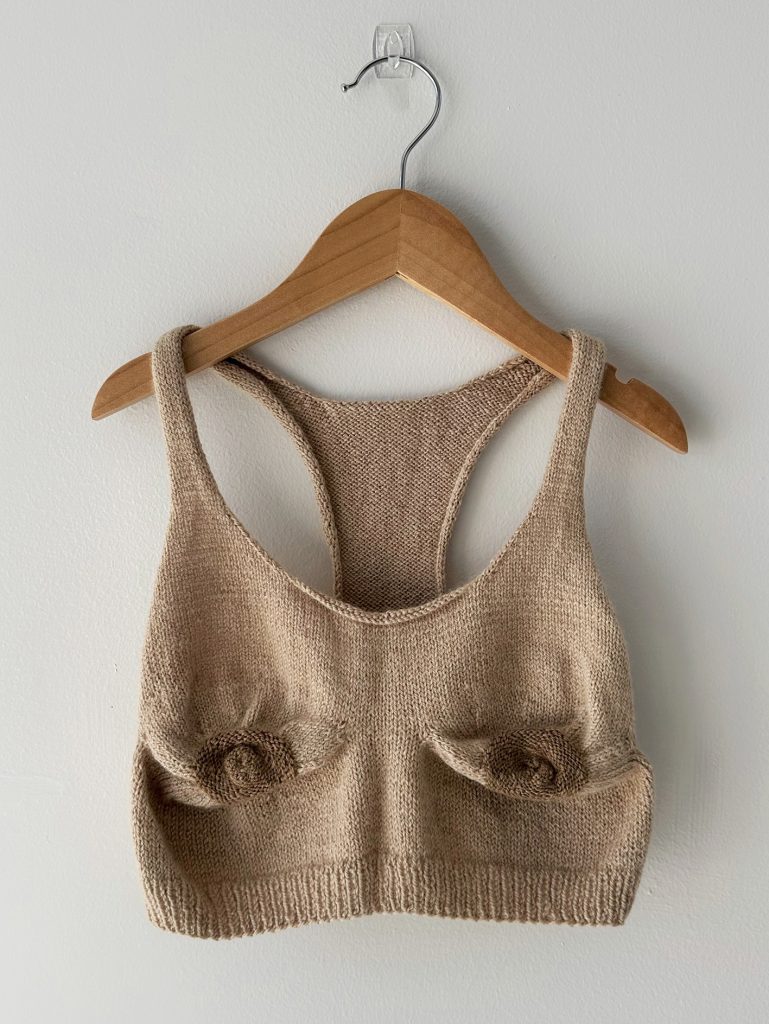
Cassie Arnold, Itty Bitties (Self Portrait), 2021. Hand-knit wool, wood hanger, 9½ × 12 inches. Courtesy of the artist.
The title of the exhibition, “Mom Bras,” specifically refers to how breasts change after childbirth, especially if the mother breastfeeds her baby. In fact, Arnold states in the exhibition’s wall panel/essay that the exhibition “celebrates the natural curves, scars, wrinkles, hairs, and textures of our breasts and helps us to tell the story of who we collectively are as women.” There is even a representation of the artist’s own body titled Itty Bitties (Self Portrait) (2021) that relays a realistic view of a prideful self, uncaring about any lofty, over-ripe implants.
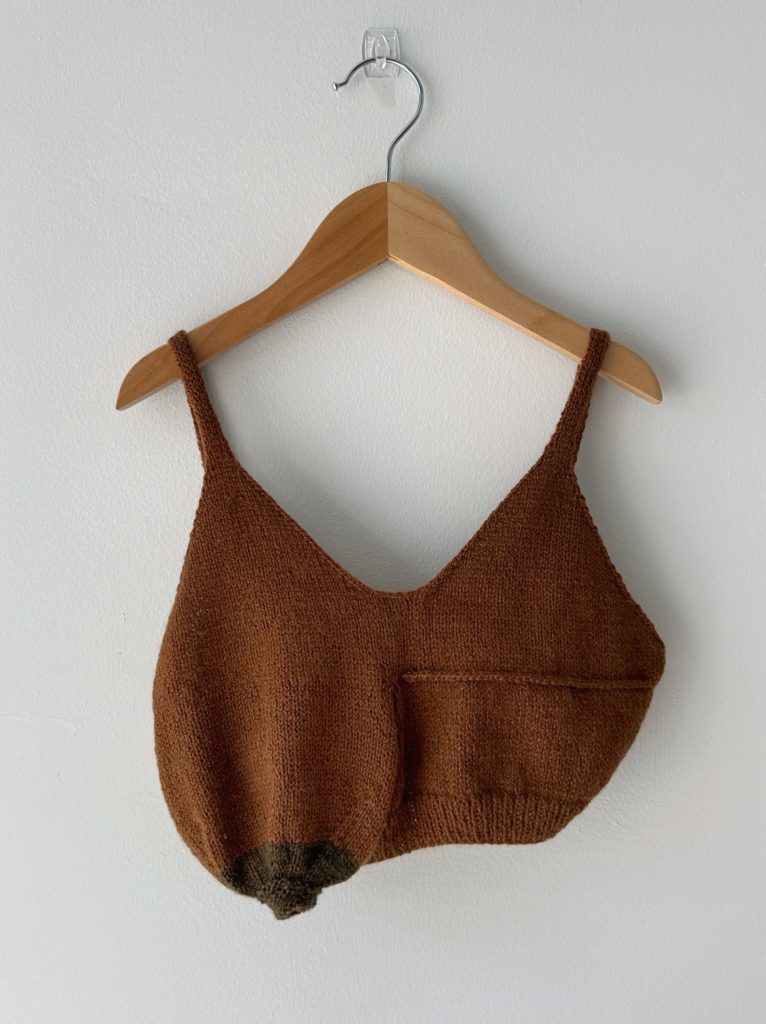
Cassie Arnold, Fighter. Survivor., 2021. Handknit wool, wood hanger, 9½ × 12 inches. Courtesy of the artist.
The powerful Fighter. Survivor. (2021) is both sad and profound, with an obviously removed breast and mastectomy scar. This work in particular sets the tone here for a basic reality check that life has major challenges and all of our wishes to reach old age are not guaranteed. However, the strength that is exemplified in Fighter. Survivor should give hope to those struggling with serious illness.
Mom Bra 3 (Vitiligo) (2026) presents an autoimmune skin condition as something quite beautiful. Conversely, what is presented as beauty in our culture, specifically from advertising to social media, is so twisted that it makes it hard to see the real natural beauty in individuals. Having Mom Bra 3 (Vitiligo) in the exhibition, with other variations of the female form, takes independent representation to a new level. By shifting representation from a person’s face to the breasts as an identifier in Mom Bra, Arnold helps us all to rethink not just the distortions created by airbrushed ads and plastic surgery, but the very thing that makes all of us who we are in our hearts and souls.
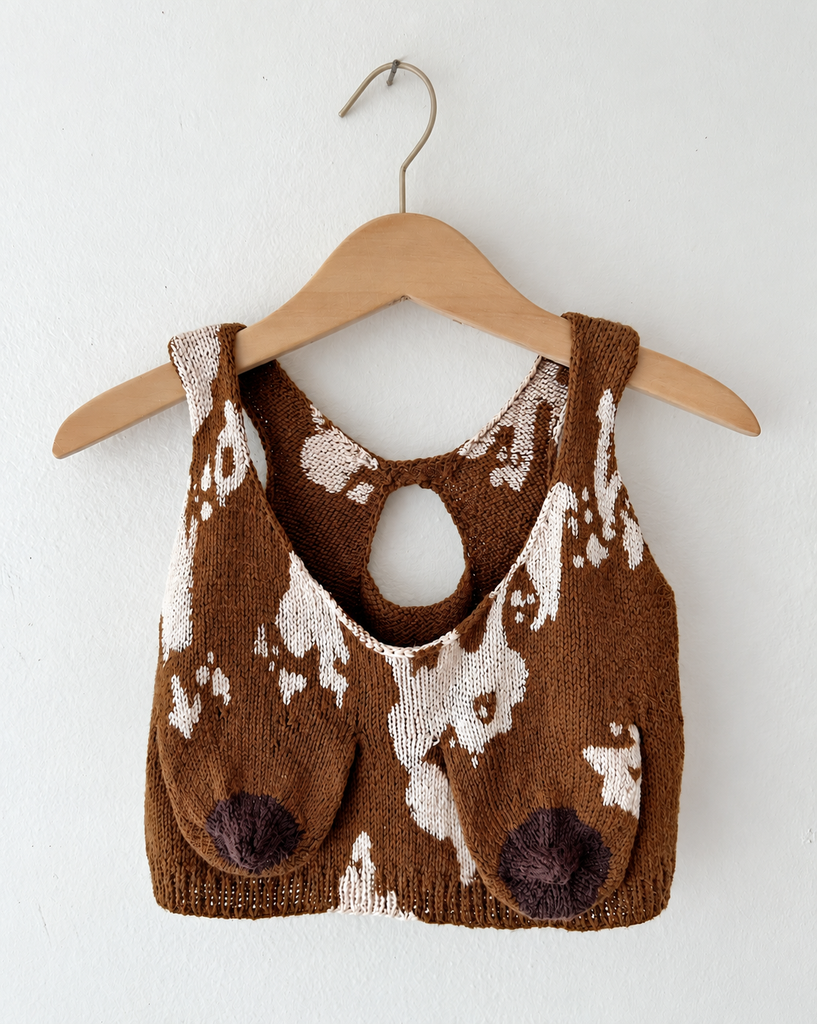
Cassie Arnold, Mom Bra 3 (Vitiligo), 2026. Handknit wool, wood hanger, 9½ × 12 inches. Courtesy of the artist.
Unfortunately, women’s bodies remain a battleground. One only has to look at the current case at Cornell University and all of the delays. Under New York law, a person who becomes voluntarily intoxicated by consuming alcohol or drugs faces significant legal obstacles in establishing that they were unable to consent to sex. This legal distinction is widely known as the “voluntary intoxication loophole” or “exclusion.” Common sense tells us this law is unacceptable and needs to be changed.
Troy Jones and Cassie Arnold both address systemic issues that have plagued the Americas since the first Europeans set foot on the continents. In many ways, the last ten years have clearly shown that the mistreatment between races and genders has only gotten worse here in the US. What we see in the art of Jones and Cassie is a bit of light at the end of the tunnel. A place of pride where every individual’s heart, soul, mind, and body deserve respect, equal opportunity, and love.