Notes on the Second Iteration of a Collective Curatorial Process – WhiteBox Portable at Gallery MC
By Yohanna M. Roa
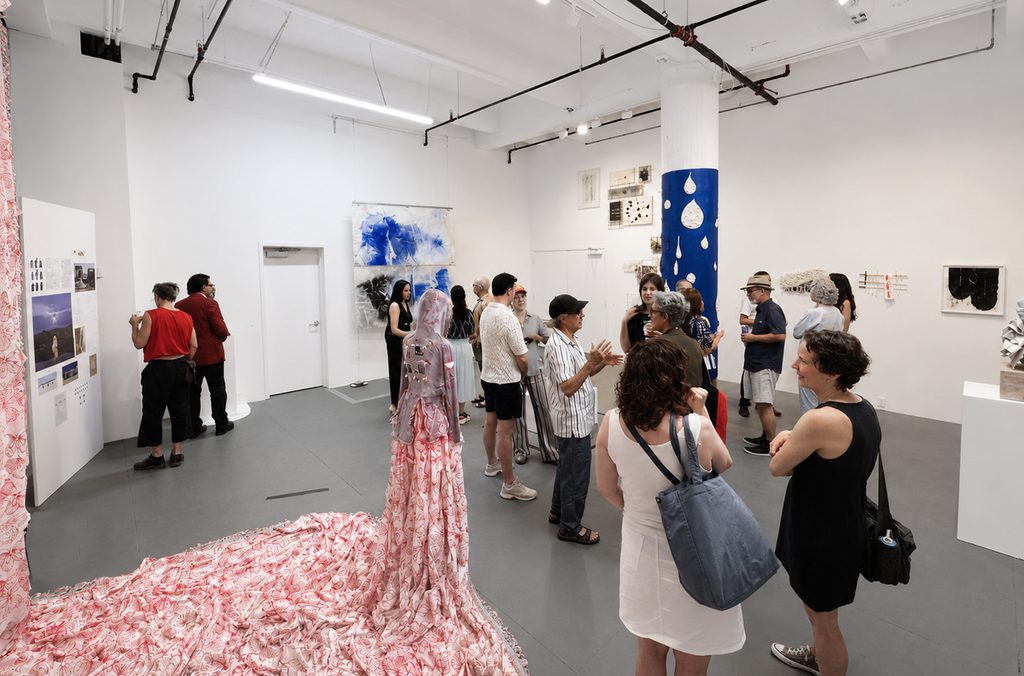
the braid – la trenza: Sorrow and Joy, exhibition view, WhiteBox Portable at Gallery MC, New York, 2026.
What happens when curatorial practice shifts away from frameworks established by external authority and becomes a political space where the personal and the public intertwine through exchange, negotiation, vulnerability, and shared responsibility?
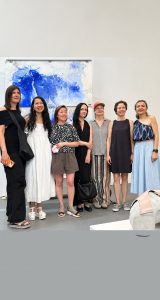
This second iteration of the braid – la trenza, titled Sorrow and Joy, took place from June 11 to July 10, 2026, as a WhiteBox Portable project at Gallery MC in New York. Nine artists participated: Susan Salinger, Mary Mattingly, Monika Weiss, Cecile Chong, Lilia Ziamou, Esperanza Cortés, Sandra Eula Lee, Tatiana Istomina, and myself. The exhibition closed with a conversation among the artists moderated by Amalia Uribe, as well as performances by Susan Salinger and Monika Weiss.
the braid – la trenza began in 2023 at WhiteBox on New York’s Lower East Side as an investigation into collaboration between artists and curators, and as a critique of the fiction of neutrality that continues to structure much curatorial practice. (Article by Erin L. McCutcheon) From a feminist and decolonial perspective, the project recognizes that all curatorial practice is political and situated: it is traversed by specific positions, power relations, affects, bodies, and material conditions. There is no external gaze capable of ordering artworks and discourses from a universal position; there are partial perspectives that enter into relation and produce knowledge together.
The project’s name derives from the historical braiding practices of women of African descent during slavery in the Americas, particularly those associated with Colombia’s Pacific region, where hairstyles functioned as escape maps, systems of communication, and places for preserving seeds. Here, the braid operates as a decolonial map and as a way of thinking about collective knowledge: distinct voices can be intertwined without losing their singularity.
In the first iteration, I sent my work Curtain (2018) and a text to curator Blanca de la Torre, who responded together with Cecilia Chueca. The materials were then passed successively to other teams of artists and curators. Other artists and curators became involved in this first iteration, among them Jovana Stokic, with whom we later published an interview about the project in Cosmos magazine[1]. There was no predetermined theme: the exhibition generated its content through this chain of responses, making exchanges, negotiations, and decisions that are usually invisible part of its structure.
the braid – la trenza: Sorrow and Joy, 2026. WhiteBox Portable at Gallery MC, New York. Banner image
For Sorrow and Joy, I wanted to take this procedure in another direction. Instead of artist-curator pairs, the chain would consist solely of artists responding to one another. Collaboration was not to appear as a theme or an ethical aspiration, but to become a concrete condition for producing the exhibition. In this sense, the methodology approached the minga, not as a folkloric reference or an image of community, but as a practice of cooperation, reciprocity, and shared labor oriented toward the common good.
I did not want to begin the chain myself, so I organized a digital draw to determine the order, although I asked to occupy the second position: as the project’s initiator, I would have access to all the materials, conversations, and exchanges, and my position was therefore not equivalent to that of the other participants. The order was Susan Salinger, Yohanna M. Roa, Mary Mattingly, Monika Weiss, Cecile Chong, Lilia Ziamou, Esperanza Cortés, Sandra Eula Lee, and Tatiana Istomina. Each artist received materials from the preceding participant and responded from within her own practice. We were working, in a sense, blindly: each of us controlled her own work and response, but not the exhibition as a whole.
The works do not illustrate a preexisting curatorial thesis. They produce a sequence of resonances, interruptions, and displacements in which one artist’s concerns reappear transformed in the next.
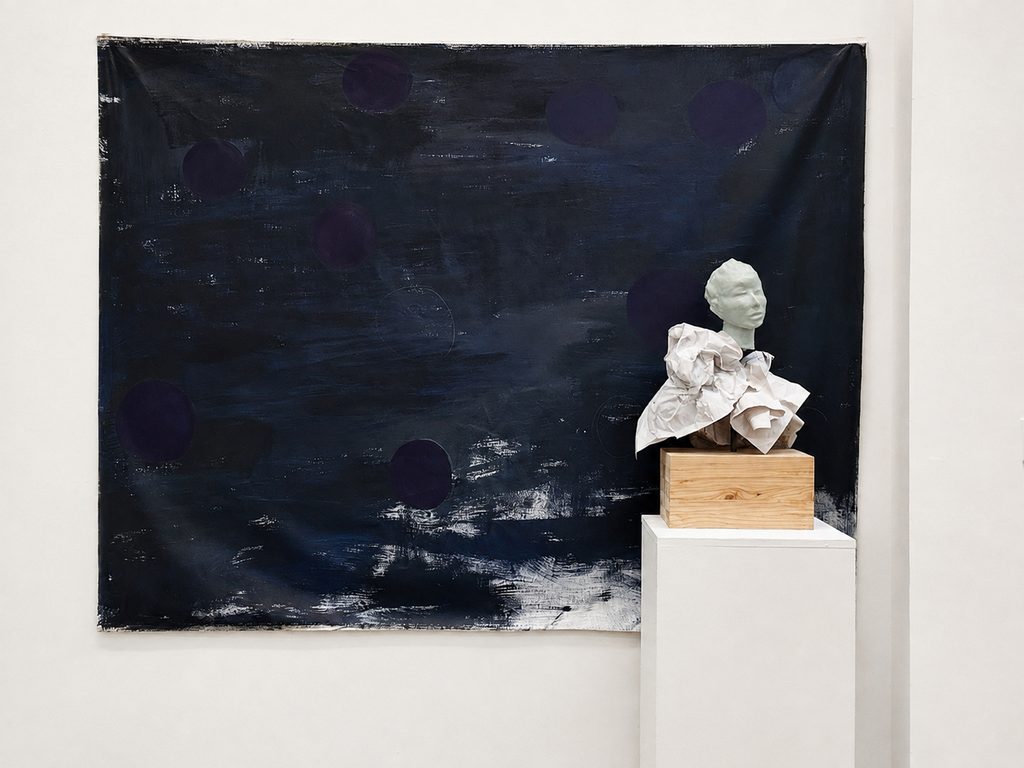
Susan Salinger, Letter to a Friend, 2026. Clay, wood, steel, paper, and canvas. 6 ft. × 5 ft. × 3 ft.
Susan Salinger initiated the chain with Letter to Janet, a letter written in 2026 to Janet Panetta, two years after her death. The letter, tiny—barely two inches by two inches—turns writing into a material object and grief into a form of presence. Between loss and permanence, the work introduces the two states that gave this iteration its name: sorrow and joy, not as opposing experiences, but as conditions capable of coexisting.
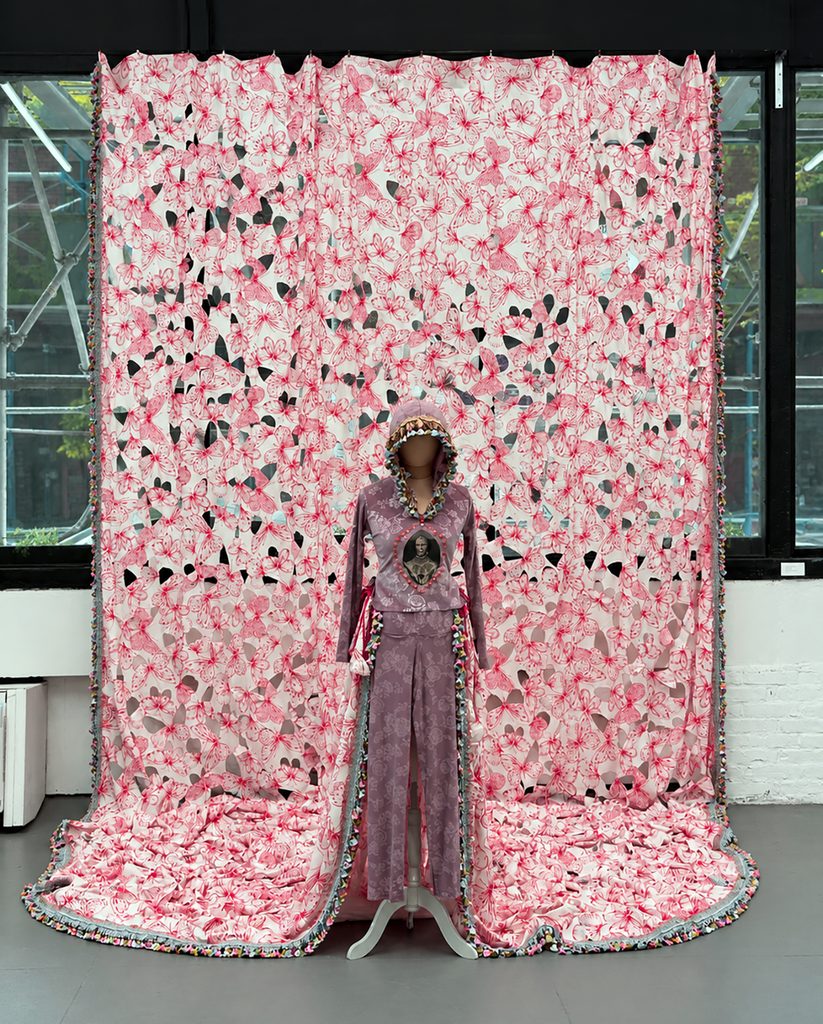
Yohanna M. Roa, Textile Woman, 2022–2025. Textile installation-performance. Dimensions variable.
Receiving Susan’s materials led me to Textile Woman. In this installation-performance, two large textiles attached to the walls connect to my body through a belt, making domestic architecture function simultaneously as dress, shelter, and mechanism of restraint. The work draws on the memory of my grandmother, a self-taught seamstress and designer. During the action, I sew my dress to the wall and then destroy what I have just joined together until I break free. This intimate memory intersects with the gendered division of labor and its transmission among women: the personal is one of the sites where these structures become material.
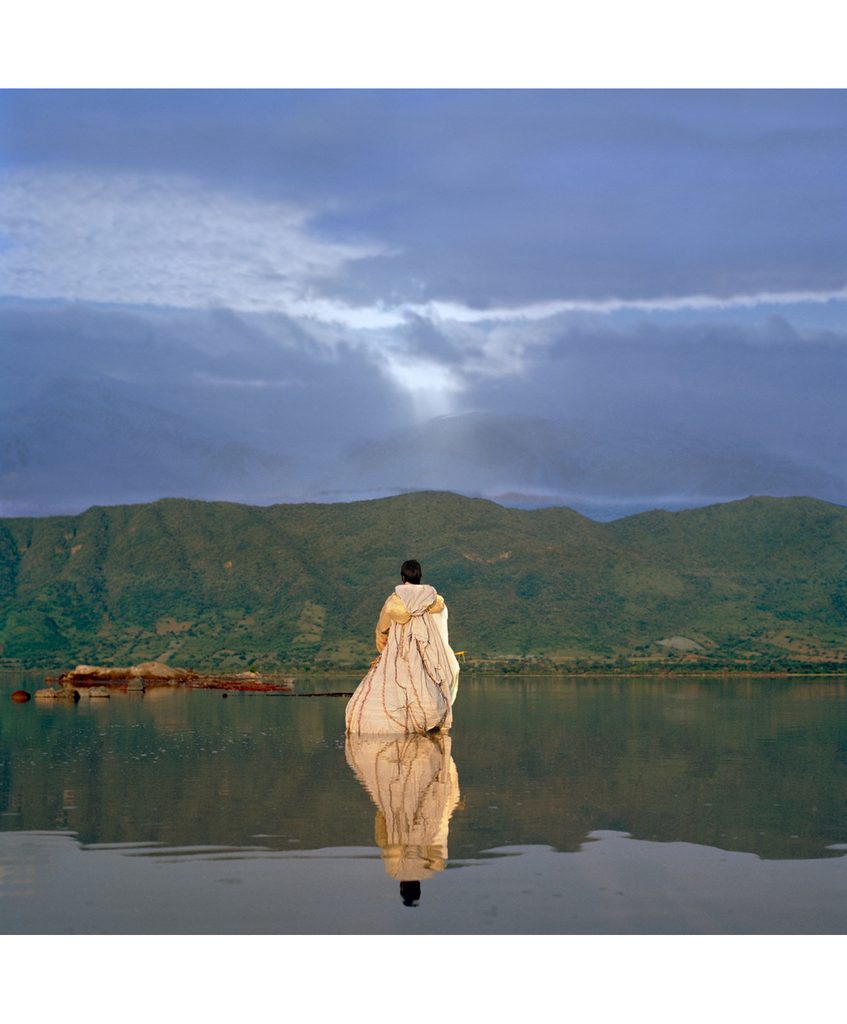
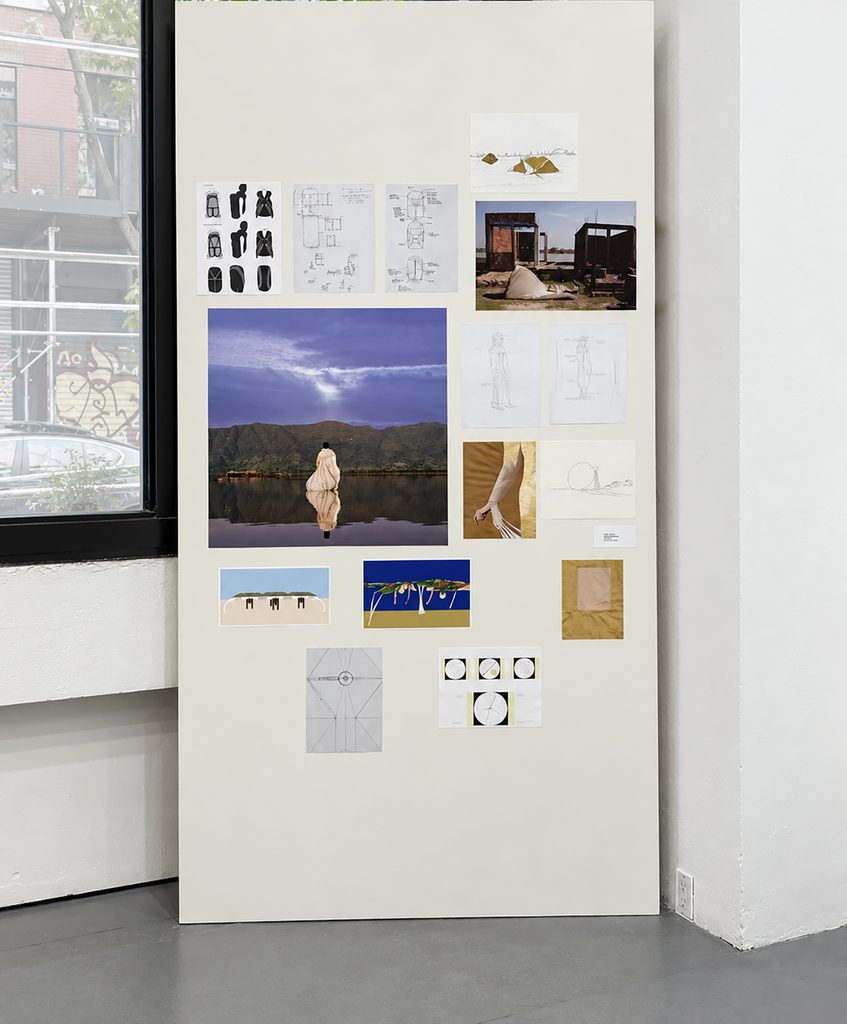
Mary Mattingly, Wearable Homes. Documents. Dimensions variable.
Mary Mattingly received these materials and shifted the conversation toward Wearable Homes, where clothing becomes portable architecture for a future marked by climate migration and precarity. Initially conceived as individual units of survival, these bodily structures can be connected to one another to form collective shelters. Survival is no longer imagined as individual self-sufficiency but depends materially on the possibility of connecting with others.
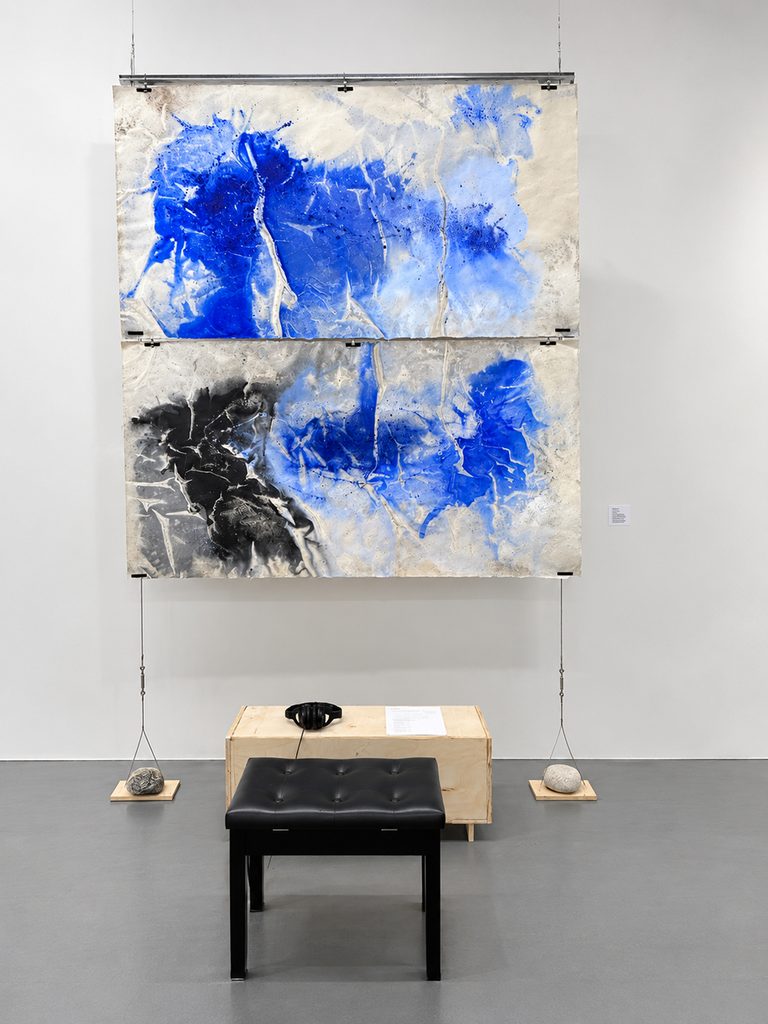
Monika Weiss, Lethe-Medusa, 2023–2026. Installation, dimensions variable. Resin, water, lapis lazuli pigment, graphite powder on rice paper, piano chair, headphones, listening directions, and sound/music composed by the artist. Singing voice: Kelly Beekman, mezzo-soprano; speaking voices: Mary Zhou and Monika Weiss. Passages from The Exaltation of Inana by Enheduanna (2300 BCE), in English, Sumerian, and Polish. English translation by Sophus Helle.
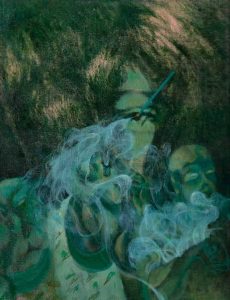
With Lethe-Medusa, Monika Weiss shifted the chain toward listening. A translucent diptych made of resin, water, pigment, and graphite is articulated with a sound composition built from recordings of trees moving in the wind, whose rhythms Weiss transposes into the human voice. Lethe, the river of forgetting, and Medusa converge in an ecofeminist lament that shifts memory and loss toward a relation between human and more-than-human bodies.
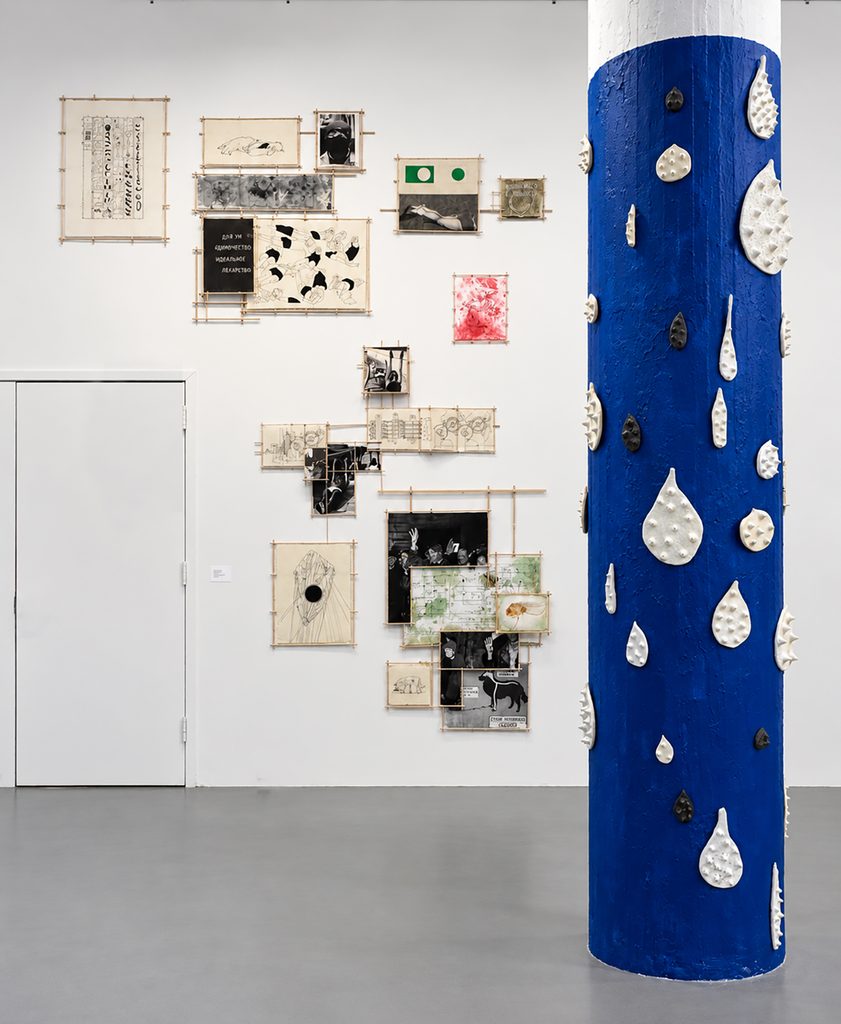
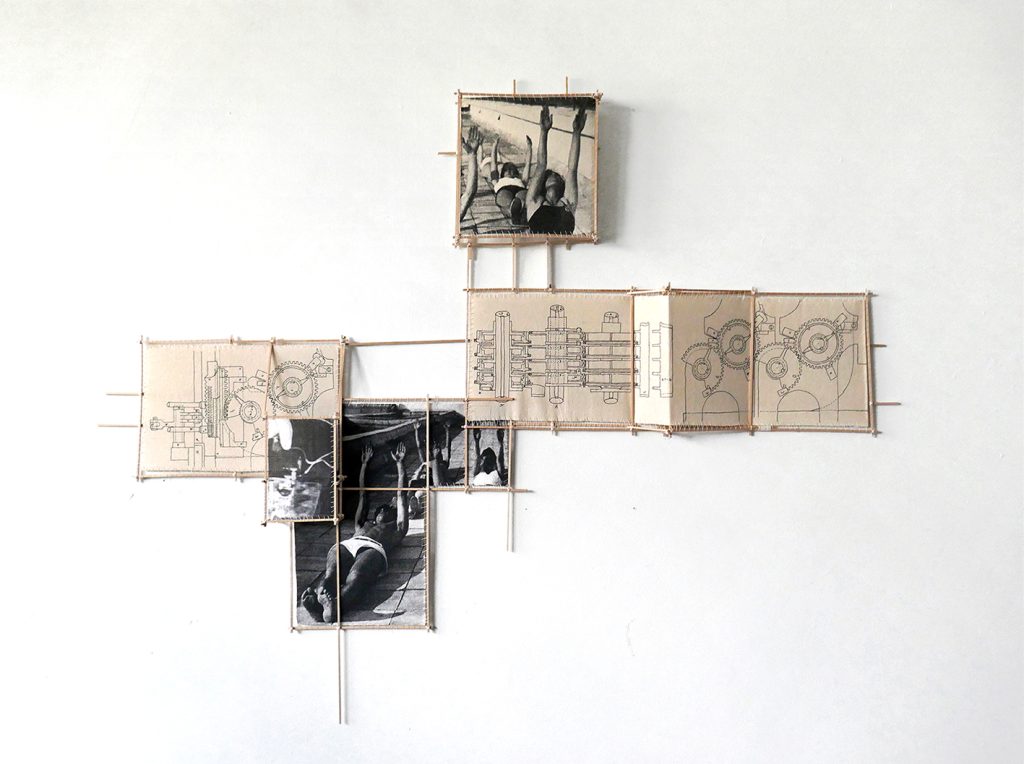
Tatiana Istomina, Flight Mechanics, 2021. Wood, fabric, hand embroidery, silkscreen, string, and glue. 42 × 52 × 3 in. Right: Cecile Chong, Wailing Cacti, 2025. Ceramic and volcanic ash on blue wall. 9 ft. × 4 ft. × 2 in.
Cecile Chong responded with Wailing Cacti. Against a deep blue field, ceramic cactus forms appear as tears, rain, drifting bodies, or seeds. Chong draws on Opuntia cacti, their capacity to nourish and survive, but also on their migratory history: plants native to the Americas that circulated to other continents along colonial routes. Resilience ceases to be an abstract celebration: even organisms capable of adapting to extreme conditions encounter limits in the face of ecological crisis.
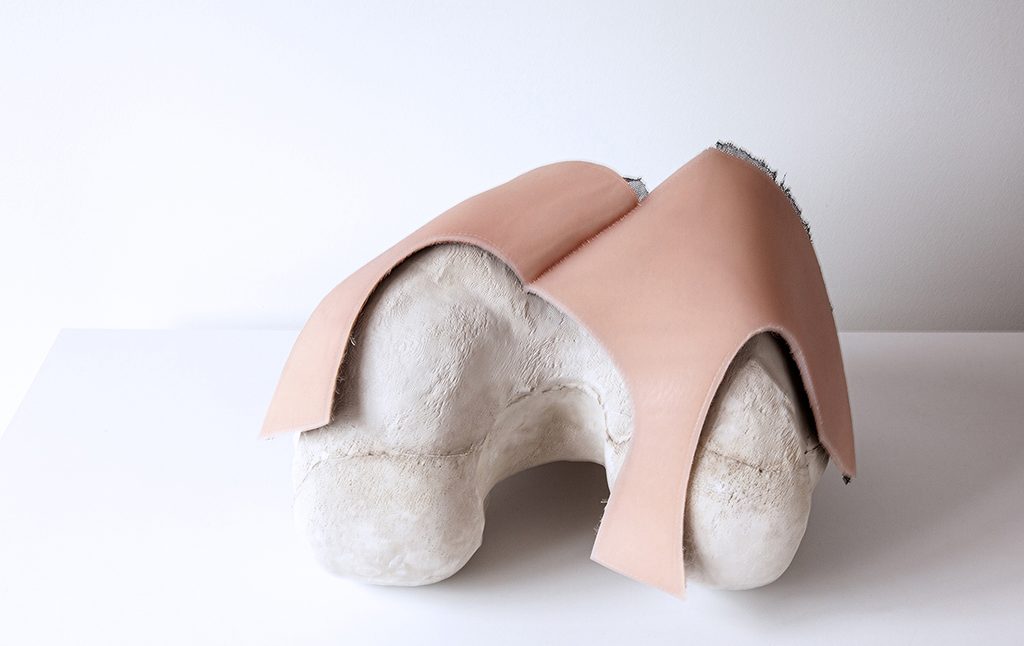
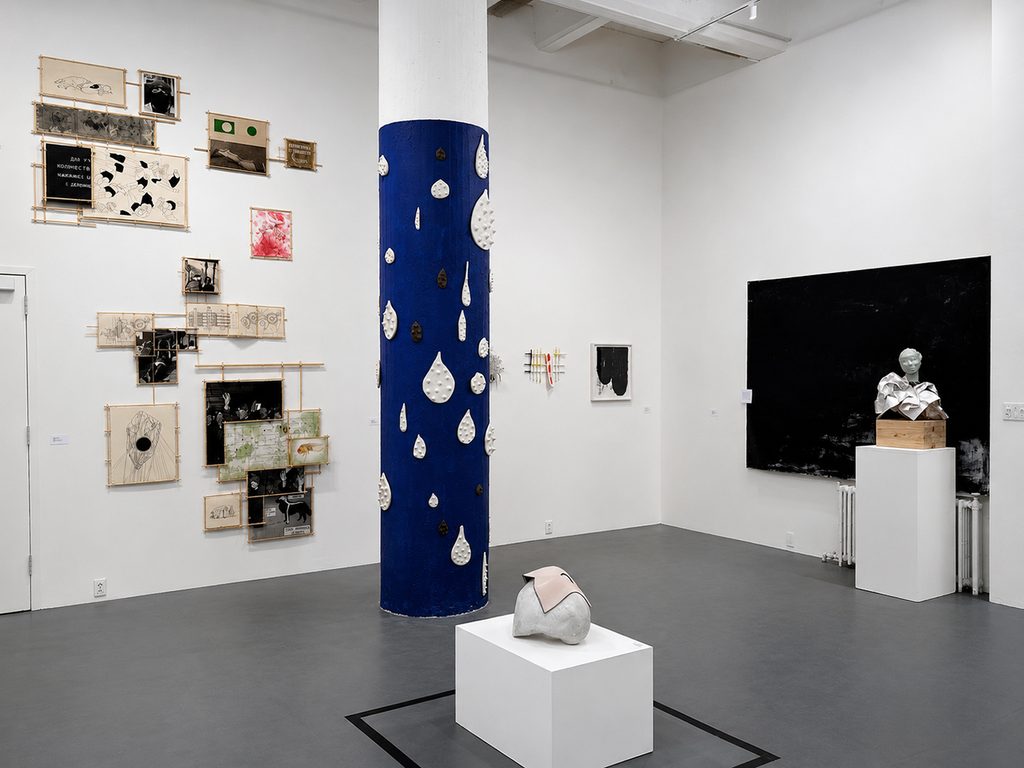
Left: Lilia Ziamou, The Bone Wore Garters, 2022. Cement, treated fabrics, digital drawing, silicone, and threads. 15 × 13 × 10 in. Right: Tatiana Istomina, Flight Mechanics, 2021. Cecile Chong, Wailing Cacti, 2025. Susan Salinger, Letter to a Friend, 2026.
In The Bone Wore a Bra, Lilia Ziamou shifts these questions back toward the body. Through 3D scanning, digital modeling, and traditional sculptural processes, she treats bone as a structure capable of being dressed, repaired, and transformed. A pink silicone form, sewn and stretched over the bone structure, oscillates between flesh and garment, protection and exposure. Repair does not mean restoring a body to an assumed original state: the body retains memory precisely because it has been transformed.
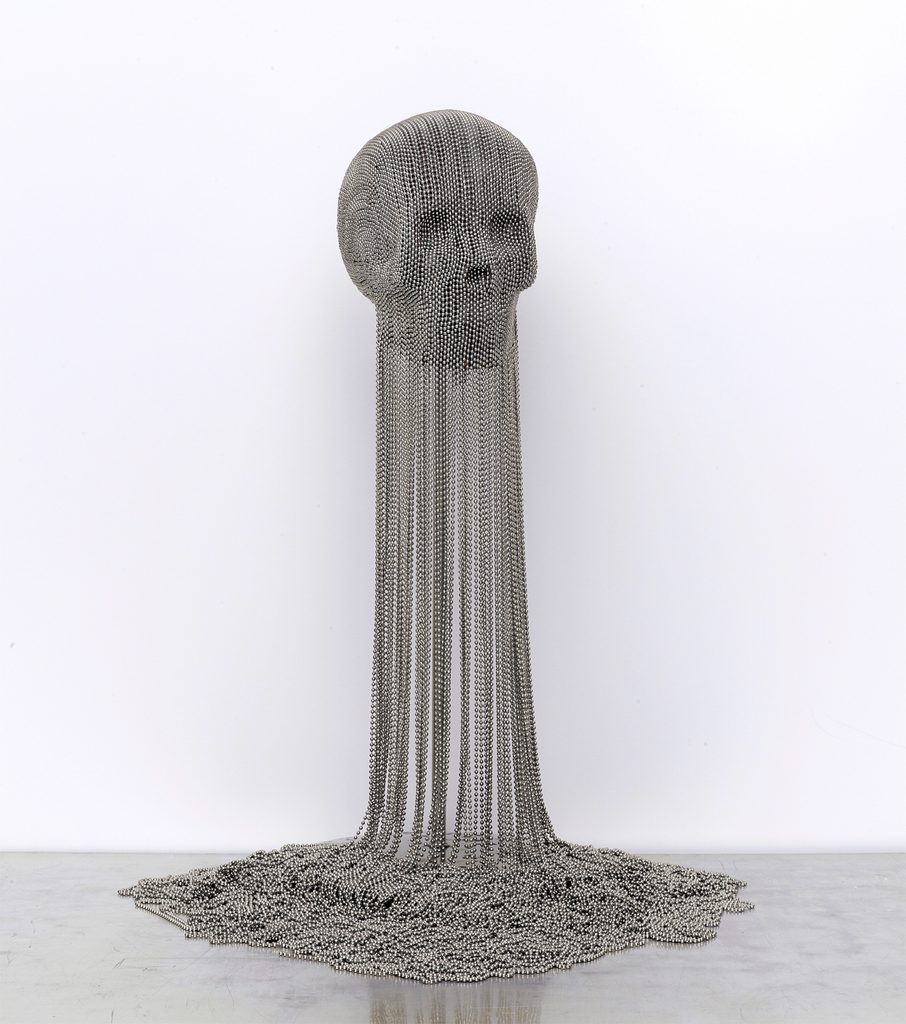
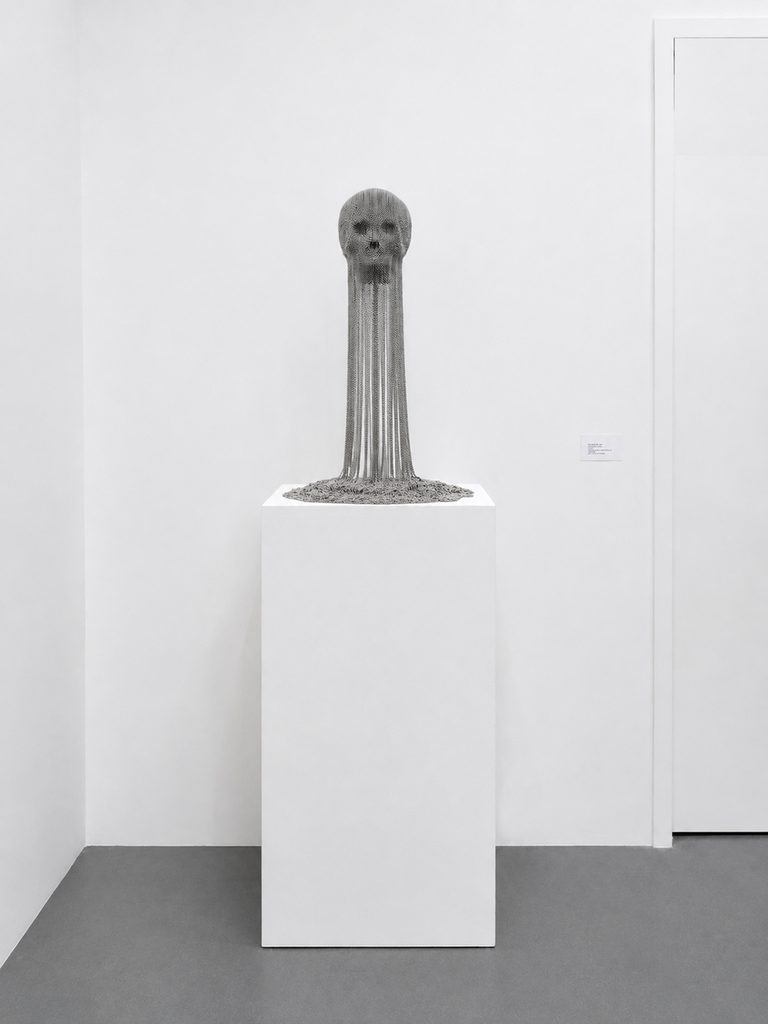
Esperanza Cortés, Flora and Fauna, 2015. Clay sculpture, ball chain, and found metal base. 20 in. H × 20 in. diameter.
Esperanza Cortés’s Flora and Fauna shifts this reflection toward a body traversed by historical memory. A clay head covered and extended by chains brings the vulnerability of the bodily form together with a material associated with weight, restraint, and continuity. In Cortés’s practice, skulls and organs become sites where individual experience intersects with the ongoing legacies of colonialism, labor, social justice, and environmental devastation. The body thus appears as matter upon which history continues to act.
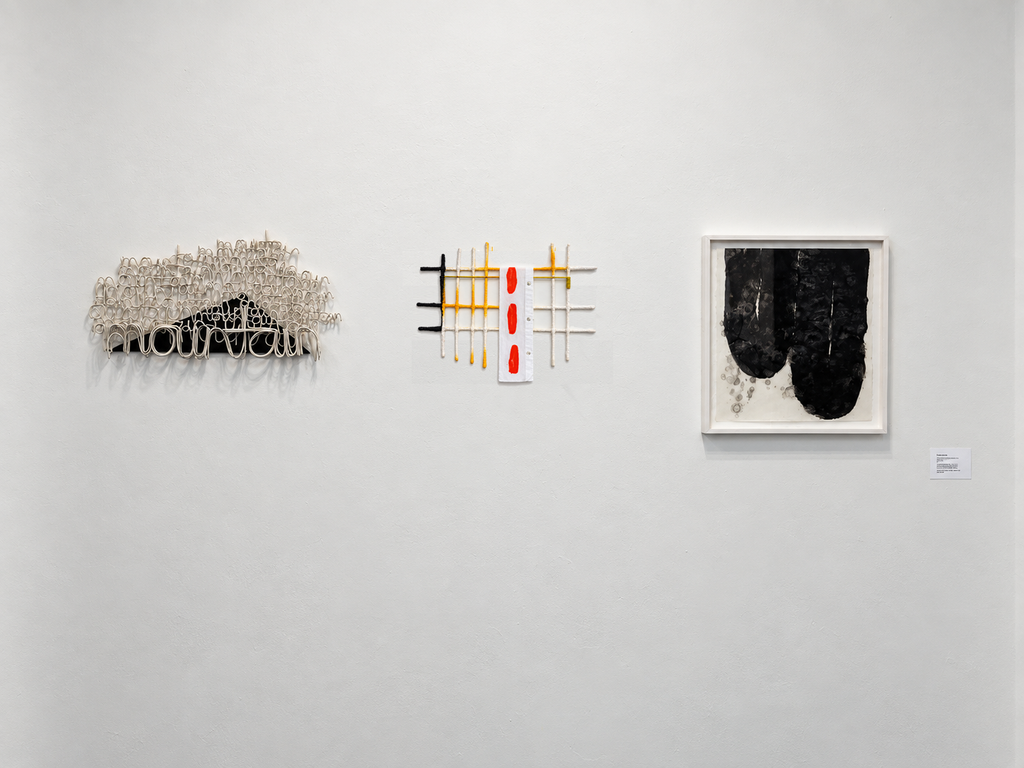
Sandra Eula Lee, The Walking Mountain (paved), 2016. Found electrical wire from construction sites in Seoul, thread, wood, and asphalt. 14 × 26 in.
Sandra Eula Lee responded with The Walking Mountain (paved), in which electrical wire recovered from construction sites in Seoul is handwoven with thread over an asphalt-covered form. Weaving functions as repair, while the mountain offers a way of thinking about migration between geological time and our accelerated present. Day (white shirt) and Day (double black) extend this relationship among construction materials, body, labor, displacement, and impermanence.
Tatiana Istomina closed the circuit with Flight Mechanics. Her assemblages combine printed images, painting, and embroidery within precarious structures of wood and thread, bringing together Soviet photographs from the 1920s and 1930s, early computer designs, and scientific documentation. Istomina examines political, mechanical, biological, and epistemological systems in which each individual can be simultaneously an indispensable component and a potential point of failure. The desire to fly contains both the aspiration to overcome limits and imagine other futures and the possibility of oppression, crisis, and collapse. By responding to both Esperanza Cortés and Susan Salinger, her work materially closed the circuit.
The chain had to be modified because of absences and health issues. During the process, one artist became temporarily ill; I passed her materials on to the next participant and, when she was able to return, her contributions reentered the circulation. Illness, absence, recovery, and care materially altered the chain. The private acquired a political dimension here: bodies, their limits, and their material conditions intervened in who could work, when, and within what relations of support.
The question of power also emerged during the installation. No participant formally assumed the role of curator, but removing the name of that function did not make power disappear. I designed the final floor plan with the support of Juan Puntes, director of WhiteBox, attempting to respect each artist’s preferred placement, although the conditions of Gallery MC required adjustments. The resulting proximity made that negotiation physically perceptible: the works approached one another, visually interfered with one another, and produced unexpected adjacencies. Each practice retained its singularity, but none could be experienced entirely in isolation from the others.
Monika Weiss, Lethe-Medusa, 2023–2026. Performed as part of The Braid / La Trenza, Part II, presented by WhiteBox Portable at Gallery MC, New York, June–July 2026.
On the closing day, Susan Salinger presented the performative component of Letter to Janet: the audience gathered in a circle and participated through movement and collectively produced rhythms, shifting an intimate letter written after the death of a friend into a shared experience of grief, memory, and presence. Monika Weiss presented the sound performance of Lethe-Medusa, bringing together voice, recordings of the forest, lament, and deep listening.
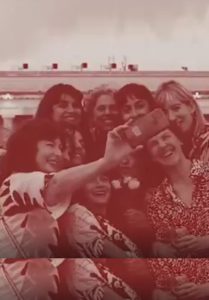
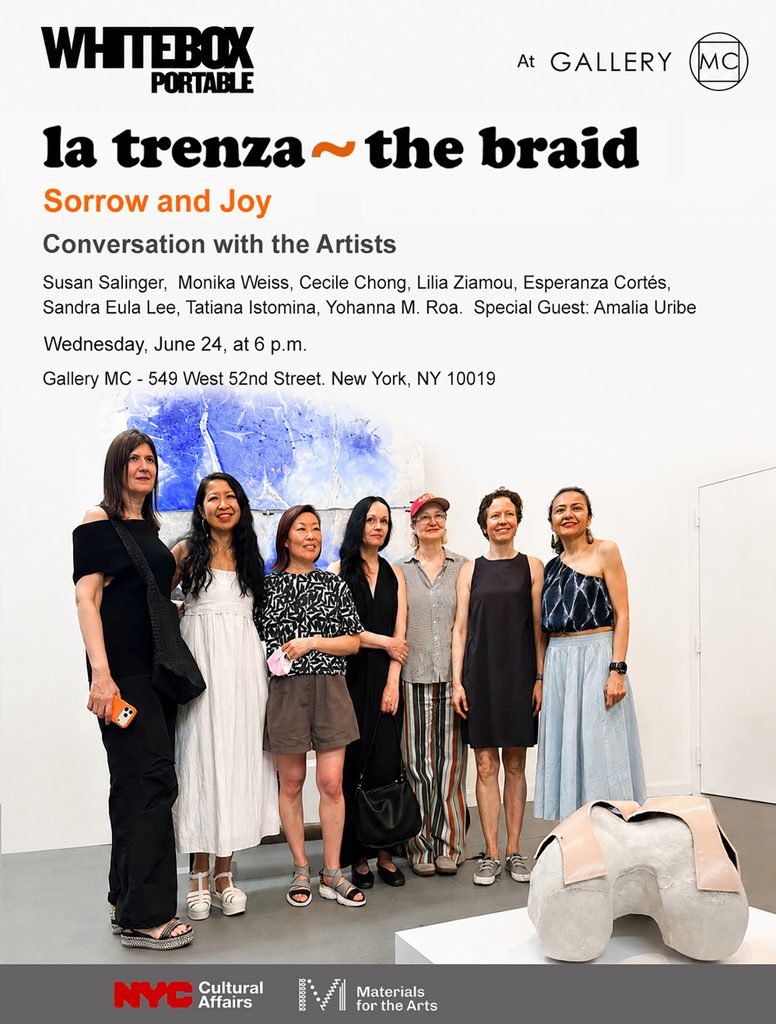
After the performances, Amalia Uribe moderated a conversation among the artists about the curatorial process, how each of us approached it from our own experience, and what emerged when we finally encountered the works together in the exhibition space. For much of the process, we had worked with incomplete information: each artist received materials, made decisions, and sent forward a new proposal without knowing the trajectory as a whole. The conversation allowed us to reflect on what each had received and transformed, our perceptions of the final assemblage, and the unexpected relationships and tensions among the works. It also brought into focus the personal and political dimensions of the process, particularly how individual decisions, differences, and negotiations shaped the collective exhibition. These reflections opened the possibility of continuing the curatorial process as a field of inquiry: not to repeat a formula, but to examine its contradictions and test other forms of artistic and collective production.
Currently, the braid – la trenza is moving toward a new iteration at the Bronx River Art Center in New York, followed by another in Oaxaca, Mexico, in 2028. Sorrow and Joy established a concrete premise for that continuity: the way we make an exhibition cannot be separated from what it proposes. If the braid functions as a political methodology, it is not because it eliminates differences or relations of power, but because it allows us to make them visible and work within them.
[1] M. Roa, Y. (2026). The braid—la trenza: A feminist and decolonial curatorial practice. Feminist Art Practices and Research, 2(1). https://doi.org/10.1080/29986982.2026.2662441