Subverted Times. Interferences in the Museum’s Space/Time
Museum of the Americas — Madrid
On view through March 8, 2026
Catalogue forthcoming
By Lorena Salamanca
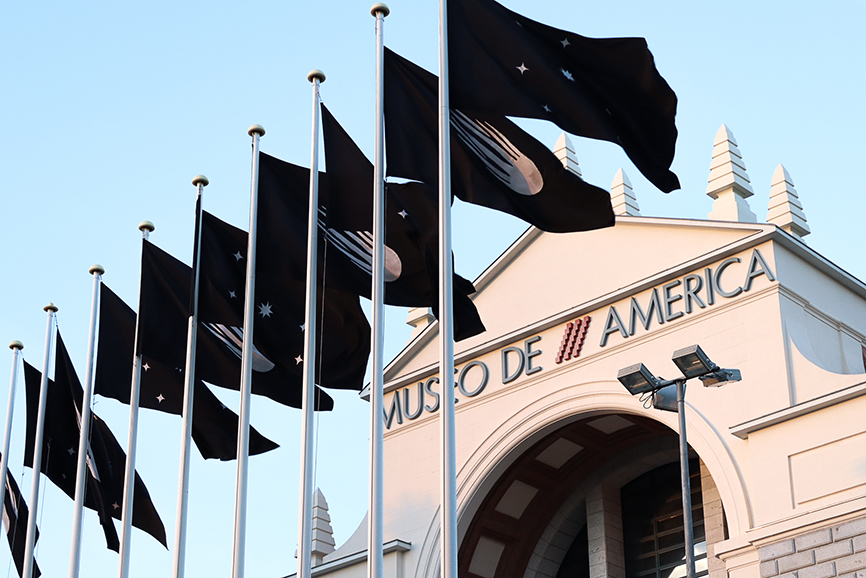
Luisa Ordóñez, To the Stars It Shall Return (2025). Courtesy of the artist.
Through the arc between artistic interventions and curatorial propositions in the exhibition Subverted Times. Interferences in the Museum’s Space/Time, I examine several tensions between the Western ethnological museum, contemporary art, and temporally situated interventionist practices, emphasizing how these gestures derail the colonial continuum (Lambert, 2019). At the same time, I invite readers to move through the conceptual and material overflows surrounding the unilateral narrative of European history, the archive, the politics of representation, and the vernacular technologies embedded within other metrics of time. These acts of derailment destabilize regimes of historicity (Hartog, 2003) and regimes of temporality (Torres, 2022) attached both to chronological systems and to the traditional temporal axes through which time and space are commonly organized (past–present–future).
The exhibition brings together Abdiel Segarra, Claudia Claremi, Fabio Manosalva, Luisa Ordóñez, Silvia Ramírez Monroy, and Ugo Martínez Lázaro, who initially conceived this initiative as a collective platform for study and reflection, within which collaborative curatorial thinking permeates their own artistic interventions. The exhibition also includes contributions from Pablo Zamorano, Glenda Zapata, Ariel Sosa, and Lorena Tabares Salamanca (the author), invited during the preliminary phase already unfolding within the Museum of the Americas (MAM) in Madrid.
This text emerges from my participation as a researcher and cultural producer and deliberately departs from the form of art writing commonly associated with externality and critical distance. Instead, I adopt a careful narrative of co-produced practices unfolding within a framework of artistic imagination and political–migrant errancy, integrating subjectivities, resonances, firsthand knowledge, and dialogues developed throughout the process. In this sense, the present essay functions as a prelude to a forthcoming printed publication.
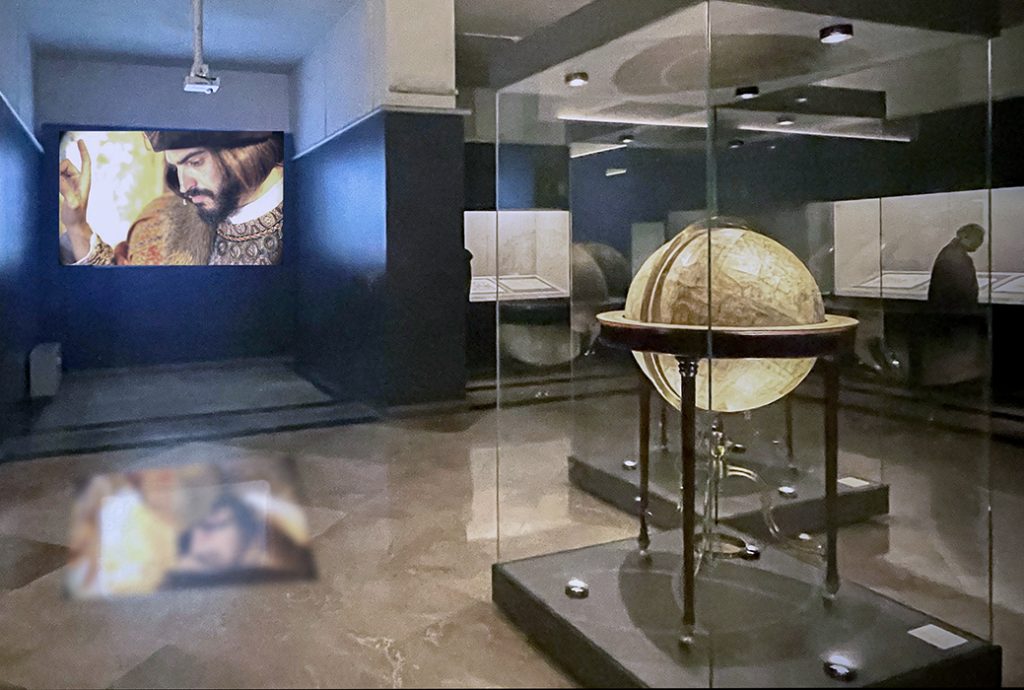
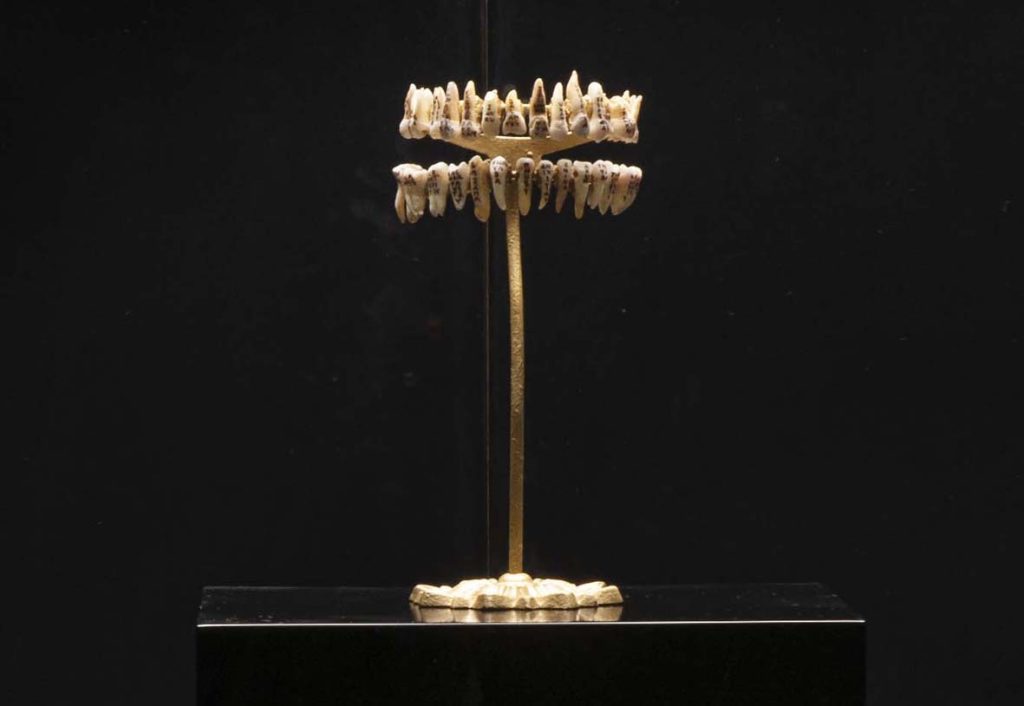
Left: Claudia Claremi, Colonial Amnesia (Delirium) (2025).Courtesy of the artist. Right: Glenda Zapata, Jawbone (2023). Chant performed by Rubén Ataucuri. Photo: Museum of the Americas.
Subverted Times… intervenes in universal time as the force that binds together the collection of ethnological objects belonging to the MAM’s permanent holdings. The emphasis on permanence, together with the Western naturalization of time, splits into two principles that remain in constant tension. Permanence becomes a blunt temporal specter: it embraces linear, progressive, and accumulative time, situating the objects and energies it preserves in the past, while simultaneously relying upon stasis and suspension.
These two principles effectively structure the historical stages of the precolonial, the colonial, and the postcolonial, sequential categories that overlook the hybridity of temporalities or even the absence of the concept of progress outside their own dominant and universalizing frameworks. Increasingly, the very validity of the postcolonial itself is called into question, particularly in a moment when settler colonialism continues to be authorized in the present. Meanwhile, stasis confines non-Western societies to a suspended temporal condition: a space in which attempts to transform the past appear nearly impossible and the future seems structurally foreclosed. Such arbitrariness ultimately freezes historical experience within a distant and fabricated archaism.
I no longer remember who once suggested to me that the present under dispute is anchored less in the past than in absence. Personally, I remain skeptical of restitution as a genuinely reparative mechanism. Rather than restoring historical continuity, restitution often deepens the absence of the communities to whom these objects belong, performing instead a geopolitical transfer of hegemonic entitlement that preserves the structural negation of the “other.”
Returning to Subverted Times…, the exhibition proposes a series of critical and artistic leaps through ten site-specific interventions in which the reversibility and multidimensionality of time, a plural constellation of philosophical, mathematical, physical, and linguistic categories, becomes a navigational map for moving through the museum.
To rely on other systems for measuring time is to recap, remake, and walk both ancestrally and contemporaneously; to compress distances; to repeat and update in dialogue with societies that persist in resisting colonial violence and those that, tragically, continue to endure its ongoing devastation. Other temporalities, spiral, circular, concentric, eccentric, generate regimes of cyclical time (Martins, 2021) that unsettle the linear ordering of past, present, and future. They grant a force of return, resonance, and reversibility to our condition as wandering beings, enabling geological, geographic, political, and cultural memories to surface and circulate.
Within the museum, the supposed universality of time becomes permeated by temporal systems in constant redefinition that sustain life and gesture toward its potential escape beyond the institutional architecture that contains it.
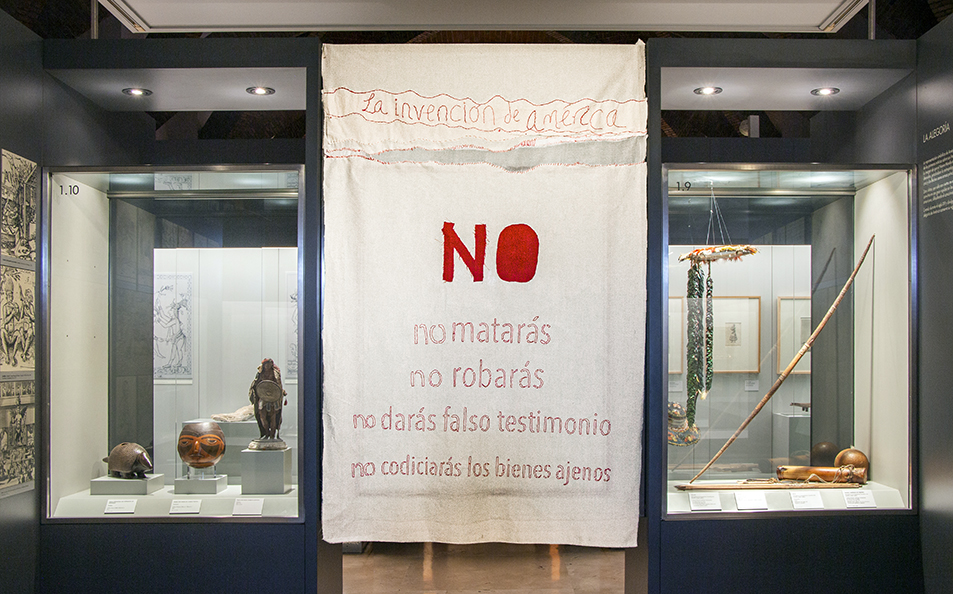
Silvia Ramírez Monroy, When Everything Breaks (2025). Courtesy of the artist.
In the first gallery stands the textile work When Everything Breaks (2025) by Silvia Ramírez Monroy. Bluish tonalities overlap among fragments of fabric of varying dimensions, while the central typographic embroidery in red references Edmundo O’Gorman’s book The Invention of America (1958), using its title as the heading for another invention: the Spanish Empire constructed under the doctrinal authority of Christian theology. If the violent dimension of this colonial enterprise rested upon the moral architecture of Catholicism, Ramírez foregrounds instead the abandonment of the very law that the conquistadors claimed to extend, while questioning the partial interpretation of the commandments upon which that moral order depended.
Through the imposition of a unified temporality, the expansion of Christianity subsumed other temporal systems within the teleological narrative of salvation, redemption, and forgiveness. According to philosopher Eduardo Mendieta (Castro-Gómez & Mendieta, 1998), this may be understood as a form of chronotopological expropriation, a modality of coloniality that precedes modernity itself.
At the center of the sixth gallery, the artist presents Invocation (2025), a textile sphere constructed from fragments of literary and historical texts. Within it, garments worn by herself and by other migrants accumulate into a globe weighing roughly forty kilograms, concealing symbolic objects, including a clay sphere that functions as a metaphor for rewritten histories. The outer layers, inscribed with handwritten text, emphasize the relationship between tool, word, and body, questioning the presumed neutrality of the archive while asserting its mutability.
The work juxtaposes multiple sources, including Indigenous testimonies regarding the invasion of Tenochtitlán alongside contemporary analyses and declarations from figures such as Josefa Contreras, the Zoque people, the Zapatista movement, and Nasa representatives who denounce both historical and environmental violence. Three photographs and a video recording expose the internal “entrails” of the work’s compositional process.
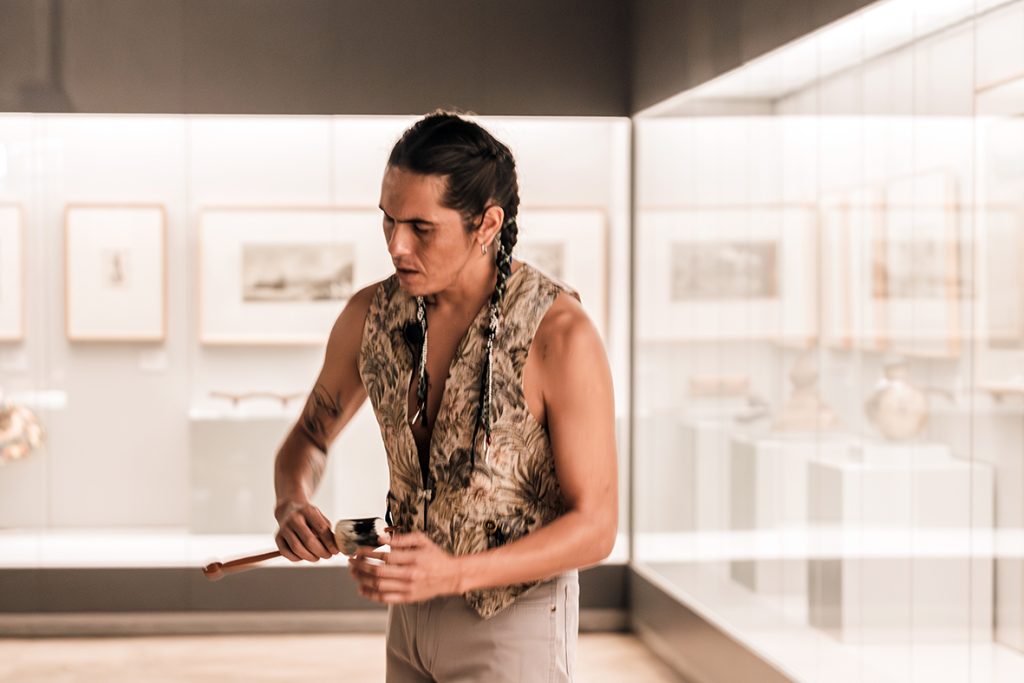
Pablo Zamorano Azóca, Topos, There Is Place in the Body (2025). Photo: Javier Pardo Fuertes.
Topos (There Is Place in the Body), a series of monthly activations by Pablo Zamorano, combines performance, objects, mirrors and period costumes and an acoustic exploration of the voice. The action begins with a costume change that evokes the modern Creole subject, referencing the heteronormative genealogy of colonial modernity. Zamorano then moves through the museum’s cabinets of curiosities while his body oscillates between trance and collapse, producing onomatopoetic sounds and abrasive gestures—contracting, stretching, extending across the floor, tearing through the air. An intervened audio guide accompanies the action with a soundscape that intensifies these vocal and linguistic frictions.
In a former storage room within the colonial cartography section, Fabio Manosalva installs In Absent Bodies Living Memories (2025): a hybrid sculpture positioned between machine and flower, assembled from appropriated metal fragments and situated within a darkened space crossed by green light. Two sound columns emit maritime waves and Colombian soundscapes for twenty-two minutes. Against the fiction of a completed colonial past, Manosalva constructs a sonic archive projecting future listenings of living struggles and resistances, challenging the museum’s linear narrative and the silences that sustain it.
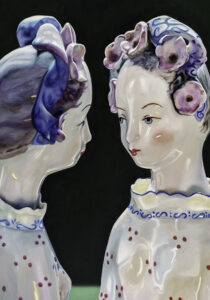
From an experimental and counter-archival orientation, Claudia Claremi juxtaposes theatrical maritime scenarios and monarchical mandates involving figures such as Queen Isabella and Christopher Columbus in the context of the 1492 voyage to the Indies with colonial representations preserved within the MAM collections. Through an audiovisual montage positioned at the threshold between documentary and anthropology, Claremi emphasizes tradition as a rehearsed perpetuation of social hierarchies.
In the chapter (Delirium) of the triptych film Colonial Amnesia (2025), a staging inspired by Golden Age theater constructs a heroic biographical anachronism marked by deliberate technical omissions. This operation functions as a commemorative banner reinforcing nationalist impulses within a context shaped by structural racism and social division. It relies upon what might be described as a “retrospective illusion,” a narrative that migrates into actors and spectators alike as an expectation of continuity, what Claremi interprets as structural amnesia. Similar dynamics appear in the numerous reenactments staged each October 12 or March 3 in museums, schools, and public spaces across Spain.
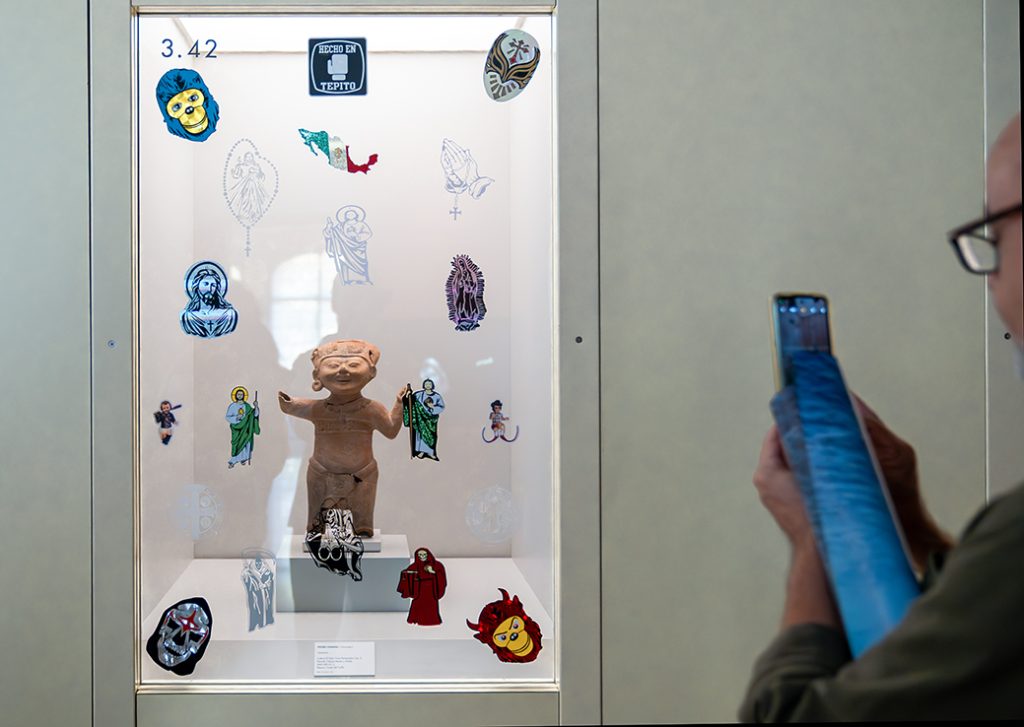
Ugo Martínez Lázaro, Reactivating the Myth, Decolonizing Time (2025). Rain god Cocijo or his assistant, the maize god Pitao Cozobi. Courtesy of the artist.
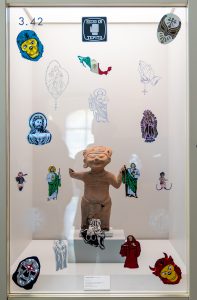
In Reactivating the Myth, Decolonizing Time (2025), Ugo Martínez Lázaro relocates six Mesoamerican ceramic figures into a single area of the museum, removing them from their linear historical classification. This gesture establishes a symbolic territory of shared rituals and cosmologies that challenges museum compartmentalization. Display cases become altars drawn from Mexican popular practices in which materials and meanings circulate through transformation, reactivating cosmic forces and contemporary memories: the three solar passages, the four cardinal directions of the terrestrial plane, the celestial vault, and other invisible yet perceptible presences.
In the first display case appears Quetzalcóatl–Ehécatl; in the second, an Eagle Warrior enters into dialogue with a Mexican popular toy embodying duality. The third presents Xipe Tótec and the relationship between sacrifice, death, and regeneration; the fourth features the Smiling Figure of Tajín associated with altered states of consciousness. The fifth brings together Chalchiuhtlicue, deity of water, and the sixth Cocijo, the Zapotec god of lightning and rain.
If one attempts to measure overlapping temporalities, teeth themselves may become markers of the time of a culture that persists, resists, and continues speaking. In several Aymara traditions, death, distinct from the material culmination of the human passage through the world, is replaced by the notion of the “great journey.” This infinite path is prepared from the moment of arrival into life, and children accompany the departing being by throwing white stones along the road. The dead proclaim: “If you see me stop, throw white stones at me.” Such phrases appear in mortuary songs, forming part of ritual practices in Bolivia.
From this convergence of ritual song and embodied memory emerges Jawbone (2023) by Glenda Zapata: an assemblage of teeth from Bolivia placed on a pedestal shaped like a golden flower. By tattooing each of the thirty-two teeth in Aymara, the artist invokes both the call of the underworld and the persistence of Indigenous languages that have survived even epistemicide and colonial literacy. The piece is accompanied by the voice of Rubén Ataucuri, pre-recorded in Madrid, whose repetition of the Aymara chant reactivates memory within the context of the MAM’s mortuary gallery. The chant—an oral and ancestral form of memory—connects with the teeth, whose enamel can preserve a person’s DNA and constitutes the most durable, rigid tissue in the human body.
Abdiel D. Segarra Ríos and Ariel Sosa Urquía propose, through Signals from This Side (2025), the circular transmission of messages passed hand to hand, connecting present realities, captured in the artists’ personal photographic archives, with records of neocolonial enclaves and their articulation with European imperial colonialism. The project unfolds a sequence of assertions and questions that challenge the equivalence drawn between plunder, scientific expeditions, neoliberal campaigns of territorial protection, and extractivist enterprises.
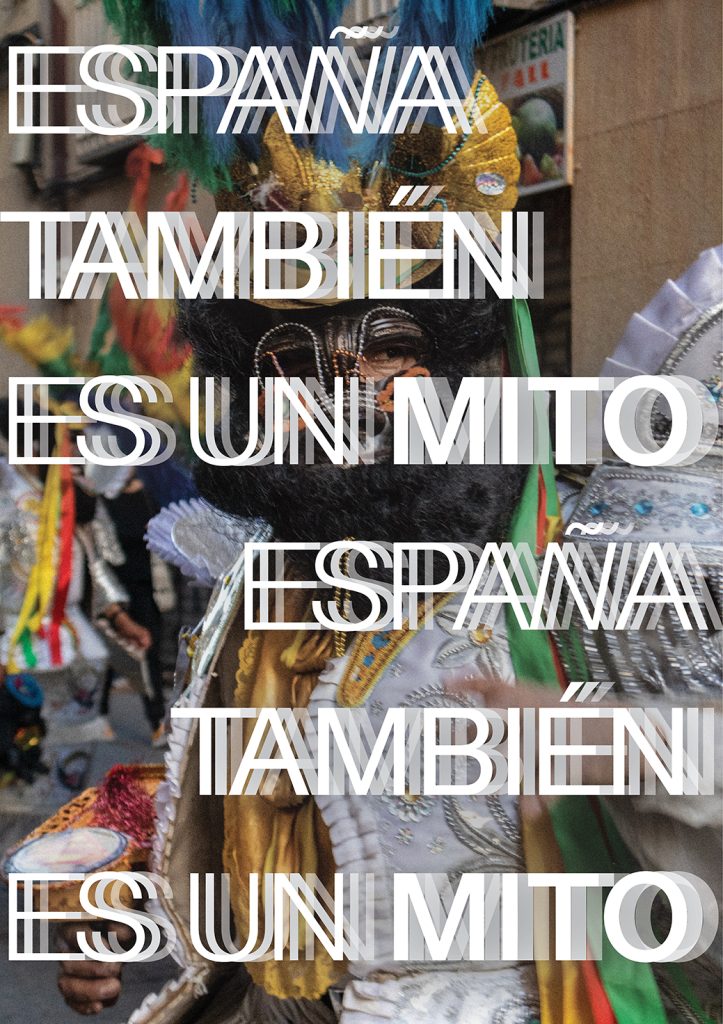
Abdiel D. Segarra Ríos & Ariel Sosa Urquía, Signals from This Side (2025). Posters and postcards. Courtesy of the artists.
On the museum’s first floor, posters and postcards invite reading and interaction, accompanied by audio recordings of protests in Puerto Rico and Honduras. Among the phrases that appear are “Spain is also a myth” and “The wound will not heal without repairing the damage.” Incidentally, the poster bearing the phrase “Museum rhymes with plunder” was printed but not displayed, as the Museo de América (MAM) argued that the relationship between the phrase and the background image did not correspond to reality. The museum maintained that the Maya object reproduced there had not been looted, but had instead reached the institution through a “traceable provenance” among collectors and archaeologists who ultimately donated it to the National Museum of Anthropology in Madrid.
In response, the authors argue that historical theft cannot be reduced to legal validation, provenance reports, or, even less, to political-administrative whitening mechanisms that impose rules upon societies without their consent. The accumulation of material objects rests upon exercises of authority that exclude living knowledge and the cultural reproduction practices of subordinated societies, perpetuating a symbolic dispossession that gestures of nominal reparation or diplomatic events can scarcely remedy.
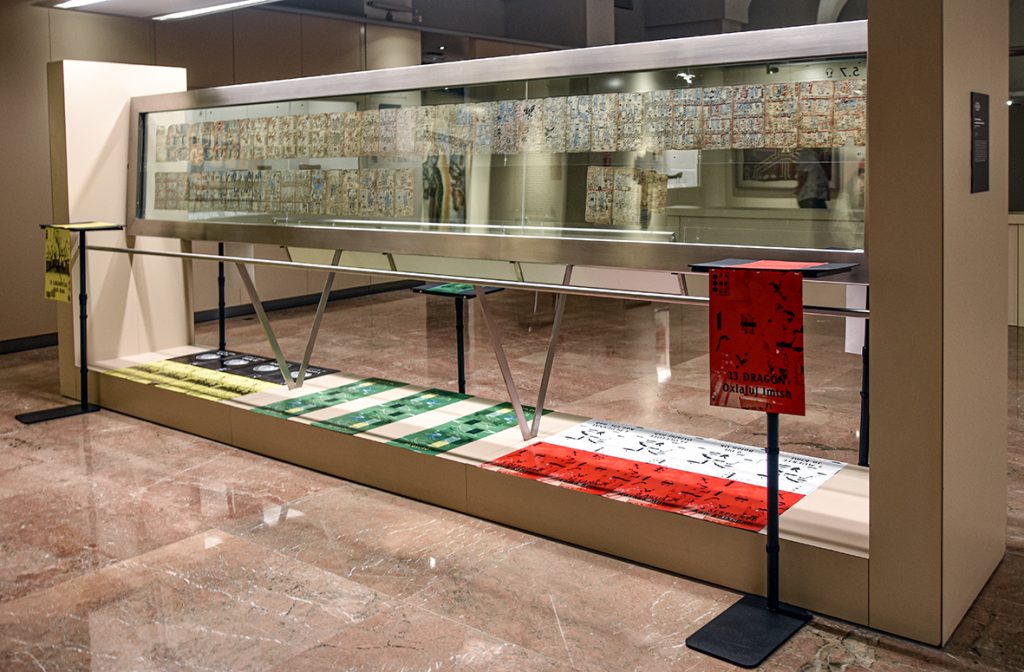
Lorena Tabares Salamanca, The Double Reverse Self, Transatlantic Recapitulation (2025). Facsimile of the Tro-Cortesian Codex in display case.
Conceived by Lorena Tabares as a textual chronotope, The Double Reverse Self: Transatlantic Recapitulation (2025) functions as a chronotopological appendix to the Tro-Cortesian Codex. Presented in calendar format and following the combinatory system of the Tzolk’in, the work gathers testimonial realities concerning struggles against colonial and neocolonial extermination. Organized into five chromatic sequences (red, white, green, black, yellow) and four days of literary progression, each image navigates time beginning at the end of the Maya trecena: day 13 (Oxlajuj) of the crocodile or mud dragon (Imish/Imix), corresponding in the Gregorian calendar to August 1, 2025, and suggesting the possibility of perpetual reinvention.
Strategically conceived for the flagpoles in the museum’s entrance plaza, To the Stars It Shall Return (2025) synchronically deploys a constellation of pictograms and a textual message, both screen-printed on black backgrounds in place of the customary flags of the American nations. Through twenty-four new flags, Luisa Ordóñez reflects on the origin of gold, attending to the central role this metal played in the consolidation of colonial modernity. The work explicitly references the numerous ethnological objects crafted entirely in gold—such as the Quimbaya Treasure, also part of the MAM collection—while tracing its reflection back to a far earlier origin: matter produced by a cosmic explosion.
Ordóñez refers to a stellar event that occurred four billion years ago, projecting noble metals—including gold—in the form of asteroids toward Earth. A comparable astronomical phenomenon was recorded in 2017. The hypothesis of materiality in flux strains, on the one hand, the appropriative narrative of the Euro-Western matrix and, on the other, reveals the geospatial depth of matter beyond everything categorized as humanity and civilization. From this position emerges a critical reflection on teleological temporalities and an opening toward cosmological infinity, in stark contrast to human vulnerability and its persistent desire for eternity.
If deep time allows a dense return toward a past metrically inconceivable when compared with the existence of the first human being, it also projects toward an equally distant future in which humanity will have crystallized its barbaric and catastrophic trajectory into particles drifting through a forgotten galaxy.
References
Castro-Gómez, Santiago, and Eduardo Mendieta, eds. 1998. Teorías sin disciplina: Latin Americanism, Postcoloniality and Globalization in Debate. Mexico City: Miguel Ángel Porrúa.
Hartog, François. 2007. Regimes of Historicity: Presentism and Experiences of Time. Mexico City: Universidad Iberoamericana.
Lambert, Léopold. 2019. The Colonial Continuum. London: The Funambulist.
Martins, Leda Maria. 2021. Performances do tempo espiralar: poéticas do corpo-tela. Rio de Janeiro: Editora Cobogó.
Torres, Fernando. 2021. Temporal Regimes. https://doi.org/10.4324/9781003180876