By Yohanna Magdalene Roa
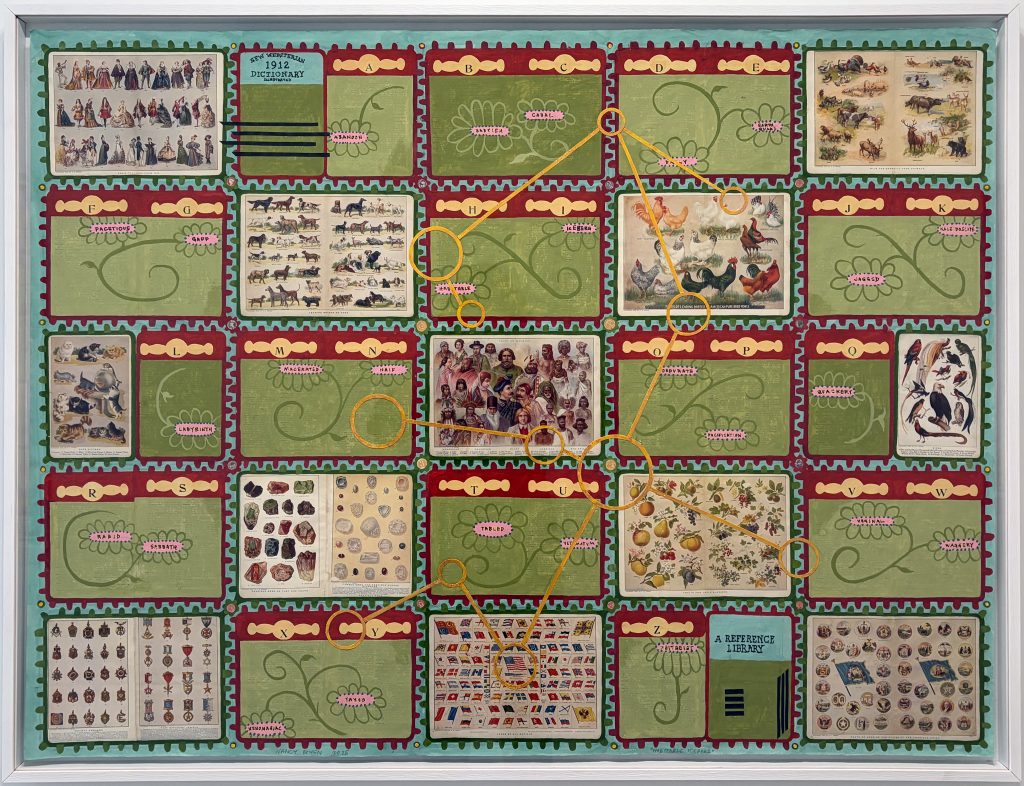
The dictionaries from which Nancy Bowen constructs her collages belong to a world that no longer exists. They are objects produced in a time when words seemed to possess stable meanings, categories promised to organize reality, and knowledge could be arranged alphabetically. For much of the twentieth century, the dictionary occupied a privileged place within modern education: it was not simply a reference tool but a pedagogical machine intended to teach what the world was and how it should be named. Unlike today, when dictionaries coexist with search engines, digital databases, online platforms, and increasingly with artificial intelligence systems that organize and circulate information in new ways, the printed dictionary functioned as a primary authority for linguistic knowledge and a model for how reality itself could be ordered and understood.
In From A to Z and the Bodies In Between, Bowen transforms these artifacts of knowledge into something different. She fragments them, displaces them, and turns them into surfaces of play, visual pathways, and improbable encounters between images, words, and forms. What once functioned as a promise of order becomes here a territory open to imagination, intuition, and drift.
The exhibition brings together a series of collages constructed from old dictionaries inherited from her parents, received from friends, or found over the years, alongside sculptures made from ceramics, shells, coral, glass, fish bones, and recovered objects. Although these two bodies of work may appear very different at first glance, they share the same operation: the reorganization of preexisting materials to produce new relationships between language, matter, and experience.
There is something archaeological in this gesture.
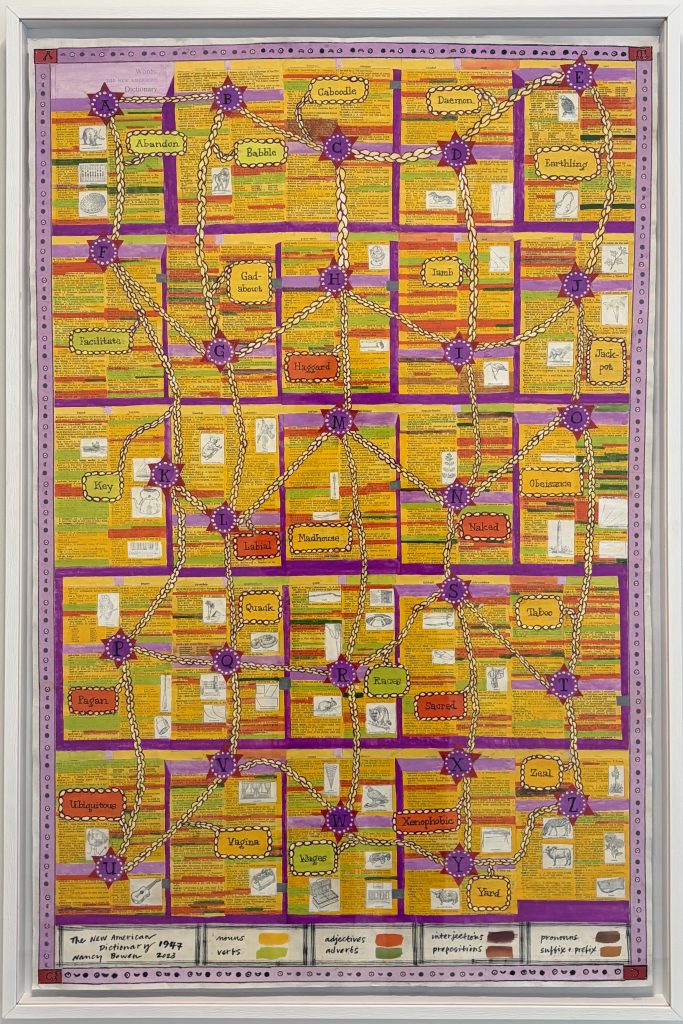
Naked Obeisance, 2023. Collage, gouache, and found book pages on rice paper. Courtesy of Nunu Fine Art and the artist
Bowen does not work with historical documents to reconstruct the past. She works with them to make visible the cultural structures that still inhabit these objects. The dictionaries she uses preserve traces of a particular vision of the world: national imaginaries, racial hierarchies, pedagogical models, scientific illustrations, and forms of knowledge that for decades were presented as neutral and universal. In this sense, they are more than repositories of language; they are cultural technologies that select, organize, and regulate meaning, contributing to defining which forms of knowledge and representation acquired legitimacy within a given historical moment.
In several of the works included in the exhibition, isolated words emerge from the visual fabric as small poetic accidents: Habitable Iceberg, Jolly Kismet, Naked Obeisance, Ravishing Spiral. These combinations do not follow an obvious narrative logic. They arise from the careful observation of the pages, the intuitive selection of terms, and the artist’s ability to recognize resonances where none apparently exist. In this sense, her practice bears a significant relationship to certain strategies associated with Dada and Surrealism. Bowen does not pursue psychic automatism or the revelation of the unconscious in the historical terms of Surrealism. Nevertheless, she shares with these traditions a confidence in the critical power of displacement. Like the Surrealists, she understands that removing an element from its habitual context can produce new forms of meaning.
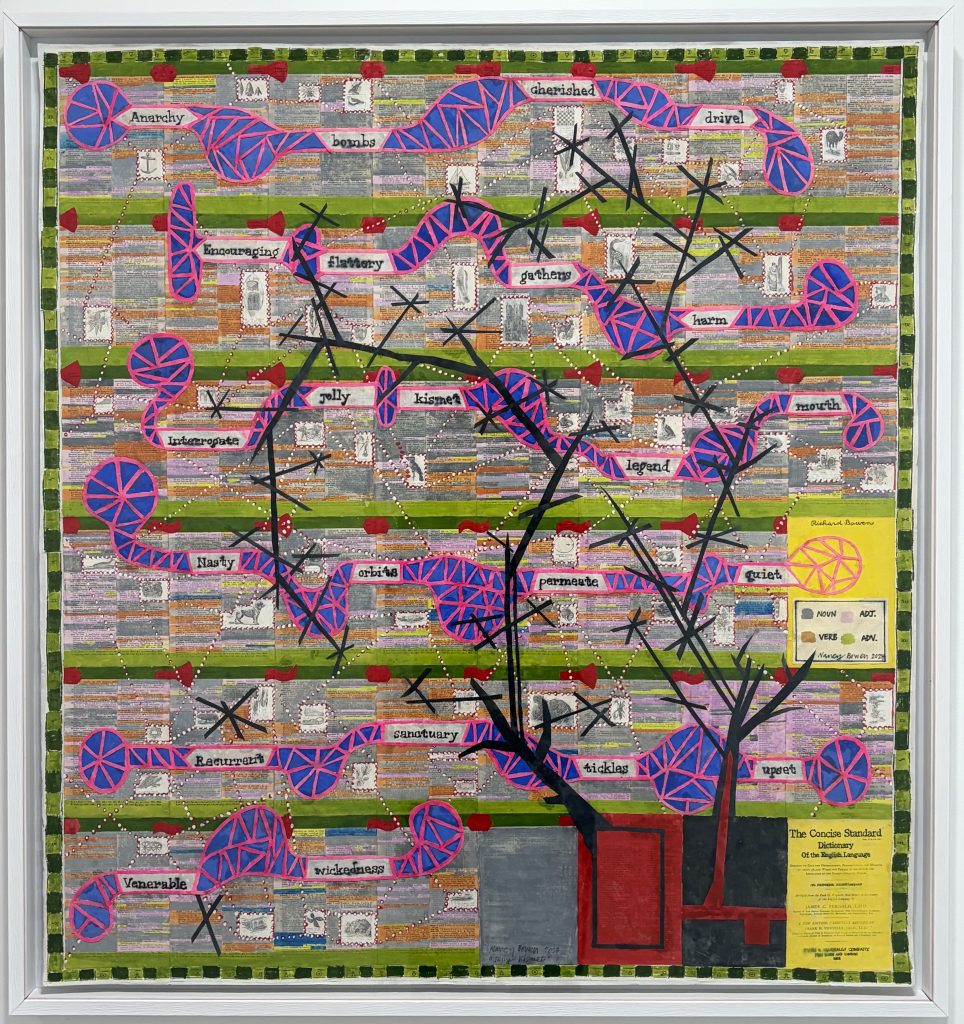
Jolly Kismet, 2024. Collage, gouache, and found book pages on rice paper. Courtesy of Nunu Fine Art and the artist.
Yet where Surrealism sought access to hidden zones of subjectivity, Bowen seems more interested in intervening in the structures through which we organize knowledge. Her associations do not reveal only desires or fantasies; they expose the mechanisms that sustain our ways of naming, classifying, and understanding the world.
Bowen’s compositions immediately evoke the quilting tradition through their modular organization, accumulation of fragments, and patient construction of repetitive sequences. Yet the connection goes far beyond formal resemblance. Historically, quilts functioned as spaces of collective memory, the transmission of stories, and the production of knowledge outside official institutions. What Bowen proposes is a particularly suggestive operation: she takes one of the great institutional technologies of modern knowledge—the dictionary—and reorganizes it through a logic closer to a domestic technology of knowledge.
Repetition plays a fundamental role in this process. Grids, chromatic sequences, and modules organize the visual surface with an almost obsessive rigor. Yet these structures never remain entirely stable. Sinuous lines interrupt the grids. Organic forms traverse geometries. Improbable diagrams connect distant images. Order thus becomes a space of constant negotiation between discipline and improvisation.
This tension becomes particularly significant when considering the generation to which Bowen belongs. Formed at a moment when the division between Fine Art and craft still operated with enormous force within artistic institutions, her work participates in a genealogy of artists who contributed to eroding those hierarchies. From the contributions of Rozsika Parker and Griselda Pollock, we know that the historical separation between intellectual labor and manual labor was never neutral; it was deeply shaped by questions of gender.
What is interesting in Bowen’s work is that she does not reclaim craft as a category separate from thought. Nor does she attempt to demonstrate that manual labor can achieve the same intellectual complexity as Fine Art. Her practice begins from a more radical premise: that such a separation never made sense in the first place. The artist works through rules, patterns, and systems, but also through intuitions, accidents, and material decisions that emerge during the process of construction itself. Her collages make visible something we often forget: ideas do not exist outside the matter that sustains them. Thought takes place in the contact between the hand, the eye, and the material world.
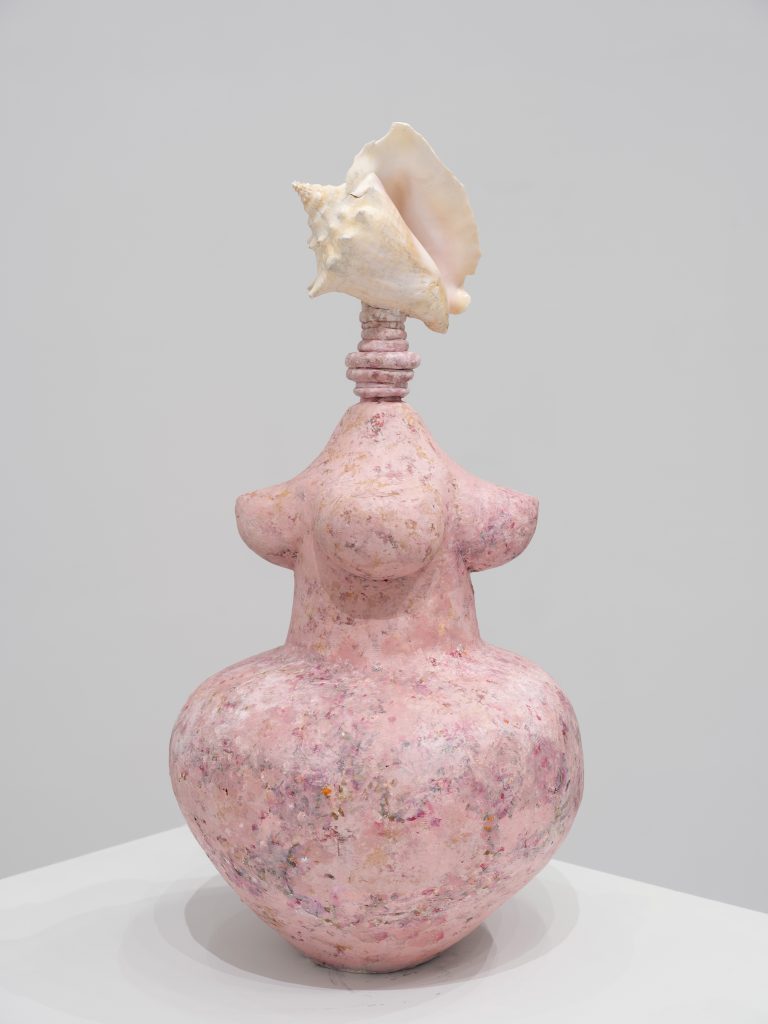
Venus Again, 2022. Under-glazed ceramic and shell. Courtesy of Nunu Fine Art and the artist
The sculptures extend this reflection from a different position. Unlike the collages, where language functions as a point of departure, here the body occupies a central place. Yet these are not stable or easily recognizable bodies. In works such as Venus Again or Sea Song, anatomical forms, marine organisms, found objects, and diverse materials combine into hybrid configurations that oscillate between figuration and abstraction.
Once again, surrealist echoes appear. Yet Bowen distances herself from the historical ways in which Surrealism used the female body as a territory of symbolic projection. Her sculptures do not present idealized bodies or fetishized fragments. They are mutable, vulnerable, humorous, and strangely autonomous entities. There is within them a constant insistence on transformation. If the collages question the stability of language, the sculptures question the stability of bodily forms. Both bodies of work share the same suspicion toward fixed categories and the same confidence in the capacity of matter to produce unforeseen meanings.
During the exhibition walkthrough, Bowen speaks about her work with an unusual combination of intellectual rigor and humor. She becomes animated by absurd words, improbable associations, unexpected colors, and formal decisions made simply because she found them visually irresistible. This playful dimension runs throughout the exhibition. Perhaps this is where an important part of its critical force resides. Bowen does not intervene in systems of knowledge through solemnity. She does so through curiosity, through the pleasure of establishing unexpected connections, and through the conviction that imagining other relationships between things remains a form of thought.
In a time marked by the increasing virtualization of knowledge and by the illusion that thought can exist separately from bodies, From A to Z and the Bodies In Between reminds us of something fundamental: words also have texture, archives possess material memory, and knowledge is never entirely abstract. It always passes through objects, through hands, through bodies, and through the histories we inherit.
Bowen’s dictionaries no longer seek to define the world. They make it strange again. And it is precisely within that strangeness that the artist finds new possibilities for imagining it.
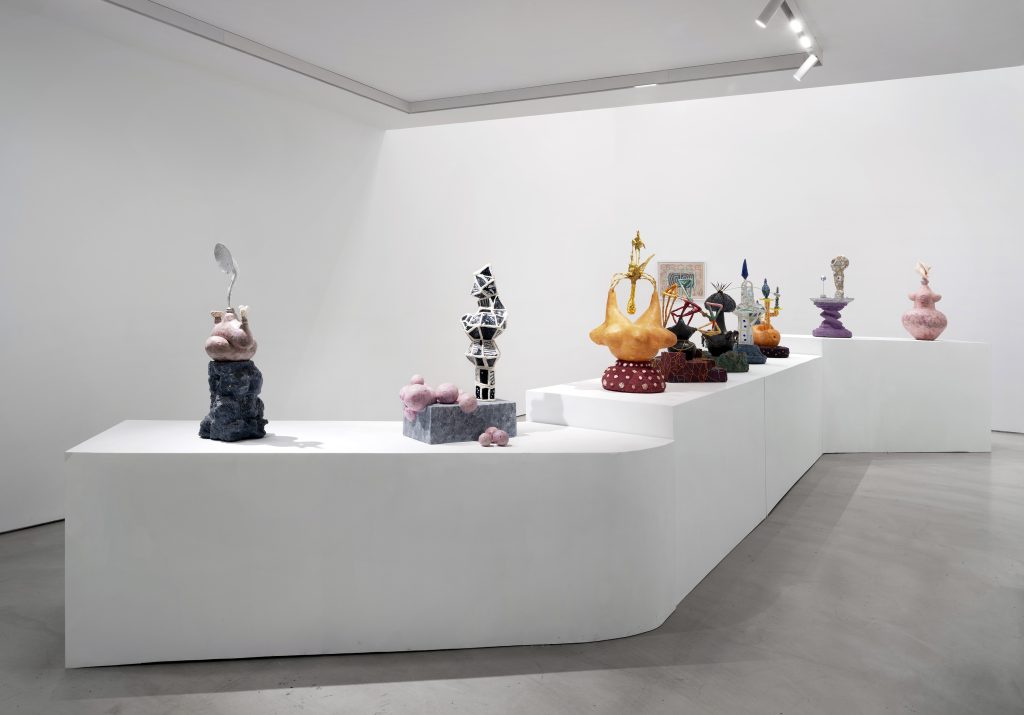
Exhibition view of From A to Z and the Bodies In Between, Nunu Fine Art, New York, 2026. Courtesy of Nunu Fine Art and the artist. Photo: Martin Seck.
Nancy Bowen: From A to Z and the Bodies In Between is currently on view at Nunu Fine Art, 381 Broome Street, New York, NY 10013. On view through June 28, 2026.