A Retrospective of Guatemalan Artist Regina José Galindo at Museo Universitario del Chopo
By Blanca Meneses
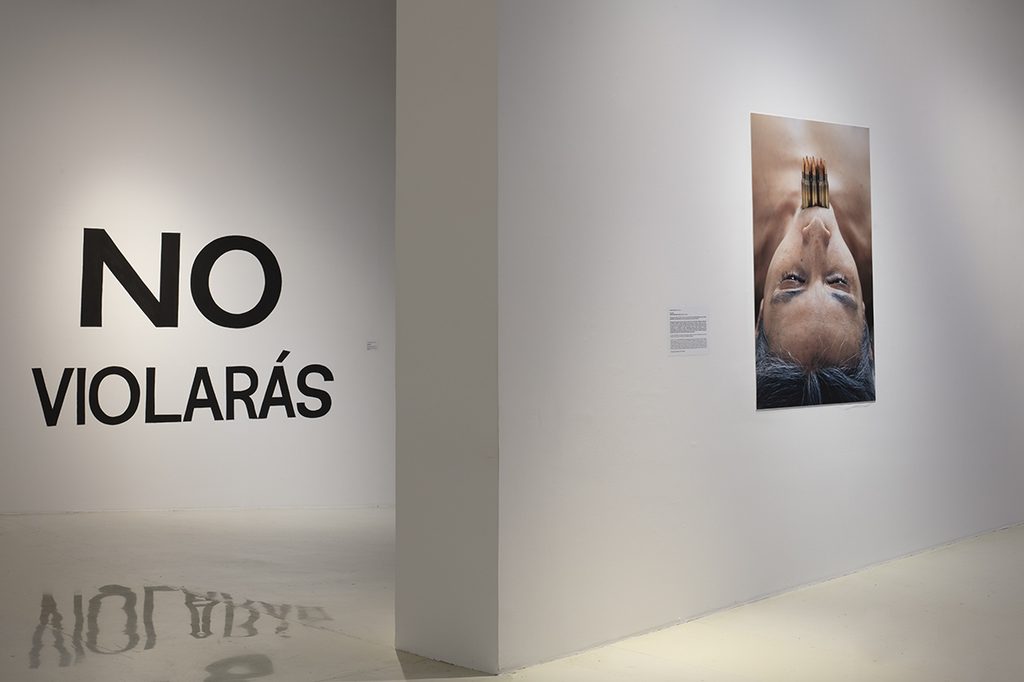
Exhibition view. Regina José Galindo, Los peores tiempos posibles (The Worst Possible Times). Museo Universitario del Chopo, 2026.
This is not the first time a solo exhibition by Regina José Galindo (b. 1974)[1] has landed in Mexico City. In 2010, the Museo Universitario Arte Contemporáneo (MUAC, UNAM) hosted Móvil, an exhibition that brought together a decade of her practice.[2] That was my first encounter with her work. I remember how her pieces planted a strange, dense heaviness beneath my skin. Unfiltered and unyielding, Regina confronted a rawness that, back then—perhaps through the naivety of youth—felt foreign to me: that neglected reality before which we often prefer voluntary blindness and an indifferent march forward.
Today, Regina returns to the capital with a thematic survey curated by Maya Juracán and Regina de Con Cossío, spanning her trajectory from 1999 to the present. Beneath the iron naves of the Museo Universitario del Chopo, that heaviness returns with a different inflection. My thirty-something-year-old body no longer has the same capacity to contain it. Exposed to her pieces, my body no longer seeks merely to endure the burden: it finds itself compelled to embody—to acuerpar—traumatic events not lived in the flesh, yet which continue to interpellate us in the immediate present.
Through thirty-three works brought together under the title The Worst Possible Times (Los peores tiempos posibles)[3], the exhibition confronts us with a map of open wounds. Galindo’s practice operates as a physical jolt in the face of the systematic ravages that cut across our lives in times of genocide, forced migration, militarism, fascism, feminicide, transfeminicide, censorship, and colonial dispossession: indelible marks inscribed on flesh and territory.
Regina José Galindo’s body is “the presence and grammar of a collective memory.”[4] It becomes a living essay on postmemory, functioning as a vessel for traumatic events inherited through narratives, archives, images, and profound silences.[5] Born at the epicenter of the Guatemalan armed conflict, Galindo belongs to a generation shaped among the debris of an incalculable devastation that was never fully narrated. Her body thus emerges as a channel of transmission: a surface that receives the pain of others, incorporates it, and returns it transmuted into action.
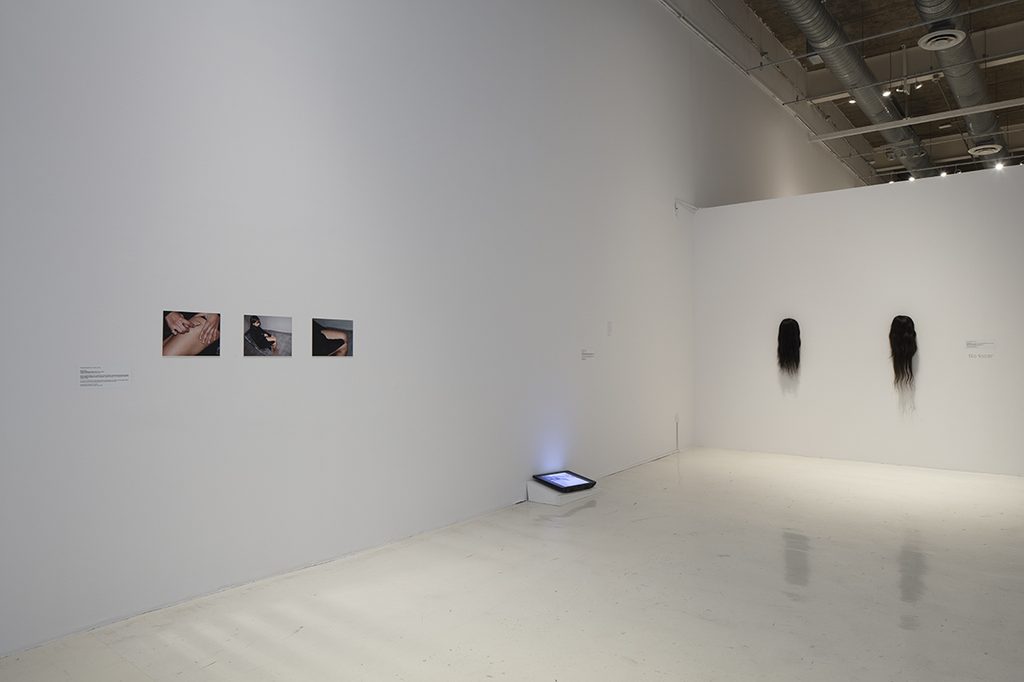
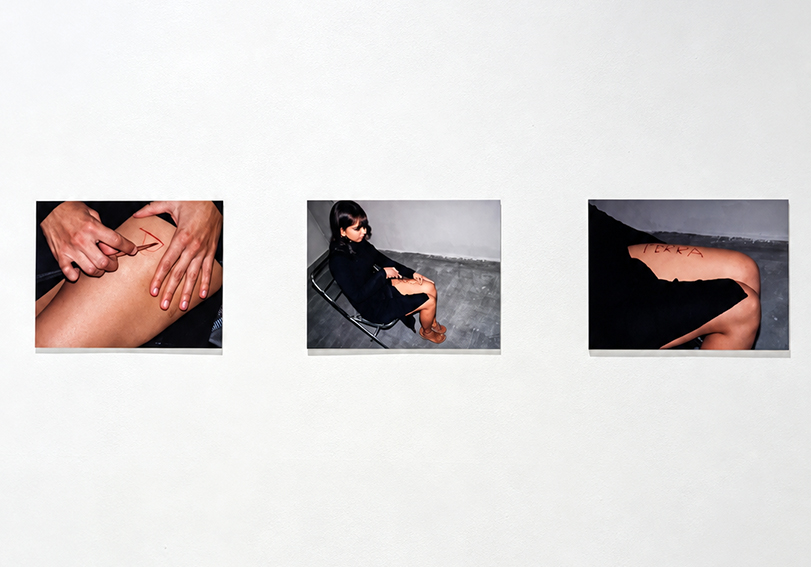
Left: Exhibition view. Regina José Galindo, Los peores tiempos posibles (The Worst Possible Times). Museo Universitario del Chopo. 2026. Right: Time of Being a Bitch. Perra (Bitch), 2005. Digital print on paper. Courtesy of the artist.
Moving through the gallery, we encounter emblematic pieces in which the body embodies symbolic violence and dispossession. In Perra (2005), the artist takes a knife and cuts into her left leg to inscribe that word onto her skin. The insult, as Bolivian activist María Galindo has observed, functions as a mechanism of classification that condenses oppressions of gender, race, and class, marking, degrading, and subordinating certain ways of existing. Yet, by lacerating her own flesh with that verbal aggression, the artist shifts its wounding force and turns the act of naming into a form of political agency.
Along this same axis of dispossession is La conquista (The Conquest, 2009), an installation made from the hair of Guatemalan women that reveals how this attribute, intimately tied to identity and cultural belonging,[6] is subjected to commodification for the benefit of global supply chains. The 2021 version displays two suspended pieces, laying bare how this dynamic of extraction remains an open wound.
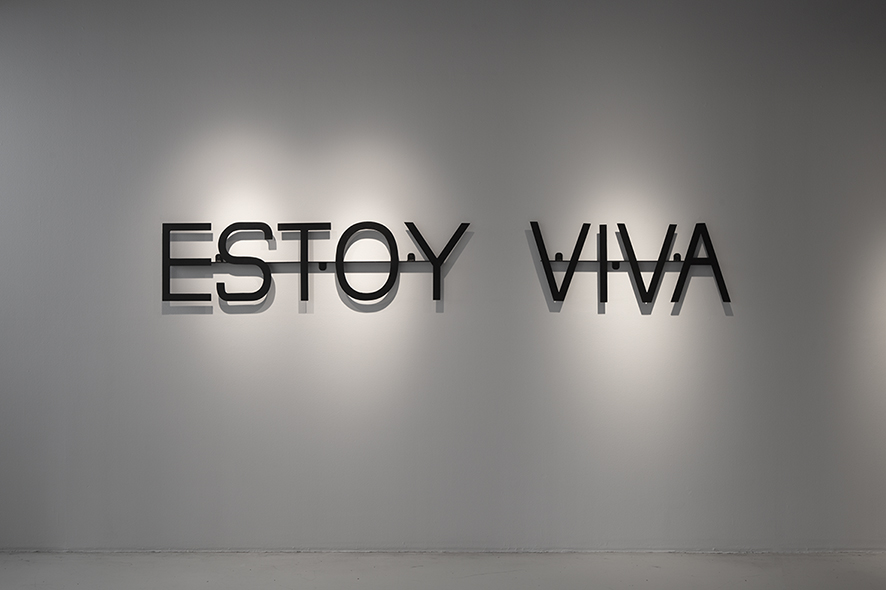
Time of Being Alive. Regina José Galindo, ESTOY VIVA (I AM ALIVE), 2022. Forged iron.
There is a poetic force in the signs Regina paints for public space. ESTOY VIVA (I AM ALIVE, 2022) pays tribute to the forty-one girls burned to death at the Virgen de la Asunción shelter in 2017. The phrase reverberates like a visceral cry about the fortune of still breathing in a fragmented environment. Our female ancestors remind us of the privilege of existence and of using it on behalf of others through continuous resistance. In that same vein, No violarás (Thou Shalt Not Rape, 2012) reads as an uncompromising command in the face of the systematic violence repeatedly and with impunity inflicted upon children and women.
Among her most recent works, those produced over the past two years stand out for their proximity to Mexican reality. In Línea de autopsia hecha con cocaína contaminada con fentanilo (Autopsy Line Made with Cocaine Contaminated with Fentanyl, 2025), a photograph shows Galindo lying on a forensic surface, naked and exposed; along her torso, a surgical Y-shaped incision is traced with the powder of both substances, synthesizing how trafficking and the illicit market inevitably lead to the devastation of the body and to death.
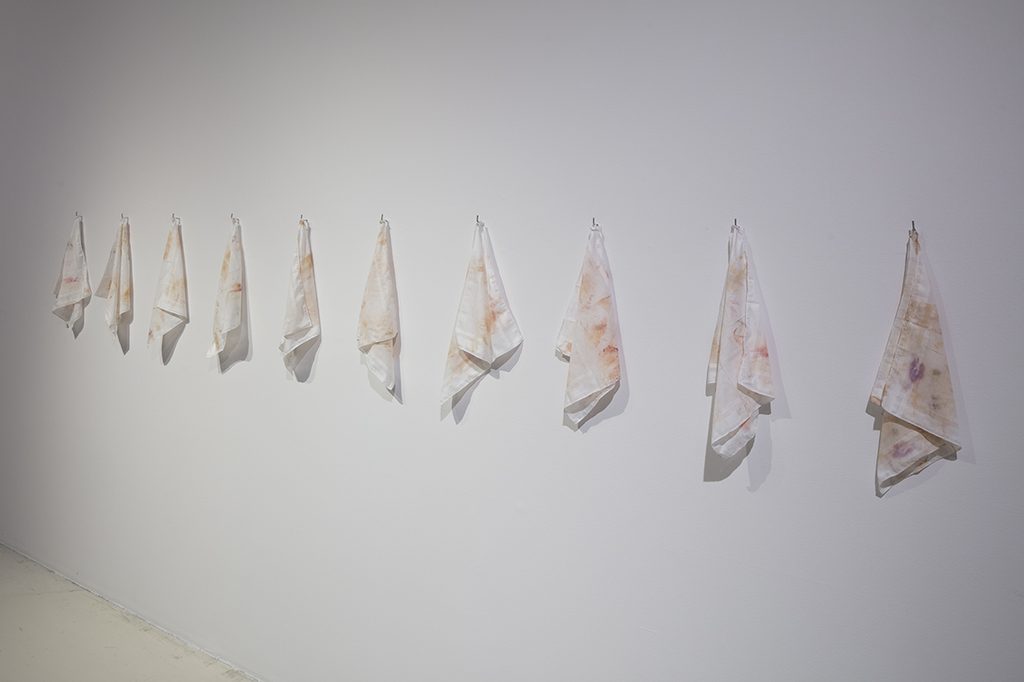
Time of Makeup. Regina José Galindo, Maquillando la muerte (Making Up Death), 2026. Performance, photography, and corpse makeup on cotton handkerchiefs.
In Maquillando la muerte (Makeup for Death, 2026), a performance presented on opening day, the artist remained motionless on a medical table while a thanatoesthetician worked on her face. The action recalls how processes devoted to the treatment of corpses have become an institutionalized infrastructure due to constant demand in a country in permanent mourning. The specialist applied makeup to Regina eleven times, once for each daily feminicide in Mexico, leaving the pigment-stained handkerchiefs as testimonies suspended between compassion and horror.
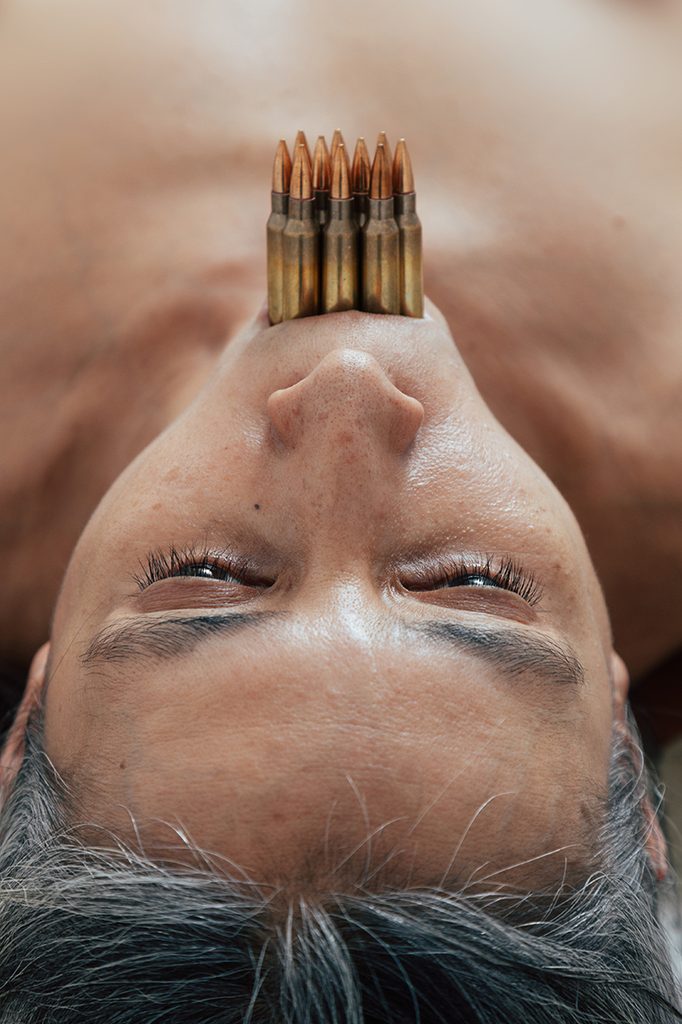
Time of War. Regina José Galindo, Galil (Galil), 2026. Digital print on paper. Courtesy of Museo Universitario del Chopo, UNAM.
The gaze expands to confront the violence against the Palestinian people in Galil (2026). Lying on a surface, the artist holds between her teeth and hands the bullets used by the Israeli army in Gaza, the same weaponry that supplied the Ixil[7] genocide in Guatemala. Galindo embodies the traumatic inheritance of two distant geographies and exposes the transhistorical complicity among powers: the sale of tools of extermination among the United States, Israel, and authoritarian regimes demonstrates that annihilation is a violent imprint that is inherited and replicated.
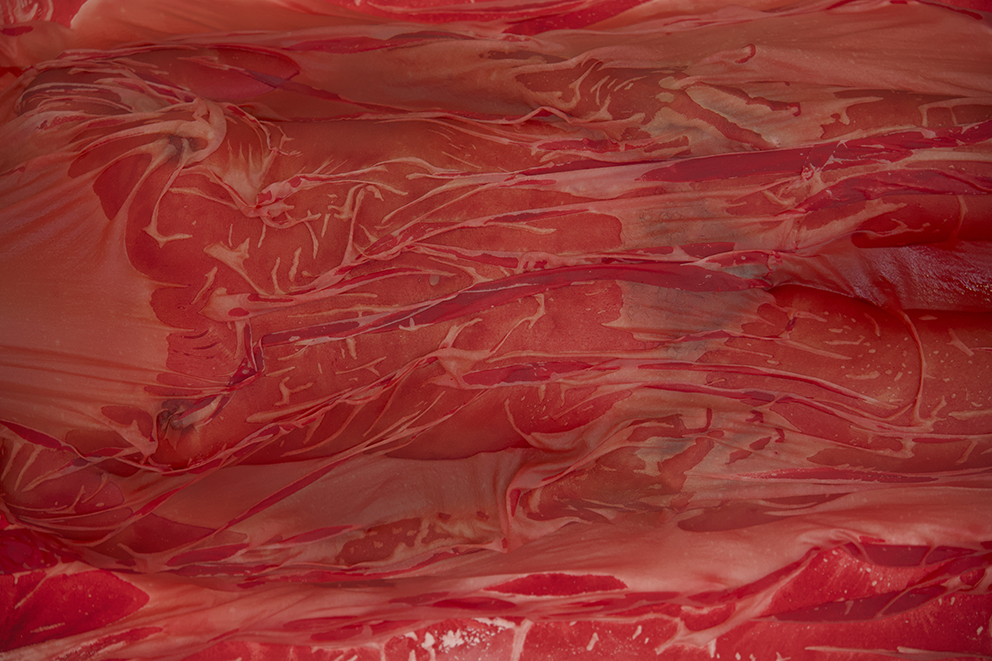
Time of Memory. Regina José Galindo, Homenaje a Latinoamérica (Homage to Latin America), 2026. Digital print on paper. Courtesy of Museo Universitario del Chopo, UNAM.
This logic of intervention shows how Donald Trump’s geopolitical interests and his strategic alliances with Israel shape regional terror, sustaining the contemporary rise of the far right. In Homenaje a Latinoamérica (Homage to Latin America, 2026), Galindo wraps her body in a canvas soaked with the blood of Latin American men and women, evoking Greco-Roman drapery to construct an elegy in the face of the scars of Yankee interventionism. As a vital counterpoint, La fuerza de la izquierda (The Strength of the Left, 2025) embodies resistance: held aloft by a group of people using their left arms, the artist activates the affective dimension of popular movements.
By putting her body on the line and tracing the continuity between the Guatemalan genocide, the massacre in Palestine, and the siege of Latin America, the artist transforms the inherited burden into an act of physical presence. Embodying postmemory—acuerpar la posmemoria—is the cardinal axis of this journey: a way of sustaining the network of affects and transgenerational resistance in order to reopen, upon the ruins of the present, the possibility of imagining other possible futures.
[1] Regina José Galindo, official website. https://www.reginajosegalindo.com/
[2] Regina José Galindo, Móvil. Exhibition catalogue. Museo Universitario Arte Contemporáneo (MUAC), UNAM, Mexico City, 2010. https://muac.unam.mx/exposicion/movil
[3] Regina José Galindo, The Worst Possible Times. Museo Universitario del Chopo, UNAM, Mexico City, August 15–November 15, 2026. Museo Universitario del Chopo
[4] Rosina Cazali, “Mobility as a Promise of Freedom,” in Móvil. Museo Universitario Arte Contemporáneo (MUAC), UNAM, Mexico City, 2010, p. 22.
[5] Marianne Hirsch, The Generation of Postmemory: Writing and Visual Culture After the Holocaust. New York, Columbia University Press, 2012, p. 5.
[6] Regina José Galindo, The Worst Possible Times. Curated by Maya Juracán and Regina de Con Cossío. Museo Universitario del Chopo, Mexico City, August 15–November 15, 2026.
[7] The Ixil people are a Maya Indigenous community concentrated in the municipalities of Santa María Nebaj, San Gaspar Chajul, and San Juan Cotzal, in El Quiché, Guatemala.