By Nekane Aramburu
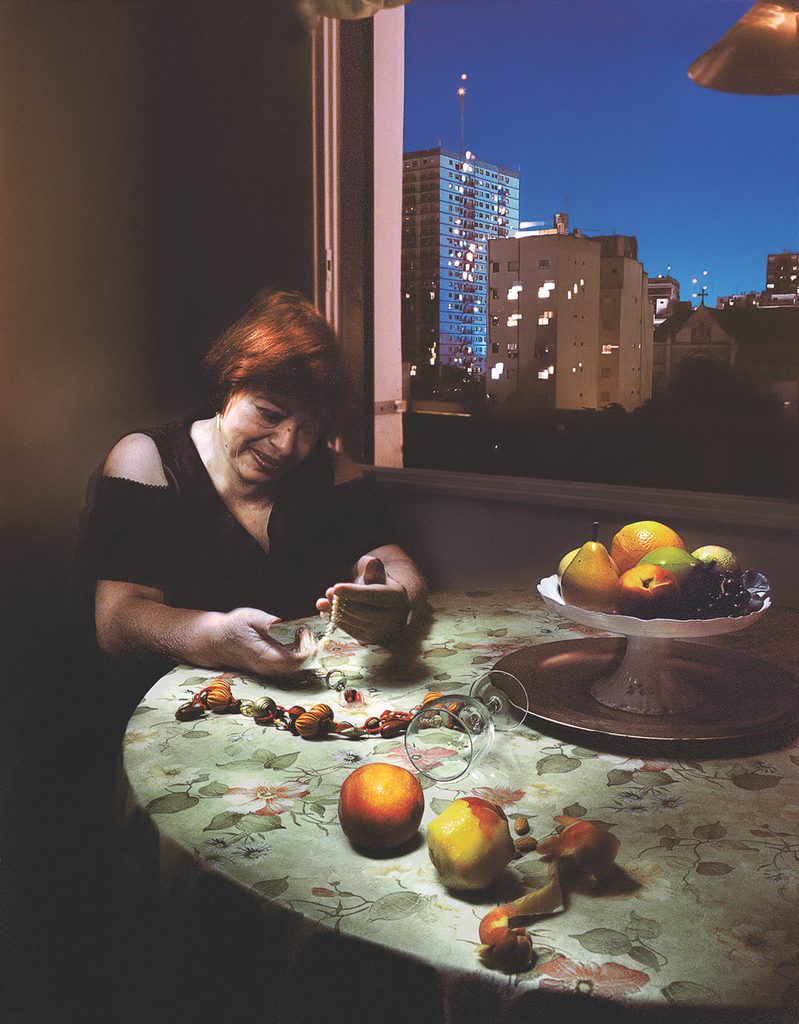
Arturo Aguiar, Vanitas, 2007. Color photograph, direct documentation of an action. 123 × 93 cm
It has been a week since Graciela Taquini left us, on September 19, 2026. In a season of successive, painful losses: Fabrizio Plessi, Darío Lopérfido, Catherine Ringer… then it was Grata’s turn. That weekend, social media was filled with memories of her. The sincerity of those words reflected the affection and recognition of everyone who had crossed paths with her. She left an indelible mark on the artistic community, and a profound human one.
I no longer remember when we first met. We would regularly run into each other in Buenos Aires. The endless dinners at Los Inmortales with La Ferla and Muntadas, the barbecues at Esteban’s, the last gathering at Marcelo’s house to begin working on Legado… Always close as a collaborator and a personal friend of Marcela Andino.
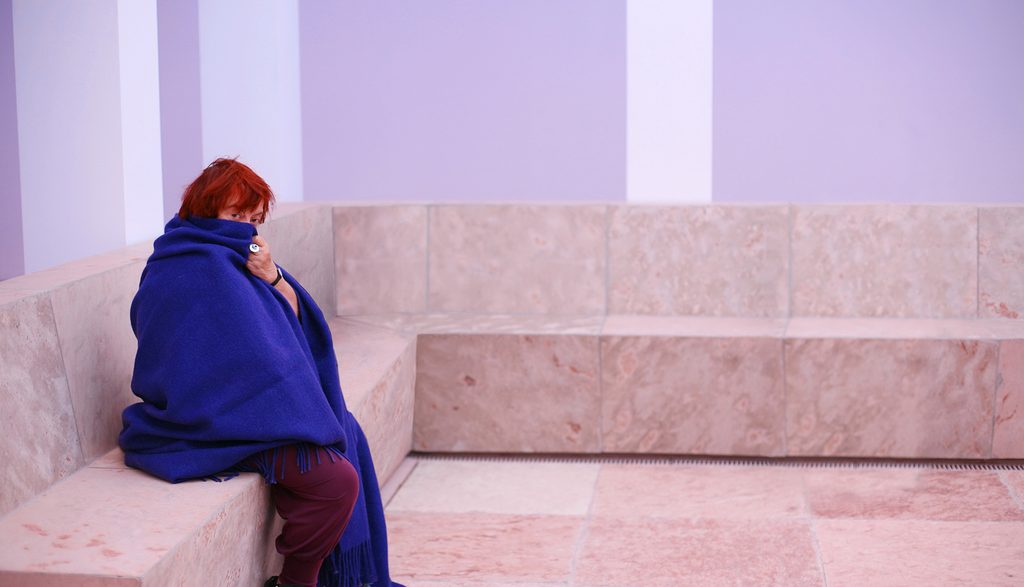
Dolores Esteve, Graciela, 2010. Color photograph.
Whenever she visited me, she would always bring something to share, medialunas or various culinary experiments. Always the effect of food and embraces.
I remember that in 2012 I proposed that Graciela present her first retrospective in Europe. It was made possible thanks to the Government of the Canary Islands in Tenerife and the impetus of Alejandro Vitaubet. I curated the exhibition from a distance, between Buenos Aires and Bogotá, giving it the title GRACIELA TAQUINI. ECTOPLASMAS (Videographic Selection of the Curator as Medium. 1988–2012).
Born in 1941, Graciela Taquini was an art historian, cultural manager, curator, and artist. She has been regarded as a driving force behind experimental video in Argentina (she began programming video art in 1984) and as a grande dame of Latin American electronic arts, organizing major exhibitions at the Cuenca Biennial, Ecuador (2001), and the Interférences Biennial, France (2000), while extending her curatorial work internationally, particularly to the United States (El Museo del Barrio, New York, 2007).
As an artist, she made her first video in 1988, when she was responsible for the video section of the Centro Cultural San Martín in Buenos Aires, and it has become almost customary to describe that work, Roles, as the first performative self-portrait in the history of Argentine video. A tireless seeker, she alternated her role as a theorist and conceptualizer of projects with her creative practice, particularly from the 2000s onward. Initially, at the beginning of this period as an artist, she did not consider herself one, although her works belong to a conceptualism close to experimental narrative and have been recognized at numerous festivals and biennials. She said that she embraced this role because of the playful nature of creation, as a means of constituting new realities and other discourses that afforded her greater freedom than her work as a curator or cultural manager. Her transformation into an artist, simultaneously fused with her other forms of work, is characterized by the integration of creative proposals with the contributions of other artists, close colleagues, her immediate circle, and countless friends who, over the decades, accompanied her as accomplices, actors, or direct and indirect resources. The conception of each work is a premeditated staging in which the collective participation of these collaborators and friends allows for variations and transmutations of the original idea in fertile synchrony.
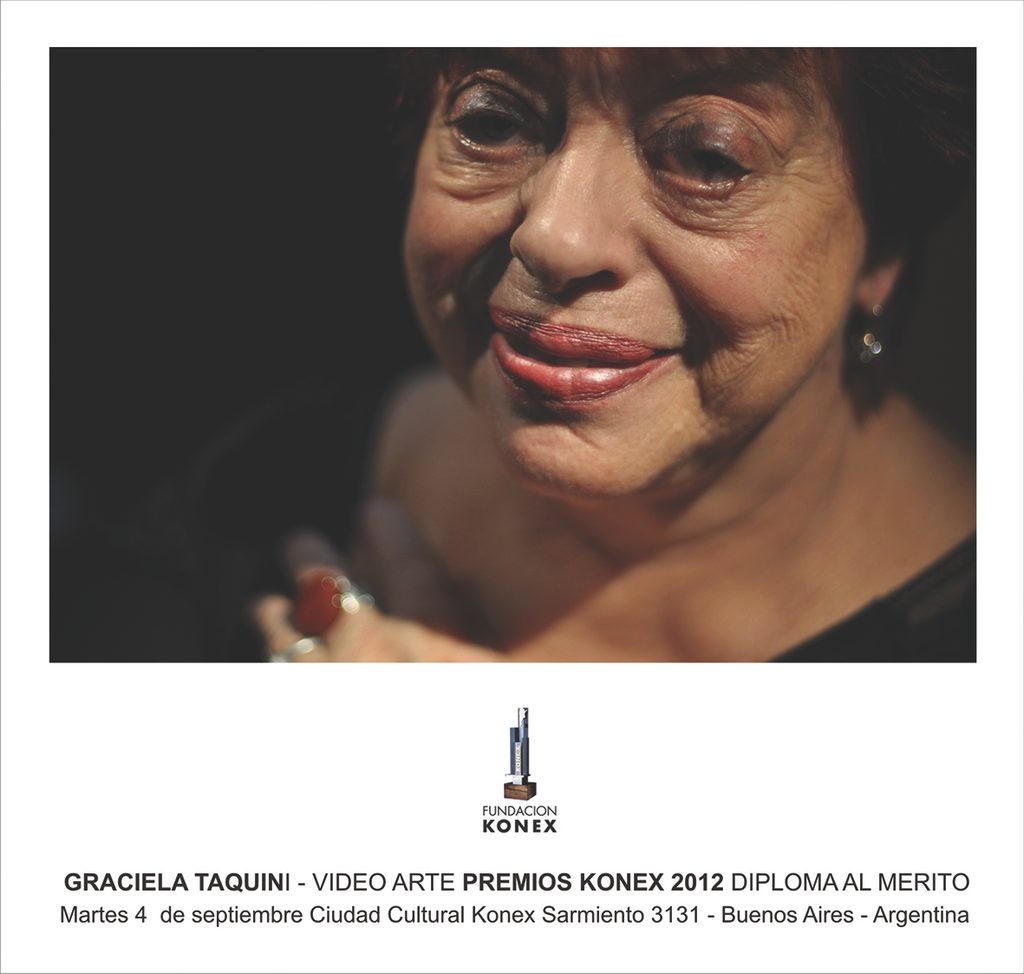
Graciela Taquini, 2012. Portrait by Gustavo Maggi. Fundación Konex.
Both her power as a catalyst and her role as a transmitter were grounded in an innate capacity to educate and to generate thought beyond critical or technical analysis. Through her works, she exorcised intimate concerns, the abysses of life and time, which, as in her curatorial projects (“my authorial curatorships are works based on my personal obsessions,” she stated in the catalogue for her retrospective Grata con otros), followed communicative strategies intended to make us enjoy, feel, or reflect.
Her simple, concise constructions are configured through events or images linked together with extraordinary effectiveness, where at times it hardly matters whether she uses found footage, interpretation, or live performance as resources. This was equally her way of expressing herself in art criticism: in a simple manner, she reflected on profound questions. Now they take on greater depth and resonance.
A depth and resonance that I also hope will belong to her project Legado, conceived as a living, dynamic archive dedicated to recovering, researching, making visible, and safeguarding experimental audiovisual production and technological arts in Argentina. A project born with a strong political and social commitment to mapping, analyzing, and disseminating, in particular, works produced by women and gender dissidents, breaking with hegemonic canons.
This fundamental body of work remains with us, in a world sadder and more sordid without her. So does the responsibility—and the beautiful challenge—of safeguarding her living archive and conveying who Grata was. The best way to honor her joy in living and her wisdom is to keep looking toward the future with the same inexhaustible curiosity she passed on to us.
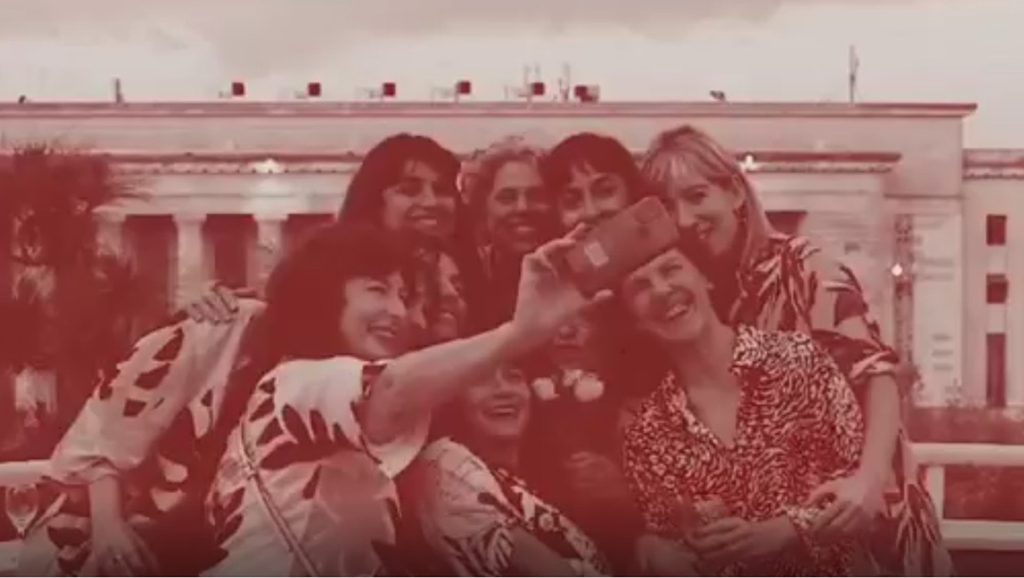
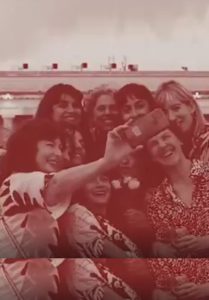
Presentation of Legado.ar, Museo Nacional de Bellas Artes, Buenos Aires, 2023