The Siamese Art of Marisa Lara and Arturo Guerrero at the Estanquillo Museum.
Four Decades of Siamese-ness
By Yohanna Magdalene Roa
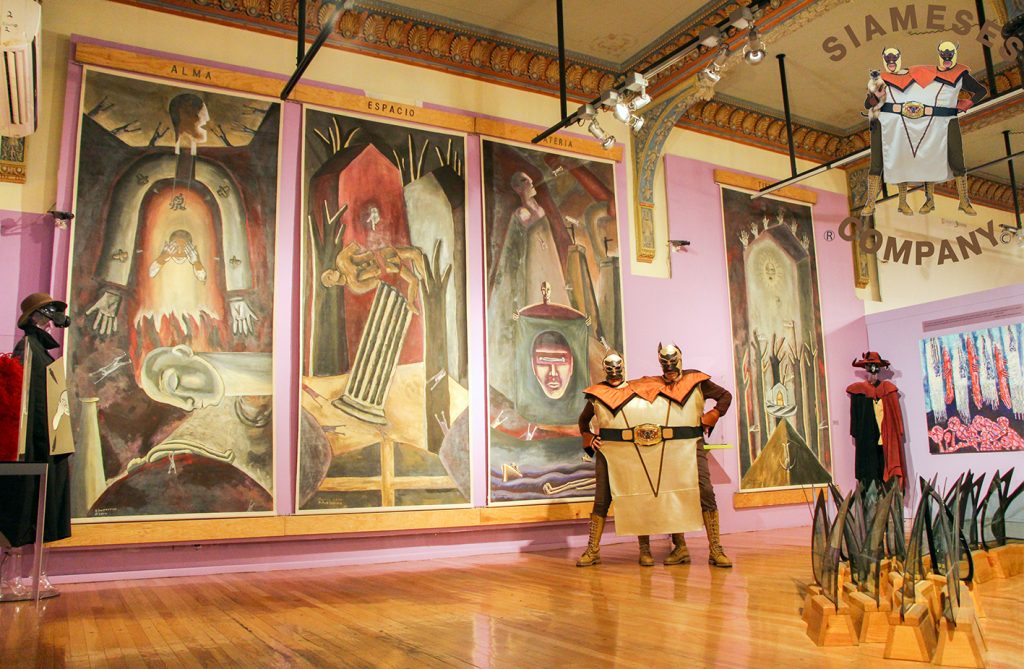
Core Section Curatorial Area. Exhibition view of Visual Bipolarity, at Museo del Estanquillo, Mexico City. In photo: Los Siamés (Marisa Lara y Arturo Guerrero).
The work of Marisa Lara and Arturo Guerrero is grounded in Mexico City: each of their pieces reflects an image to those who look at it while simultaneously allowing the everyday, political-affective, and cultural history that made it possible to surface. Visual Bipolarity presents the work of the duo known as Los Siameses / Siameses Company1 at the Museo del Estanquillo. Colecciones Carlos Monsiváis. Inaugurated in April 2025, the exhibition brought together around 300 works produced over more than forty years of collaborative practice, painting, drawing, sculpture, printmaking, photography, installation, and performance, organized into ten curatorial sections across two floors of the museum. While conceived as an exhaustive review of their trajectory, the exhibition also functioned as a critical rereading of the relationship between contemporary art, popular culture, and urban memory, in close dialogue with the archive and the figure of Carlos Monsiváis.
I had the opportunity to speak with them in Mexico City; this article is the result of that conversation.
Lara and Guerrero present themselves as “right- and left-handed painters,” working literally “with four hands,” intervening on the same piece at the same time. They insist on the idea of siameseness as an alchemical incantation: a radical complicity in which thought, body, brush, and word circulate in constant back-and-forth. Their artistic name, they recount, was coined by Monsiváis himself, fascinated by that double presence that nonetheless speaks with a single voice.
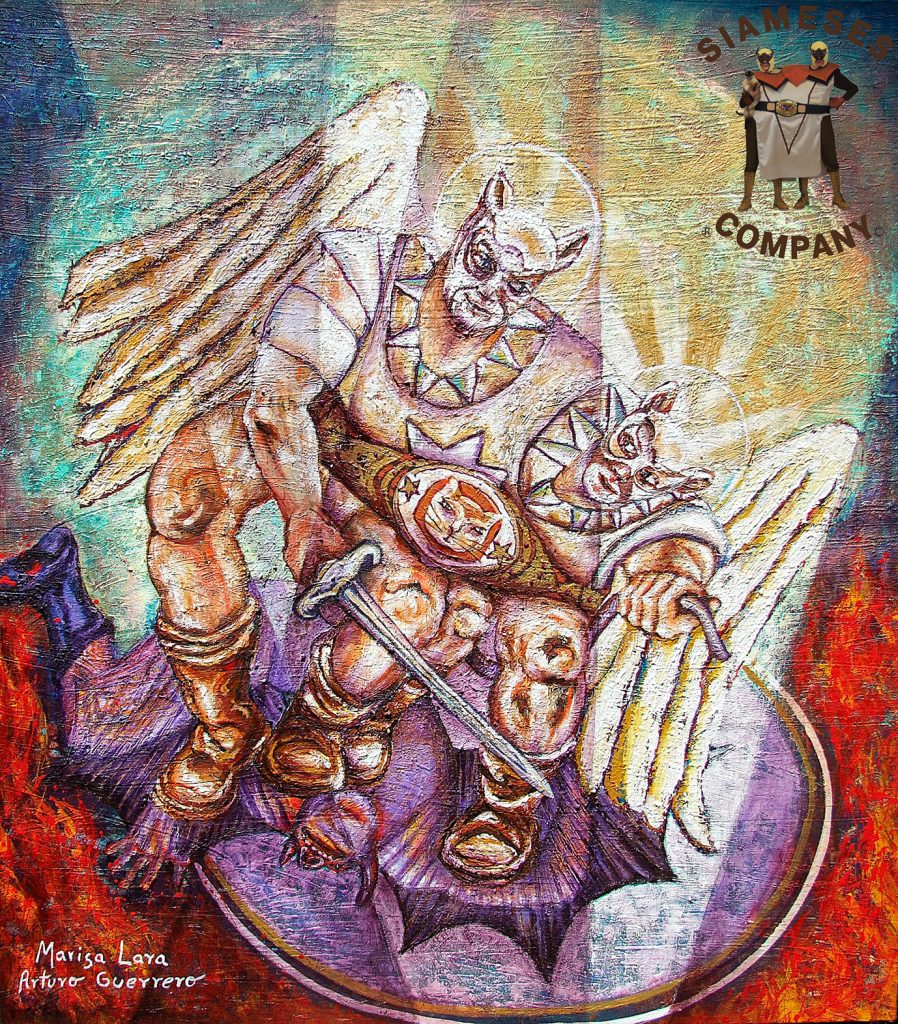
San Siamés Arcángel, 170x150cm,mixta-lienzo, 2008.
Both trained at the Escuela Nacional de Pintura, Escultura y Grabado “La Esmeralda,” where they studied painting and printmaking in the 1980s, the duo set out to break with an academic canon that, in their view, imposed the imitation of North American models. Rather than replicating metropolitan aesthetics, they chose to look directly at their own context: Mexico City as a field of tensions between “high culture” and popular culture, between dance halls and museums, between lucha libre and opera, between danzón and symphonic music. That early decision, to reject the mandate of imitation and to assume their own plurality as a site of enunciation, runs through their entire body of work.
It is no coincidence that their trajectory includes participation in biennials such as São Paulo, Havana, or Cuenca, where they carried this translingual, playful, and critical dynamic into international circuits. Yet they do not conceive of those platforms as a final destination: they always return to the neighborhood, to the dance halls, to the wrestling arenas, to spaces where the collective body is put into play.
High and Low Culture: Tensioning the Hierarchy
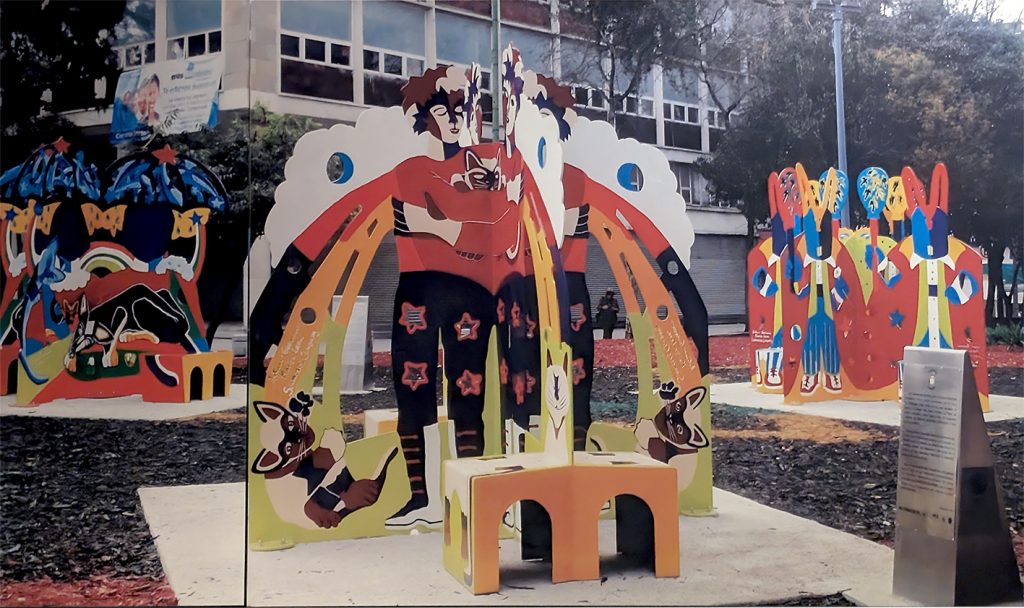
One of the central conceptual axes of Visual Bipolarity is the discussion of the always-classic boundary between “high” and “low” culture. In conversation, Lara and Guerrero underscore the extent to which this division has served to disqualify popular practices by labeling them “kitsch,” a term they read as deeply paternalistic and exclusionary.
In their view, calling certain expressions kitsch amounts to saying “you are not yet art”: a form of condescension that presupposes a civilizational center from which it is decided which practices count as “contemporary” and which are left outside of time. Against this logic, Los Siameses invert the gaze: perhaps what is peripheral is not popular, Indigenous, or mestizo cultures, but those who refuse to recognize their complexity.
Their critique of the concept of kitsch resonates with feminist and decolonial debates around taste, legitimacy, and the symbolic violence exercised by cultural hierarchies. When they note that an excess of color is perceived as “noise” within certain notions of good taste aligned with financial capital, they connect with other voices that have read the baroque, the overloaded, or the excessive as forms of resistance against the normative sobriety of whiteness.
At this point, their work enters into dialogue with reflections by authors such as Gloria Anzaldúa or Cherríe Moraga, who explore the possibility of writing, thinking, and creating from the margins without validation from hegemonic centers; or with the critiques of modernity and mestizaje articulated by Rita Segato and Silvia Rivera Cusicanqui. Not because Los Siameses explicitly cite these traditions, but because they share an intuition: the experience situated in the neighborhood, the Salón Los Ángeles, the lucha libre arena, the working-class colonia, is a theoretical and aesthetic laboratory as complex as any university seminar.
Play, Ritual, and the Body: A Method of Work
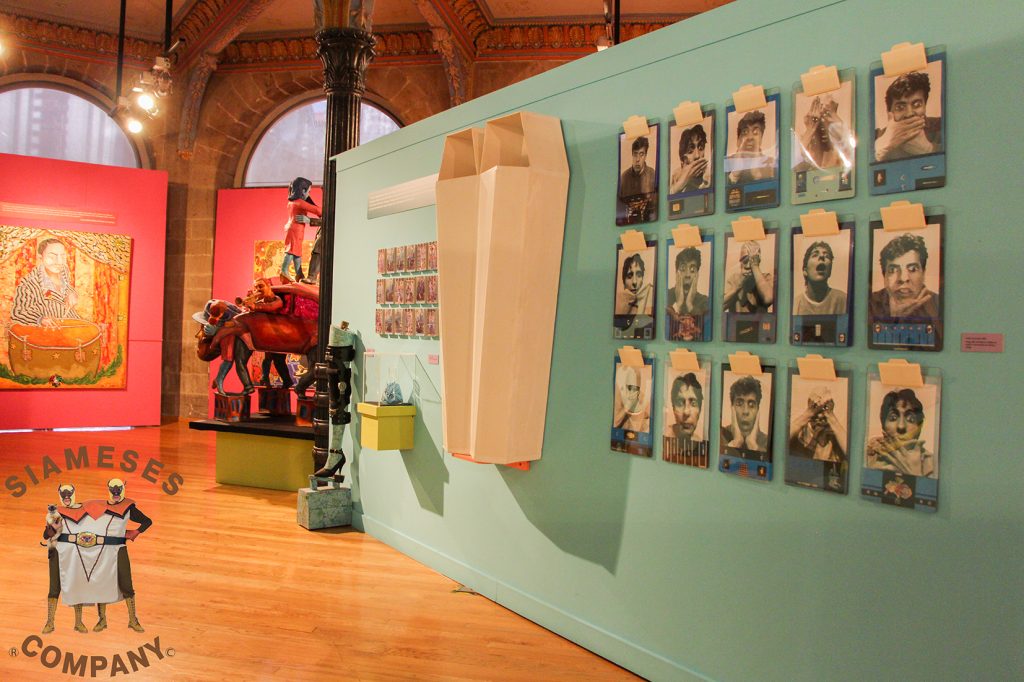
Core Section ¨Curatorial Area¨. Exhibition view of Visual Bipolarity, Los Siamés (Marisa Lara y Arturo Guerrero), at Museo del Estanquillo, Mexico City.
If anything permeated the exhibition, it was the conviction that art is, above all, a serious game. The Siamese speak of play as a space of creative freedom. For them, to play does not mean to trivialize, but rather to suspend the hierarchies that separate intellectual and manual labor, theory and craft, popular spectacle and high culture.
In Visual Bipolarity, play also appears bound to ritual. Art, they say, is a ritual of healing at a time when communal rituals seem to be disappearing. Hence their insistence on materiality: the need to touch paint, to make “brushes squeal and colors crackle”; to envelop the audience with a red umbilical cord in performances where the artwork becomes a literal bond between bodies; to present a book as if it were a “baby” requiring collective rocking.
This ritual dimension is articulated through an ongoing engagement with the body: fragmented, wounded, dancing, in mutation. One curatorial section—Curaduría—places at its center the sick body and its desire to keep dancing: an orthopedic leg prepared to dance danzón in a high heel functions simultaneously as an image of vulnerability and of vital insistence. In another section, Retablos of Wonder and Metamorphosis, bodily transformation is conceived as an endless dance, in dialogue with figures such as the axolotl, an animal capable of regenerating its limbs and read here as a metaphor for a politics of repair.
Writing, Archive, and the Siamese Book
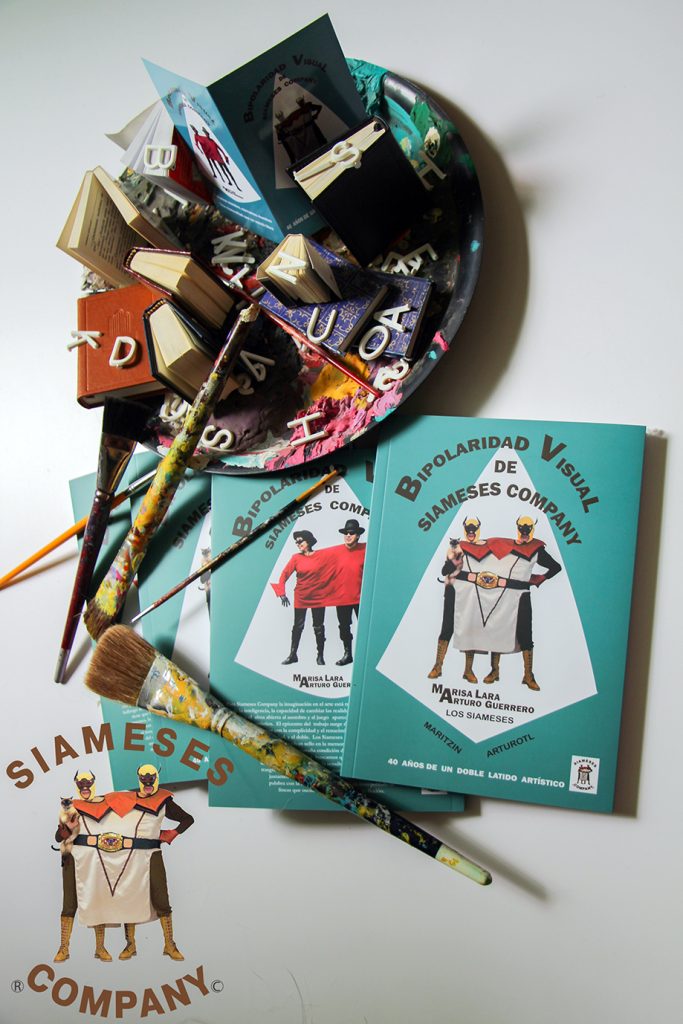
Cover of the book Visual Bipolarity, Siameses Company, 2025.
If the exhibition makes evident the transdisciplinary dimension of their practice, painting, sculpture, graphic work, installation, and performance, the book Visual Bipolarity functions as its “Siamese twin.” Conceived over many years, the volume weaves together life narrative, theoretical reflection, fiction, and the memory of encounters with key figures of Mexican culture: from Monsiváis to Elena Poniatowska, from Ninón Sevilla and Tongolele to Guillermo Bonfil Batalla.
The Museo del Estanquillo presented the book launch as a performance, underscoring that it is a work celebrating forty years of artistic complicity between Lara and Guerrero. The duo themselves describe it as “a book of adventures, reflections on art, a cry for respect and love for the planet, for otherness, for difference.” Writing becomes an extension of the studio: a space in which they narrate self-formations, reconstructions, accidents, illnesses, losses, and precarities—not as heroic myth, but as the sensitive matter of thought.
They insist on its co-written nature: just as they paint “as if dancing,” they write with four hands, allowing the text to flow like a shared scribble. Siameseness is not a metaphor, but a method of production that questions individual authorship and proposes a collective, loving, and conflictual subjectivity.
Monsiváis, Collection, and City
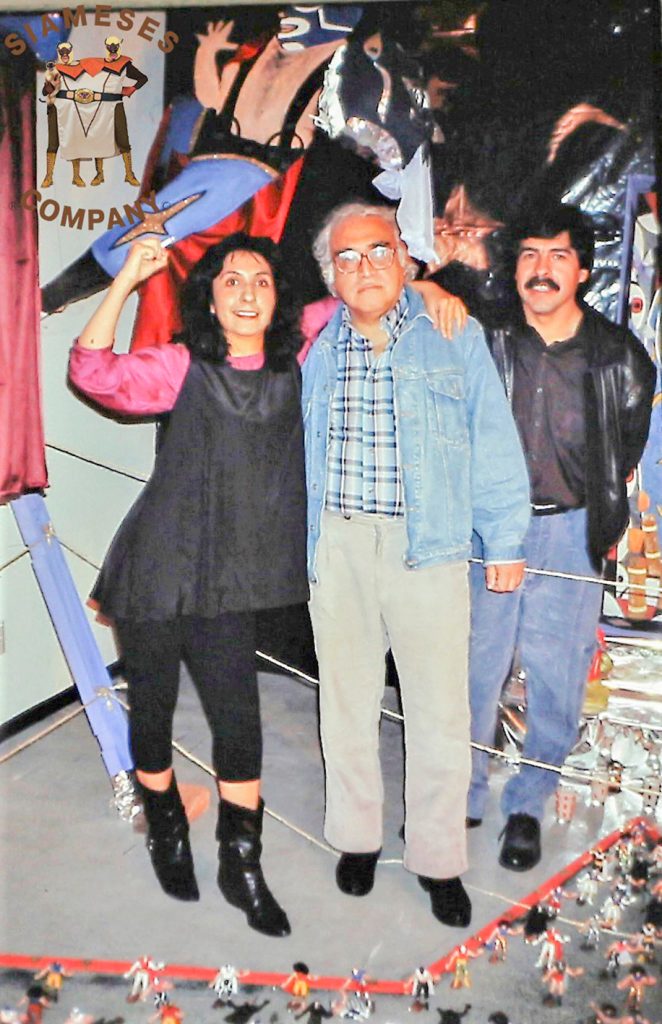
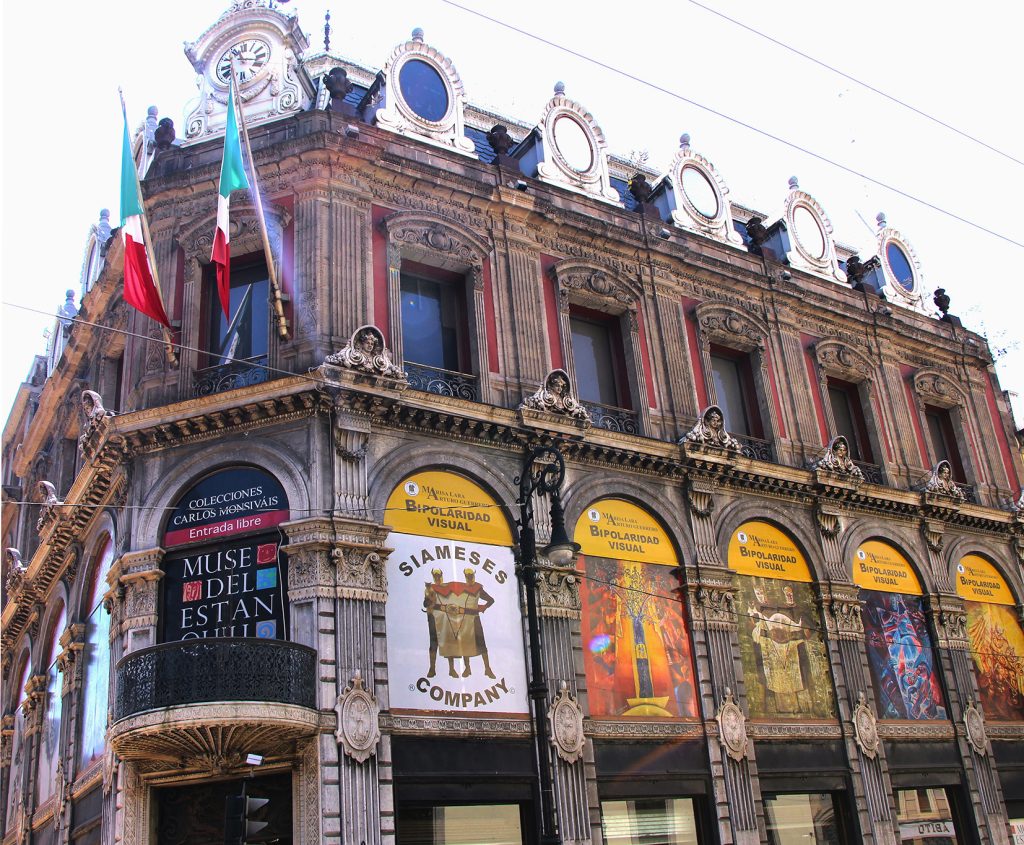
Los Siamés (Marisa Lara y Arturo Guerrero) with Carlos Monsiváis. Archive of Siameses Company. Façade of Museo del Estanquillo during the exhibition Visual Bipolarity, 2025.
Exhibiting at the Museo del Estanquillo is not a logistical detail. For Los Siameses, it was a gesture of return and conversation with Monsiváis’s obsessions: popular culture, the archive as a form of thought, the city as a continuous stage linking cinema, comics, photography, social struggles, and everyday life.
In Visual Bipolarity, certain works from the museum’s collection entered into dialogue with their own, underscoring the continuity between the chronicler’s gaze and siameseness as method. Walking through the exhibition, it was easy to imagine shared routes: nights of lucha libre in Iztapalapa, excursions to peripheral neighborhoods, long after-dinner conversations alternating between critical theory and urban gossip.
This double belonging to Monsiváis’s archive and to the territories he loved and documented places the exhibition in a singular position. Visual Bipolarity constitutes a significant chapter in the construction of a collective memory of how art has thought, embodied, and overflowed Mexico City over the past decades.
An Art That Dances, Insists, and Disobeys
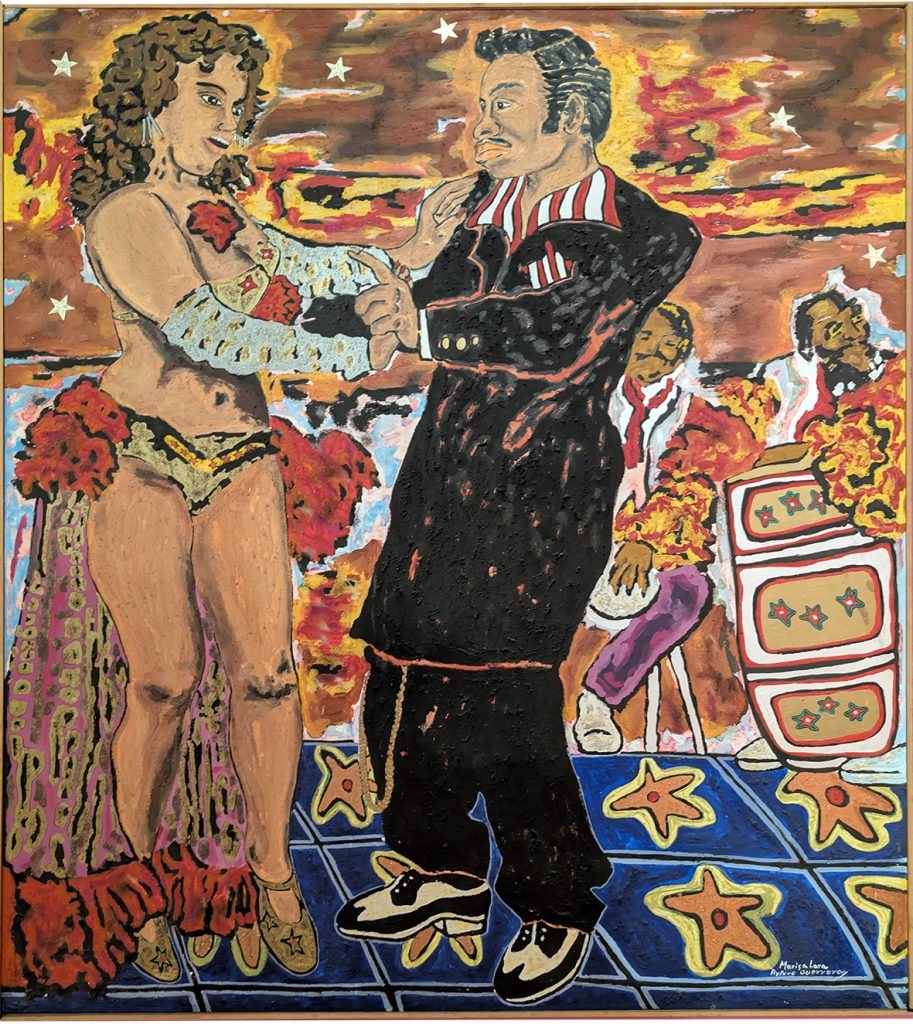
Perhaps the image that best summarizes the spirit of the exhibition is that of an orthopedic leg ready to dance the danzón. The wounded body that insists on moving condenses the ethics of Los Siameses: making art a space of joyful resistance in the face of illness, precarity, exclusion, and symbolic violence.
From the perspective of INESMagazina, the importance of the exhibition lies precisely in its capacity to decenter narratives of Mexican contemporary art, reinserting practices that for years were considered minor or eccentric. Visual Bipolarity demonstrates that these experiences have been decisive in imagining other relationships between creation, critical thought, the body, play, and community.
Lara and Guerrero say it clearly: “We are art wrestlers.” What Visual Bipolarity stages is that struggle, the insistence on the right to mix, to dance with the archive, to laugh at solemnities, to paint worlds and narrate them at the same time. An art that understands the museum not as a silent cathedral, but as a conceptual dance floor where the beautiful can be ugly, the ugly can be beautiful, and—above all—where difference is allowed to exist in all its stridency.
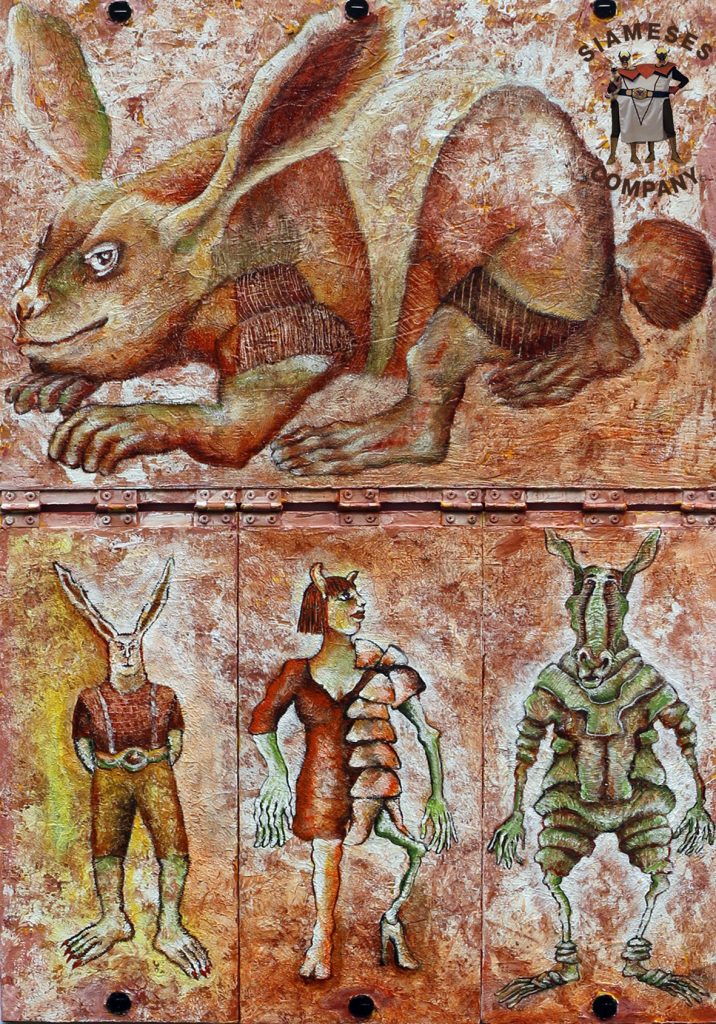
The Triumph of Avatars, 72 × 36 cm, oil on wood, 2019.
- Siameses Company is the artistic name and registered trademark of the project, created by its members to account for a mode of collective production. According to the artists, this modality of creation engages with the notion of “siameseness,” a term to which Carlos Monsiváis alludes in a complicit manner to describe bonds of radical proximity and creative co-constitution. Personal conversation with the artists, Mexico City, 2025. ↩︎
All images belong to the personal archive of Los Siamés (Marisa Lara y Arturo Guerrero). Acknowledgments to the artists and to Museo del Estanquillo.
More info: artedos@siamesescompany.com